

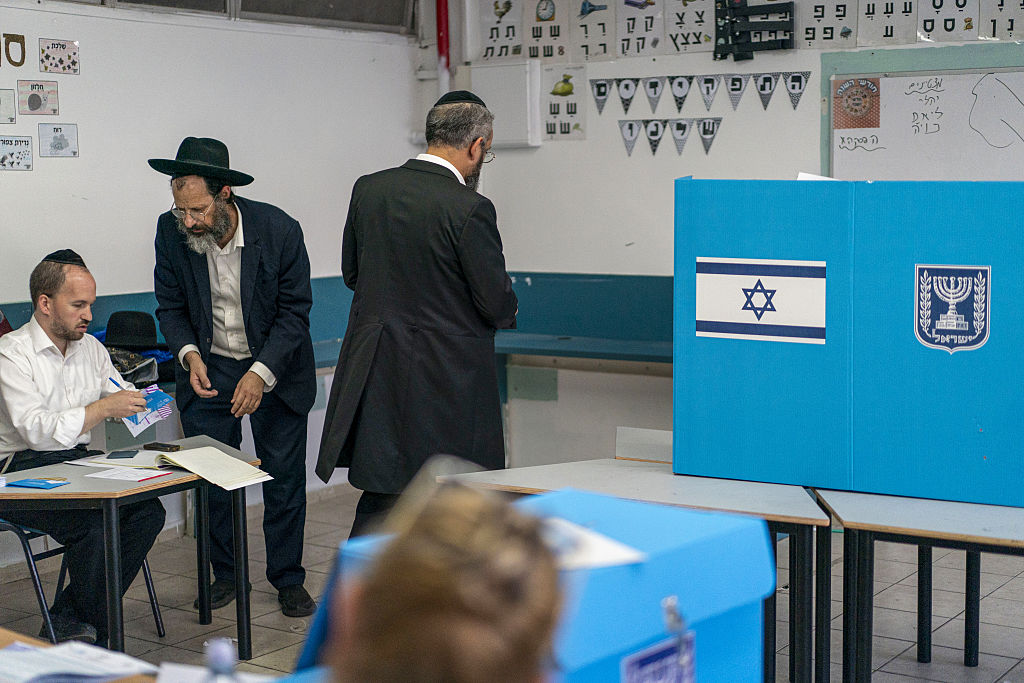



Israelis vote today, Oct. 27, but the election is only the first step in forming a government. To govern, a coalition must hold a Knesset majority of at least 61 seats. Building one depends not only on election results, but also on party stances and negotiations. Parties barter by softening their campaign promises and offering ministerial appointments. Although seats will be allocated by Nov. 4, forming a coalition could take months. If no coalition is formed, new elections will be held, and the outgoing government remains in power as caretaker in the meantime. This page covers the possible coalitions, where each party stands on the key red lines, and the timeline ahead.
Jump to: Possible coalitions · Deadlock · Party positions · Timeline
Possible coalitions
Coalition formation depends not only on parties joining ranks, but also on compromising on core issues with rivals. Parties barter by softening their campaign policy promises and offering ministerial appointments that oversee their enactment.
Possible coalitions · Oct. 23 opinion poll
Who could form a government?
Select a scenario to see which parties it depends on and whether it reaches the 61 seats needed for a Knesset majority.
Scenarios: Netanyahu-led conservative government (Likud, Otzma Yehudit, RZP–Zehut, Shas, UTJ); Eisenkot/Bennett broad Zionist coalition (Yashar!, Together, The Democrats, Yisrael Beiteinu, RZP–Zehut, plus at least one unallocated seat); Eisenkot-led minority government (Yashar!, Together, The Democrats, Yisrael Beiteinu, with Joint List and Ra’am voting for it or abstaining).
Seats according to the Oct. 23 opinion poll. Two seats are currently unallocated. Scenarios are drawn from MEPC’s analysis and are illustrative.
Deadlocked Knesset outcome
Given the parties’ current policy red lines and projected polling, the Knesset could be deadlocked. If Yisrael Beiteinu does not waver on joining a minority coalition, or if RZP–Zehut remains untenable to The Democrats, a governing coalition is unlikely to form. If the newly elected Knesset fails to form a governing coalition, it will go through two to three rounds of coalition-formation attempts before being forced into another election — all under the continued rule of a Netanyahu caretaker government.
Coalition formation positions
Party platforms guide coalition formation. After the Oct. 27, 2026, election, for example, anti-Netanyahu parties are likely to join ranks, while a Haredi party is unlikely to join with any party that is pro-Haredi draft. The policies and principles laid out below are the building blocks and brakes of the future governing coalition.
Coalition formation positions
Who will sit with whom?
Pick a question to see which parties accept it, and which treat it as a red line.
*Reservists-NEP and Amcha Yisrael may not reach the 3.25% threshold. Seats according to the Oct. 23 opinion poll.
Timeline of the coalition formation process
Although certifying Israel’s election takes only around eight days, government formation can be an incredibly lengthy and complex process. Based on the election results, the president assigns candidates to build a governing coalition that will produce a Knesset majority (at least 61 seats). If each successive attempt fails, the coalition formation process can extend for as long as nine months before a new election is triggered.
During this period, the outgoing government remains in power as caretaker, retaining executive authority, potentially keeping Netanyahu in power long after the election even if his coalition loses its majority. What is more, a failure to form a government from this election starts the process over.
Timeline of the coalition formation process
From Election Day to a possible new vote
Key legal deadlines if each attempt to form a government fails.
-
October 2026
Oct. 27
Election Day.
-
November
Nov. 4
Deadline for finalizing election results and allocating seats.
-
Nov. 11
Deadline for the president to assign a candidate to form a government, following discussions with representatives of the elected parties.
-
December
Dec. 23
Deadline for the first candidate to form a coalition, with a possible 14-day extension.If this fails, the president has three days to appoint a replacement or forgo the option of replacement.
-
January 2027
Jan. 23
Deadline for the second candidate to form a coalition.Upon failure, or if the president does not choose a second candidate, Knesset members can choose a third candidate, with 61 votes required. Otherwise, the Knesset is dissolved and a new election is held.
-
March
March 1
Deadline for the third candidate to form a coalition.If this fails, the Knesset is dissolved and new elections are held within 90 days, and the process begins anew.
-
May
May 25
Last possible deadline for a new election in the event of failure to form a government coalition.
Throughout this period, the outgoing government remains in power as a caretaker.
Related: Israel’s 2026 Elections Explained: Key Parties, Candidates, and What’s at Stake