


Over the past three years, I have visited India three times and participated in many engaging discussions on U.S. foreign policy and India’s rise as a world power at several universities and think tanks. Across these conversations, I encountered widespread acceptance within the Indian strategic community of the idea that the United States is declining and that its decline presents India with an opportunity to make its mark on the global stage. I was surprised by how confidently prominent voices on defense and foreign policy in the Indian public sphere spoke of U.S. decline, treating it as an uncontested reality.
These engagements centered on two major themes: the changing direction of U.S. foreign policy and grand strategy under President Donald Trump and the realignment of Indian foreign policy, particularly its increasingly open embrace of Israel while offering little more than lip service to the Palestinian cause. Underlying both was a larger question: Would repeated U.S. failures in the Middle East create space for a rising India to play a greater regional role? The prospect of a weaker United States giving way to a multipolar order in which India could exercise greater influence seemed to preoccupy sections of the Indian strategic community. The Middle East was central to this thinking, given India’s substantial interests in the region: its close partnership with Israel, nearly 10 million Indians residing in the Gulf countries who sent home more than $50 billion in remittances in 2024-2025, and trade with the Gulf and wider West Asia exceeding $200 billion in 2023-2024.
What surprised me was how readily the U.S.’s failure to achieve its maximalist objectives in the war with Iran –— a quick victory, regime change, and the complete surrender of Iran’s nuclear program – was being treated as evidence of American decline. Combined with Washington’s failure to turn Iraq into a pro-Israel democracy and its withdrawal from Afghanistan, leaving the Taliban in charge, these setbacks were repeatedly invoked by members of the Indian strategic community to argue that U.S. power was waning and a multipolar world was emerging. The assumption seemed to be that its inability to secure its preferred political outcomes demonstrated a corresponding decline in its overall power.
Indian Minister of External Affairs Subrahmanyam Jaishankar, who frequently opines on the global balance of power, has repeatedly argued that the world is moving toward multipolarity, away from the unipolar moment that followed the collapse of the Soviet Union. In the broader narrative that has gained currency in India, U.S. decline explains this transition: The global order is no longer dominated by the United States but shaped by a cluster of powers that includes Europe, Japan, Russia, China, and India.
I submit that this assessment reflects more wishful thinking than a cold, rational analysis of the actual balance of power. The proposition that U.S. decline has already ushered in a multipolar world deserves scrutiny, particularly when it becomes a premise for Indian foreign policy decisions.
The Enduring Foundations of U.S. Power
Analyses of the global balance of power have been so overwhelmed by the rapid rise of China that they often overlook the enduring military and economic power of the United States. Amid all the discussion of the rise of Asian manufacturing and the growth of economies such as China, Japan, South Korea, Taiwan, Hong Kong, India, and Vietnam, a basic fact receives surprisingly little attention: The United States remains the world’s second-largest manufacturing economy, with output of approximately $3 trillion in 2025. Among the top six manufacturing economies, the U.S. ranks second only to China, more than three times Germany and Japan, and more than five times India and South Korea.
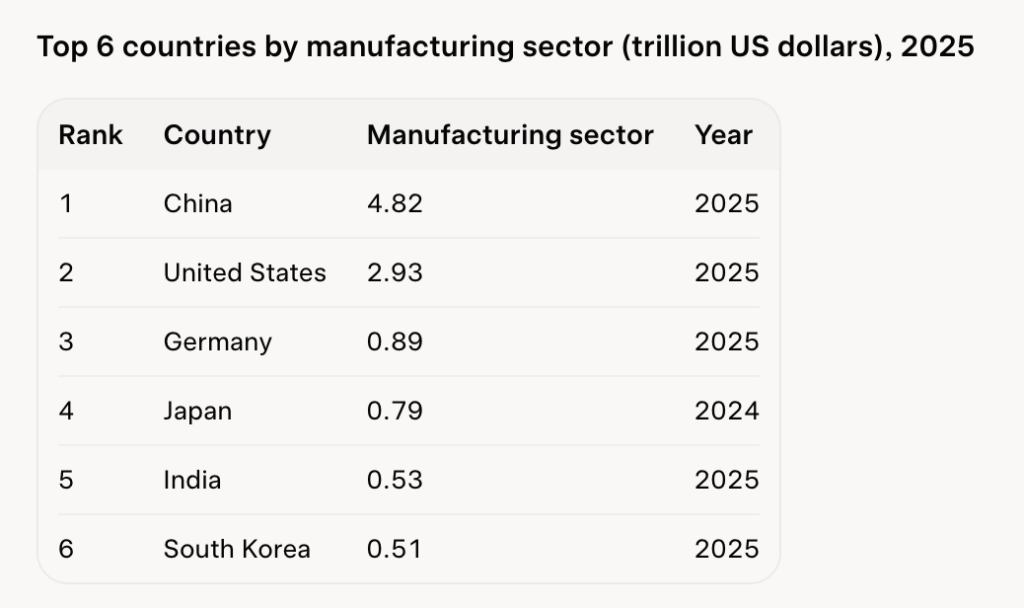 Source: World Bank and U.S. Bureau of Economic Analysis.
Manufacturing is often assumed to be the weakest link in the U.S. economy, especially when compared with China. But only in comparison to China. If the U.S. manufacturing sector were a separate national economy, it would rank eighth in the world – larger than Russia. This is a remarkable scale of production for a sector so often invoked as evidence of U.S. decline.
Military Failures Do Not Mean Military Decline
Prophets of American decline point to U.S. military and nation-building failures in Afghanistan and Iraq, and now the war with Iran, as evidence. But the United States also failed to achieve its political objectives in Vietnam. The difficulty of translating military superiority into political success is hardly new. Failed interventions do not, by themselves, demonstrate that the balance of military power has shifted.
The U.S.’s ability to project force across the globe, supported by its extensive network of overseas bases, continues to distinguish it from every other member of the supposed multipolar club. Its failures in nation-building expose the limits of military power, but do not establish that other powers have closed the gap. Nor have the United Kingdom, France, India, Russia, or China demonstrated through recent military successes that they possess anything approaching the U.S. military’s global reach. Despite being described as a declining power, the United States still spends 10 to 15 times as much on defense as several of its supposed peers in the multipolar club, many of whom depend on the U.S. for their own defense and host its military bases.
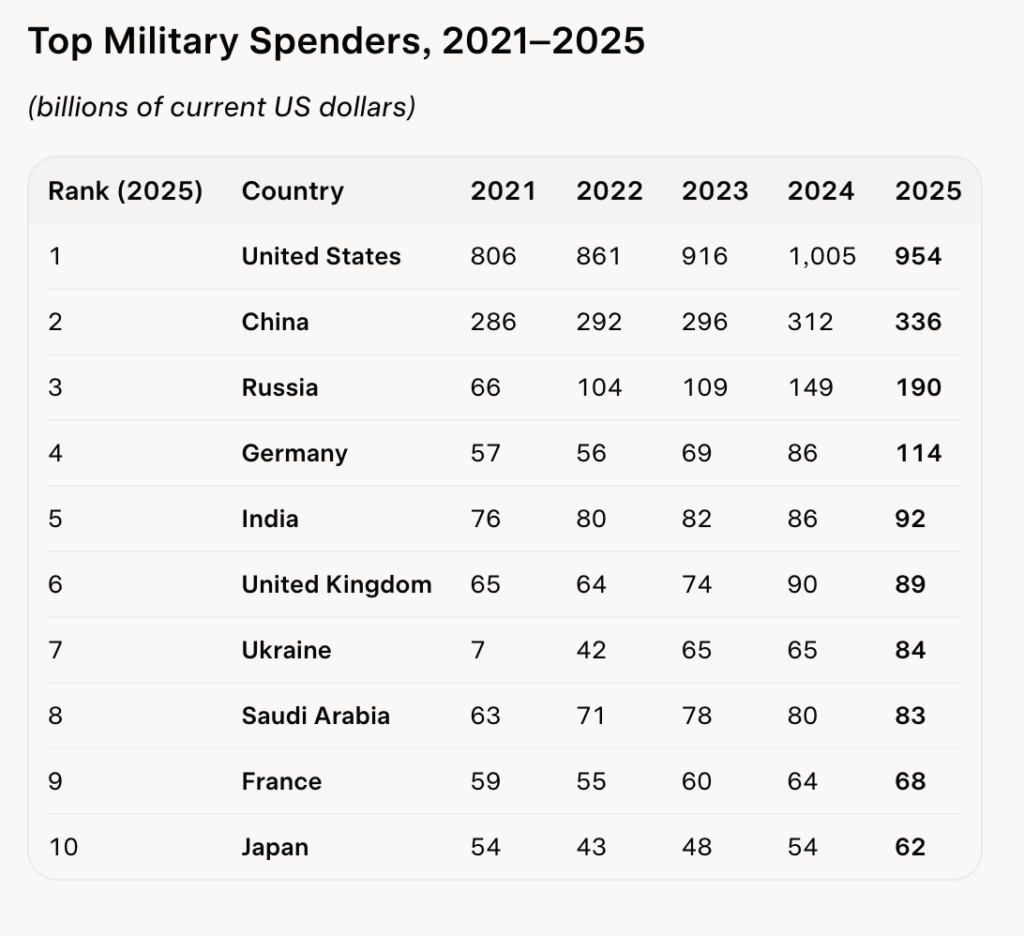
Source: SIPRI Military Expenditure Database, April 2026.
Economic Resilience and Dollar Dominance
With a GDP of $32 trillion in 2026, the U.S. economy is eight times the size of India’s, one and a half times the size of China’s, and six to eight times the size of most other members of the multipolar club.
The Soviet Union collapsed in 1991, heralding the era of U.S. unipolarity. At that time, the United States accounted for only 25% of the global economy. Its share rose to 30% in 2000 before declining steadily to 22% in 2010. But since 2010, during the very era of China’s incredible economic rise, the U.S. share of the global economy has increased steadily every year: from 22% in 2010 to 24% in 2015, 25% in 2020, and 26% in 2025.
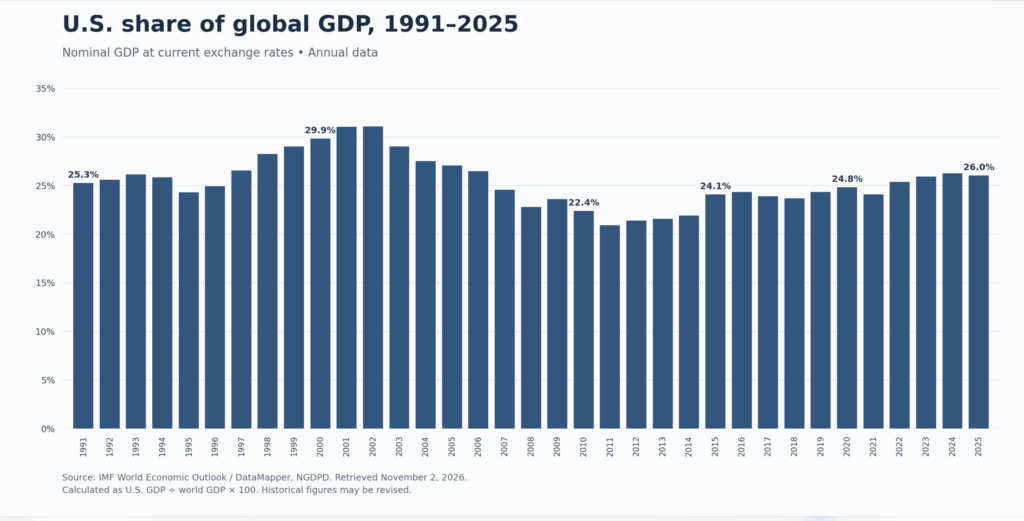
How can these hard facts be ignored? Over the past 15 years, the United States has increased its share of the global economy. How is that decline? What makes this especially remarkable is that it has happened during a period when both India and China have been growing at a phenomenal pace.
Let us look at how some of the leading members of the pack of rising global powers catching up with the U.S. are doing. In the graphs below I plot what percentage of the U.S. economy China, India, and Europe constitute. It is clear that both Europe (from around 90% in 2016 to around 70% in 2025) and China (from 75% in 2021 to 64% in 2025) are declining relatively and India has remained stagnant, 12%-13% of the U.S. economy.
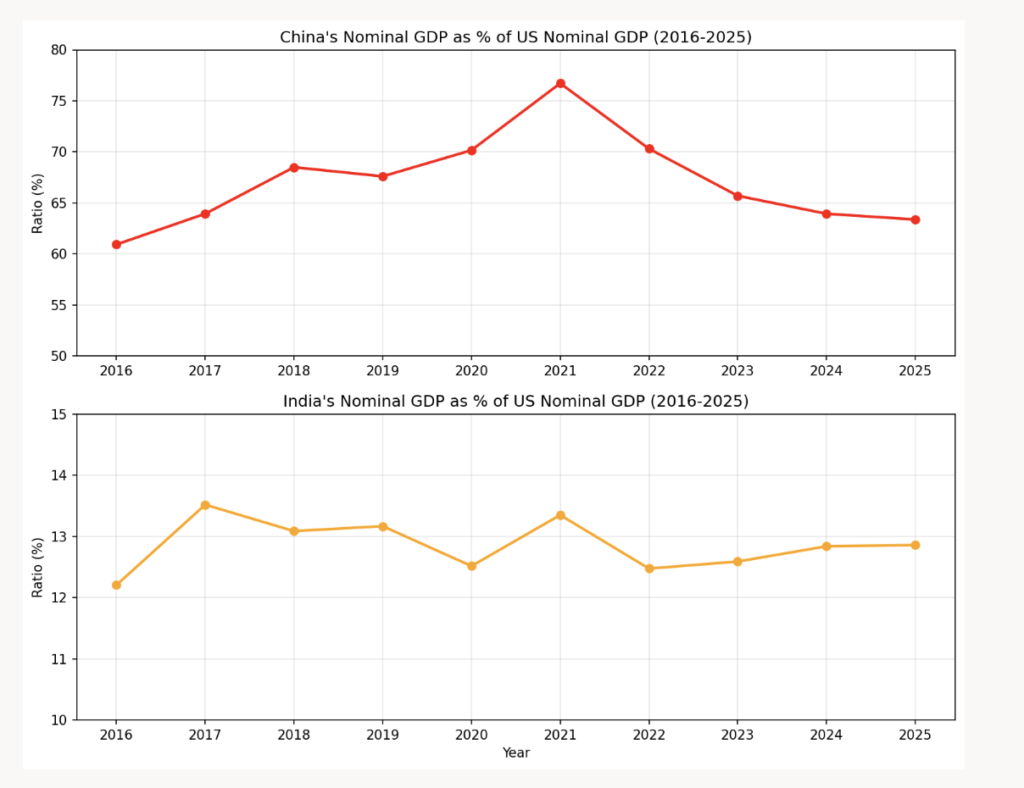
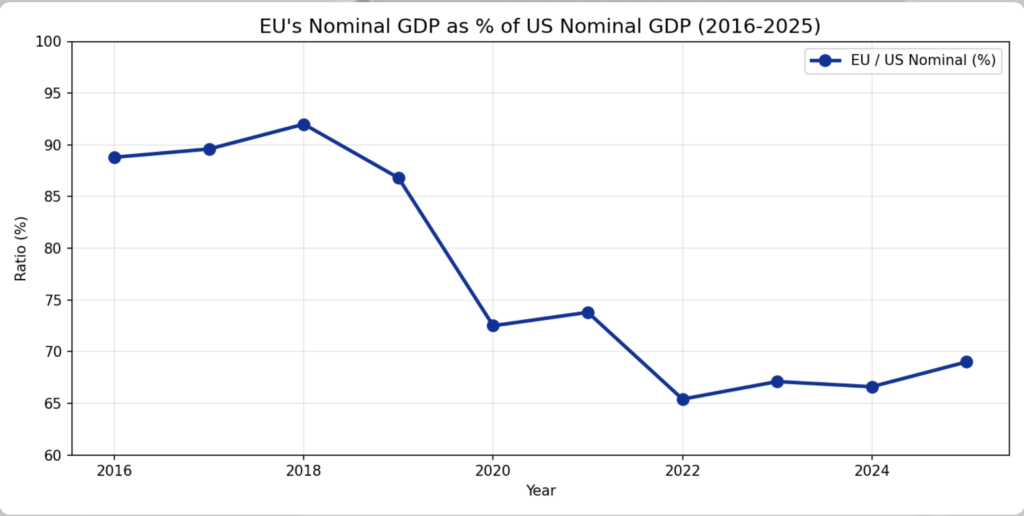
Source: IMF World Economic Outlook.
One clear source of U.S. power is dollar dominance. The dollar still accounts for 57% of global foreign exchange reserves, and its principal competitor is neither the Indian rupee nor the Chinese yuan. It is the euro – the currency of America’s European friends.
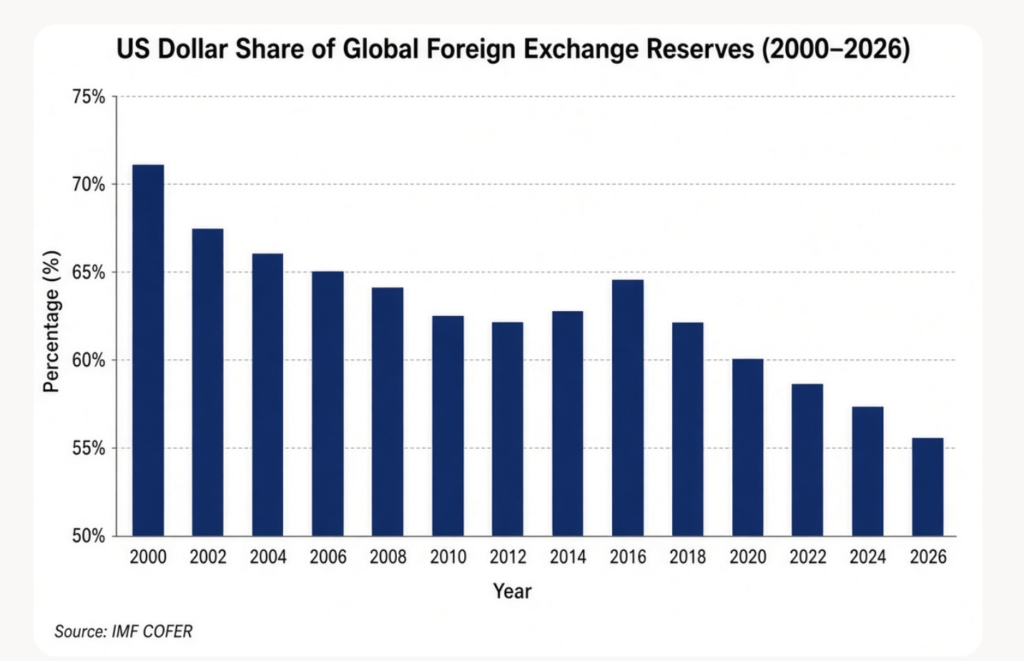
Despite the chatter about declining dollar power, it accounted for only 47% of global foreign exchange reserves in 1991, when the era of globalization began, compared with 57% today. This is well below its share of over 85% in the 1970s, but it has hovered around 60% for the past two decades. Its decline as a reserve currency is therefore less significant than some suggest. By comparison, the euro accounts for only 20% of global foreign exchange reserves, while all other currencies combined account for 23%. Dollar dominance endures.
Technology, Artificial Intelligence, and Soft Power
Economic and military power in the modern era depend essentially on science and technology. The United States became a great power because of its industrial edge over the rest of the world: pioneering airplanes and space travel, inventing the internet, and staying far ahead of others in the Fourth Industrial Revolution, the digital revolution, and the information age.
Now, as we enter the era of artificial intelligence, which will be the biggest driver of economic and military power in the near future, the United States is leading the world in hardware through companies such as Nvidia and Micron. On the software side, U.S. companies and platforms such as Claude, ChatGPT, Meta, Google, and Grok are far ahead of anything that members of the supposed multipolar world have to offer.
In artificial intelligence the world is bipolar, with China chasing the United States. That is the global AI landscape. If artificial intelligence is going to determine the future, then the future looks very bright for the United States.
According to the Global Soft Power Index, the United States has ranked first in every year from 2022 through 2026, and in six of the past seven editions since 2020. China’s ranking has risen steadily from fifth in 2020 to second in 2026, retaining second place for two consecutive years. India, on the other hand, has fallen significantly, from 27th in 2020 to 32nd in 2026.
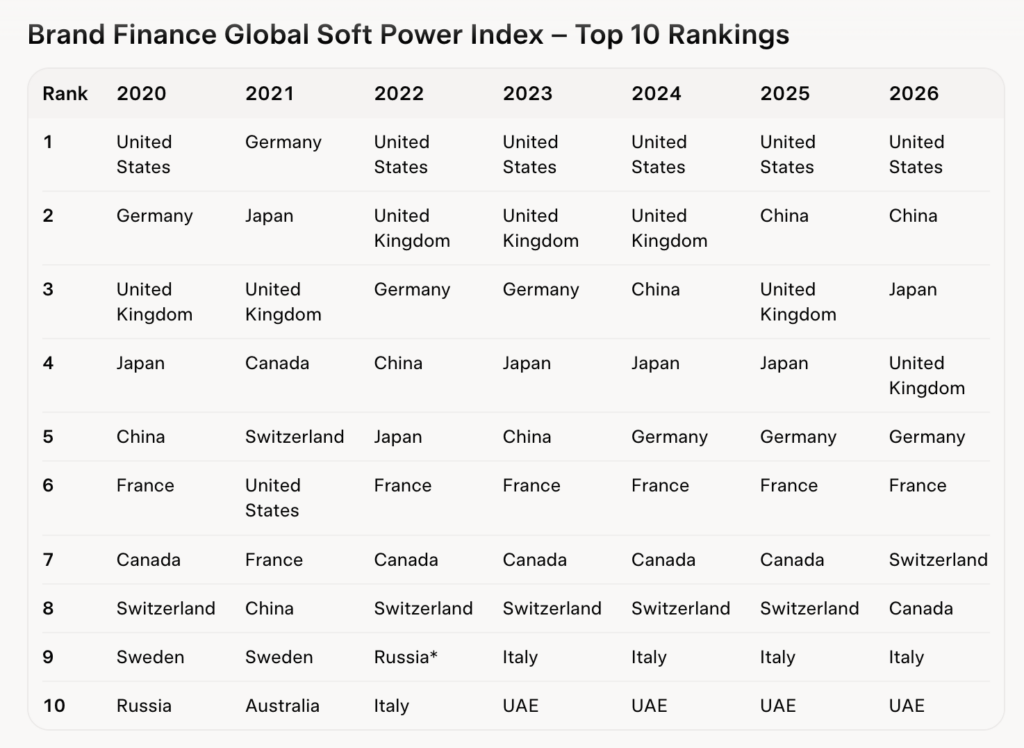
Source: Brand Finance Global Soft Power Index 2022 to 2026.
Policy Recommendation: Don’t Bet on the United States’ Decline
Taken together, these indicators suggest that the United States remains militarily far more powerful than any of the states that consider themselves as rising global powers heralding an emerging multipolar order. Objectively, its economy has not suffered the decline that many suggest. Indeed, its share of global GDP has increased steadily since 2010. And despite the terrible things the United States has done around the world, it still ranks first in soft power. The U.S. is still far ahead of the rest in all domains of power. Even though Trump has weakened NATO, no nation has as many military allies as the U.S.
All of this suggests to me that the United States is not in decline and that it is not entering a multipolar world any time soon. Yes, China is rising, and the gap between the United States and China is narrowing. But that does not make France, Japan, or India great powers.
While there is considerable strategic chatter within the Indian strategic community about the decline of U.S. power, India’s foreign policy remains cautious. If the United States is indeed a declining power, India’s substantial interests in the Middle East should make this an opportunity to expand its influence there. India could deploy its navy to patrol threatened shipping routes and protect Indian seafarers following the loss of numerous lives during the blockade of the Strait of Hormuz. India, rather than Pakistan, could be pursuing mutual defense pacts with Gulf countries. Given its large expatriate population in the region, India has a compelling interest in protecting its citizens working in the Gulf. The conflict between Saudi Arabia and the Houthis also provides an opportunity for India to demonstrate its capacity to contribute to regional security and signal that there is a new sheriff in town. Yet India has remained cautious, leaving room for less powerful states such as Pakistan and Türkiye to assume more visible regional roles.
The larger question extends beyond India. Where are China, Russia, France, and Japan ‑ the other supposed pillars of the emerging multipolar order? Diplomatic initiatives are one thing; assuming the burden of regional security is another. If U.S. decline is creating space for alternative centers of power, why have these states not collectively provided a credible alternative to its leadership in managing the crisis? Their reluctance does not, by itself, disprove multipolarity, just as U.S. military failures do not, by themselves, establish its decline. But it exposes the gap between proclaiming a new global order and demonstrating the capacity and willingness to sustain one. I recently participated in a debate on India’s grand strategy and argued that India should base its foreign policy on honesty and reality, not wishful thinking. I believe the same applies to all other so-called rising powers aspiring to fill the gap supposedly left by American decline.
One of the key factors shaping, informing, and calibrating foreign policy is the distribution of power among states, reflected in the global order and the balance of power. States that assume the United States is declining risk formulating their foreign policies on a miscalculation of these power differentials. This can prove very dangerous. Consider the United States and Israel: They underestimated Iran’s resilience and are now caught in a quagmire that undermines not only their economies and their leaders’ political futures but also the stability of the entire region. Nations proceeding as though we already live in a multipolar world will likely come to regret that assessment.
The U.S. is not declining. Don’t make policy based on that assumption.
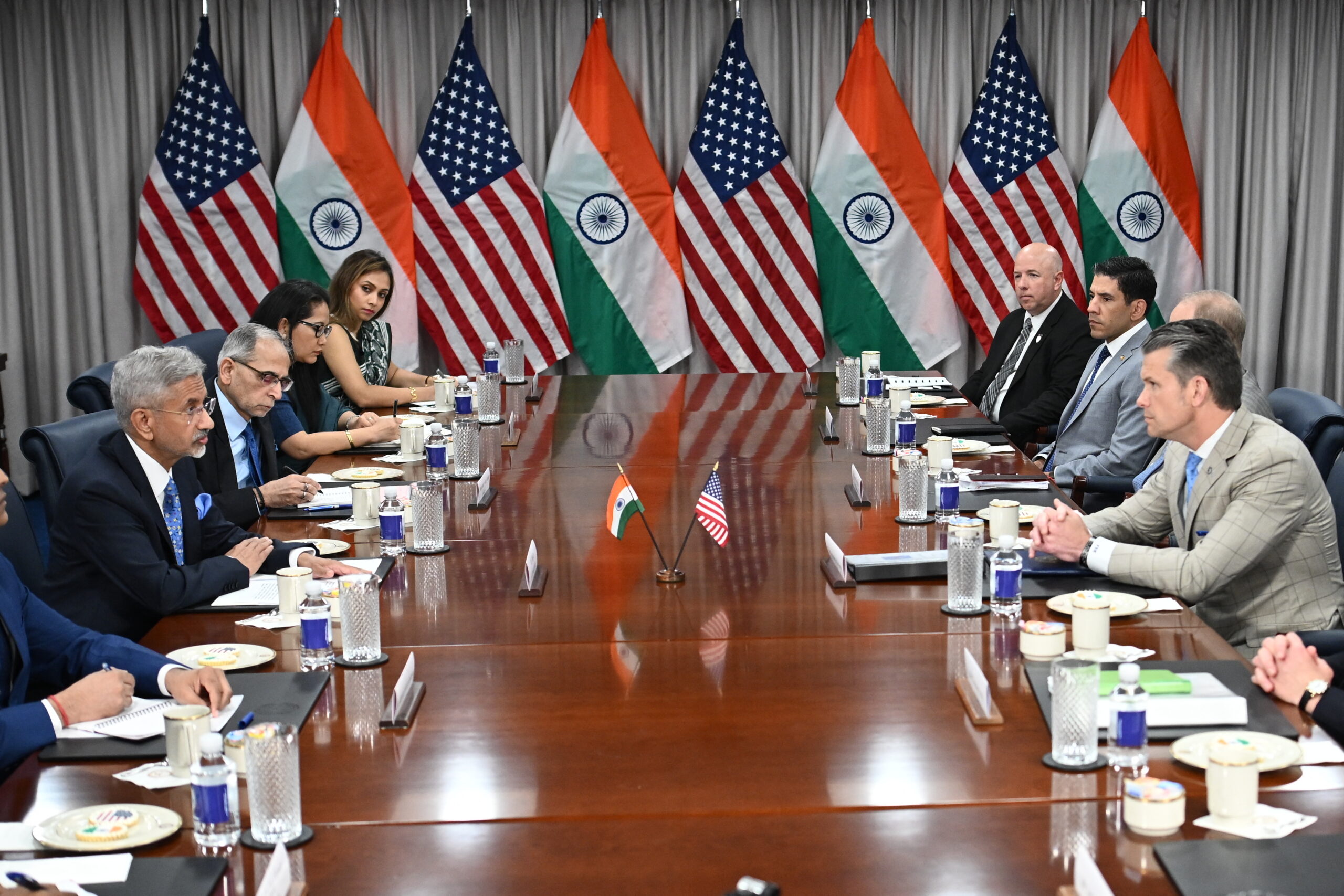
PHOTO | US Defense Secretary Pete Hegseth (R) and India’s Foreign Minister Subrahmanyam Jaishankar (L) take part in a bilateral meeting at the Pentagon in Washington, DC on on July 1, 2025. (Photo by Mandel NGAN / AFP) (Photo by MANDEL NGAN/AFP via Getty Images)