

The horrible attack on the Islamic Center in San Diego brought out the best and the worst in America. It brought out the worst in the form of domestic terrorism, militant Islamophobia, and the deadly consequences of hate speech against Muslims. But it also brought out the best in the courage of the victims who sacrificed their lives to save others, the heroism of the first responders who rushed to the mosque to protect it, and the resilience of a community that, even as it suffers a deluge of hate speech, refuses to be broken.
This was not just another act of random violence. It was a chilling reminder that hate speech against Muslims and Islamophobia are becoming deeply entrenched in American politics and have now risen to deadly levels of violence and bloodshed. On Monday, May 18, two teenagers opened fire on the Islamic Center in San Diego, killing three people and terrifying an entire faith community. Authorities are investigating the attack as a hate crime, and media reports indicate that the gunmen had been radicalized online by far right, white supremacist ideologies, and a profound hatred toward Islam and Muslims.
The American Muslim community is horrified and deeply terrorized by this incident. Many are asking: Is this a one-off attack, or is this the beginning of a new and more violent level of Islamophobia in America? There was a school on the premises of the mosque with about 140 children inside. We are grateful that they are safe, but the thought of their vulnerability is bone-chilling. It is difficult to imagine the fear of parents who send their children to learn in a house of worship, only to realize that even such a sacred and innocent space can become a target of hate. Sadly, targeting places of worship is on the rise in the US. FBI even has a program to combat this menace.
The victims have been identified as Amin Abdullah, a 51-year-old security guard who engaged the attackers and initiated a lockdown; Mansour Kaziha, a 78-year-old mosque elder; and Nadir Awad, a 57-year-old neighbor and Uber driver. All three are being remembered as heroes and pillars of the community. The suspected attackers have been identified in multiple reports as Cain Lee Clark, 17, and Caleb Liam Vazquez, 18; both were later found dead from apparent self-inflicted gunshot wounds. I am surprised that the media has not labeled them as suicide terrorists. They were clearly not ready to face the consequences of their actions.
Their youth makes the horror even more disturbing. The hatred being spread against Islam by social media activists and elected officials is acting like poison in the hearts of young Americans, turning them away from the pursuit of the American dream and into becoming terrorists. This attack is not merely a tragedy for the Muslim community of San Diego; it is a warning to all Americans about what happens when hateful rhetoric is normalized, amplified, and left unanswered.
This tragedy is also deeply personal for me. Many years ago, I delivered the Friday sermon at this very Islamic Center. I still remember clearly the view of the mosque from the elevated pulpit. It was only a few years after 9/11, and part of my sermon was about combating the rising tide of Islamophobia in America. I remember how many members of the community met with me after the sermon to thank me for raising the issue, while also sharing with me their deep fear that Islamophobia was rapidly pervading America. In 2006, while I was at the Brookings Institution, I organized one of the first major conferences on combating Islamophobia in the United States. At that time, representatives of the U.S. government denied that Islamophobia even existed. Today, while no member of the U.S. government will deny the persistence of Islamophobia, sadly there are some who actually personify it.
Members of Congress such as Randy Fine, Chip Roy, Andy Ogles, Brandon Gill, and Keith Self have made or promoted vulgar, hateful, demeaning, and dehumanizing comments about Islam and Muslims. They do not merely express prejudice; they legitimize it. Texas Gov.r Greg Abbot, too, has indulged in speech deemed as Islamophobic by American Muslims, leading to a lawsuit and contentious relations between the governor’s office and the community. These politicians appear to fear no consequences, either from voters or from the laws of this country. When elected leaders are able to speak with such hatred so consistently and so openly, the venom of Islamophobia spreads nationally.
There are exceptions, however. Many elected officials have condemned the attack on the Islamic center in San Diego, like California Gov. Gavin Newsom and the San Diego Mayor Todd Gloria. But these measures are after the fact. It would be remiss on my part to not mention Senator Dick Durban of Illinois for hosting a Senate hearing on the rise Islamophobia in the US. I had the honor of submitting testimony to this hearing.
In the shadow of the crisis in the Middle East, Muslims in America are no longer facing only random acts of hate; they are increasingly confronted by structural and institutional Islamophobia. According to CAIR, complaints filed nationwide climbed to an unprecedented 8,683 cases, driven heavily by workplace and viewpoint discrimination, as well as a dramatic 71.5% surge in law enforcement actions targeting Muslim communities and pro-Palestinian voices. These numbers show that Islamophobia is becoming a normalized feature of American public life.
The Trump administration did make some broad noises condemning the attack, but it did not confront the larger ecosystem of Islamophobia that has been nourished by politicians and influencers closely associated with its movement. A broad condemnation of violence is necessary, but it is not enough. Leaders must also condemn the hate speech that prepares the ground for violence. San Diego was not a one-off event. Remember Wadee Al-Fayoume, the six-year-old Palestinian American Muslim boy in Illinois, who was stabbed 26 times in a hate-filled rage by Joseph Czuba in October 2023. The shooting of three Muslim students in Chapel Hill, North Carolina, in 2015 is another incident of Islamophobic violence that attracted national attention but did not result in sustained response from authorities.
U.S. President Joe Biden received significant support from the American Muslim community in the 2020 election. His administration made appropriate noises about combating Islamophobia. It launched a national strategy to combat antisemitism in 2023 and then a strategy to combat Islamophobia in 2024. But while the antisemitism strategy was launched early, strongly promoted, and meaningfully implemented, the anti-Islamophobia strategy came late, received far less political attention, and remained largely symbolic and under-implemented.
Muslims are entitled to equal protection under the law. Just as antisemitism is rising in this country, so too is Islamophobia. The question American Muslims are asking is simple: Are victims of Islamophobia receiving the same urgency, sympathy, and protection from authorities that victims of antisemitism rightly receive? How can our leaders fight one form of hate with so much dedication while treating another with such softness that it begins to look like tolerance? A democracy cannot be selective in its moral outrage. If America is serious about combating hate, then anti-Muslim hatred must be confronted with the same seriousness, resources, and public resolve as every other form of bigotry.
The views expressed in this article are those of the authors and not an official policy or position of the Middle East Policy Council.
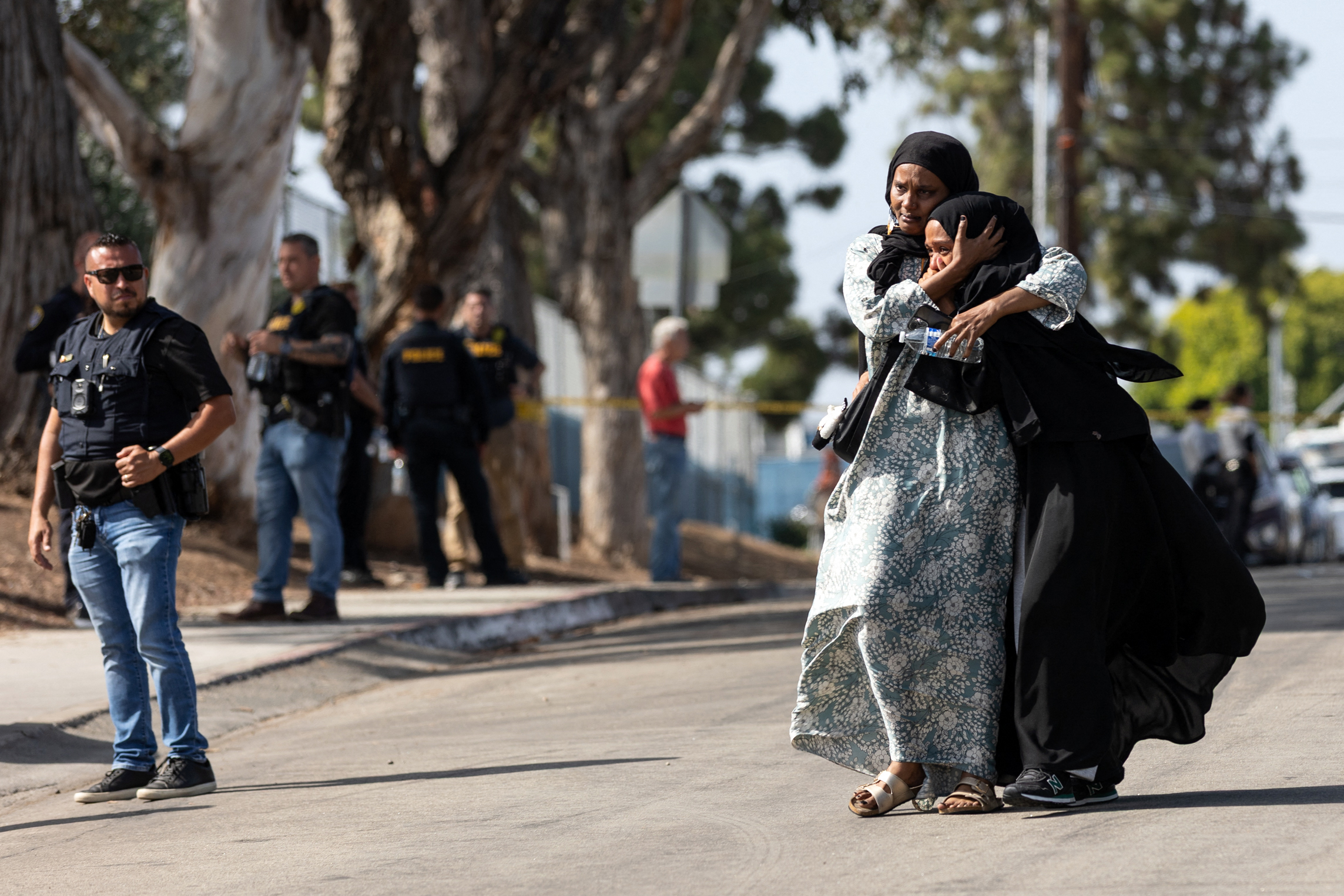
PICTURE | Two women react as they leave a reunification center following the shooting at the Islamic Center of San Diego in southern California, on May 18, 2026. A shooting at the largest mosque complex in San Diego killed three people, with two suspected teenage gunmen later found dead in a car from self-inflicted gunshot wounds, police said. (Photo by Zoë Meyers / AFP via Getty Images)