


As Iran seeks to consolidate its gains from the US-Israel conflict, the new double issue of Middle East Policy offers incisive evaluations of the war’s consequences—for the Gulf, for Washington, and for the world economy—as well as examinations of new directions in Palestinian politics, reconciliation in Syria, social governance across the region, and the attractive power of East Asia. Readers can access 11 of the 20 original articles without charge.
Last week, we covered the first half of the special double issue, which includes analyses of the future of the Strait of Hormuz; Washington’s responsibility to de-escalate the Israel-Iran conflict; and the limitations of President Donald Trump’s transactional diplomacy in resolving the Iran nuclear question. You can still read our special issue on the Iran War and our Spring 2026 issue. If you find this article useful, please forward it to others you believe will benefit; register to receive our weekly updates here. And please follow us on the social media platforms X, LinkedIn, and Instagram.
The second half of the new Middle East Policy begins with a deep exploration of the new Syria. Zeynep Banu Dalaman, in a free-to-read article, examines the challenges of building peace not simply as an absence of violence but as an affirmative process that combines institutions, representation, and transitional justice. The analysis is built on her interpretations of symbols she encountered on travels through Syria that in many cases represent persistent memories of atrocities that cannot simply be overwritten by new images (see the photos below). Dalaman summarizes the challenge:
The coexistence of pre-2018 symbols, wartime graffiti, and post-2024 memorials illustrates that new governing actors inherited a dense archive of unresolved violence. Although the Syrian interim government and Hayat Tahrir al-Sham were not responsible for earlier state atrocities, their failure to create channels for acknowledgment or inclusion risks reproducing the very silences associated with the Baathist era.
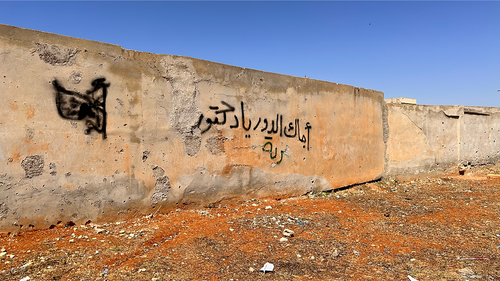
Graffiti in a school garden, Daraa, April 17, 2025
Note: The inscription reads, “Your turn has come, Doctor.” This directly references Bashar al-Assad, invoking fear, accountability, and cyclical justice within a site associated with the origins of the 2011 uprising. Painted on the same school wall where children were first detained that year, the graffiti revives the memory of defiance that ignited the revolution. Photo by the author.
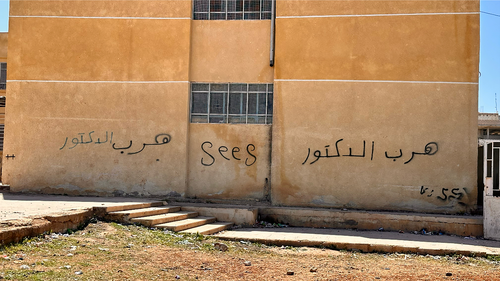
Graffiti on the same school wall, Daraa, April 17, 2025
The inscription reads, “The Doctor has fled.” Created shortly after Assad’s resignation in December 2024, this new phrase transforms the earlier site of resistance into a declaration of closure and vindication. By overwriting the same surface, the act visually bridges Syria’s two political eras—linking the memory of repression to the emergence of a fragile postwar transition. Photo by the author.
Dalaman’s piece is accompanied by Dilan Okcuoglu’s open-access investigation of the potential for federalism in post-Assad Syria. While the interim government emphasizes the need for unity and has fought to reduce competition with Kurdish and other militias, Okcuoglu contends that the Syrian civil war “deepened intercommunal divisions, making a unified state structure untenable.” Devolving at least some power of the state to local authorities and minority groups is necessary to establish “a genuinely pluralist form of governance.” Her comparative analysis of federalism in Iraq, Bosnia, and Canada provides some potential models for the new Syria.
The journal then turns to how regional states are tackling issues from currency and debt to pollution and social cohesion. Bassant Hassib and Fatimah Ayad examine how regional states have regulated cryptocurrency, finding that most governments initially justified bans on crypto trading by citing religion but quickly backtracked when the alternatives to national banking proved to be popular. These states maintained their religious discourse while loosening the reins.
In another look at the relationships between states, people, and banking, Kevin Rosier finds that severely eroded social trust was responsible for Lebanon’s debt crisis. On the subject of social cohesion, Logan Cochrane and his team closely examine Qatar’s governing documents to understand how the state combines Islamic and Western concepts as it seeks to forge a united populace. The section is rounded out with a look at plastics pollution in the Gulf and how Kuwait can attack the problem “through a mix of regulatory, market, and voluntary approaches.”
Finally, the special double issue examines how China and other East Asian states have increased their soft power in the Middle East. Ghulam Ali explores Saudi Arabia’s moving “beyond its previous reliance on oil exports and…leveraging the expertise of its Asia-Pacific partners to build…joint ventures, increased mutual investments, [and] technology sharing.” Song Niu and Danyu Wang show how Beijing has assisted Saudi Arabia with new technologies like high-speed rail and 5G communications to increase its capacity to host the hajj. And the journal shows how China has developed relations with 22 Arab countries through scientific cooperation in fields like chemistry, engineering, agriculture, and medicine, as well as emerging areas like computer science, environmental science, green finance, sustainable development, and technological innovation.
Middle East Policy, Summer 2026
Special Double Issue!
AMERICA’S WAR ON IRAN
Signals, Red Lines, and Collision: The Israel-Iran Spiral and US Intervention
Buğra Sari—open access!
Trump’s Transactional Diplomacy: Breakthrough or Breakdown?
Guilain Denoeux | Robert Springborg—open access!
Between Ideology and Strategy: The Iranian Revolution and the Reconfiguration of Middle Eastern Security
Alabbas F. Alsudani—open access!
Iran’s Forward Defense in Sub-Saharan Africa
Ariel Limanya Limbu | Ronen A. Cohen—open access!
CONSEQUENCES IN THE GULF
Crisis in the Strait of Hormuz: What Lies Ahead?
Gawdat Bahgat—free to read!
GCC-Asia Pacific Energy Nexus: Navigating Shifts in Demand and Geopolitics
Umud Shokri—open access!
Outwardly Strong, Internally Brittle: Dissecting the MBS Regime
Mohammed Ayoob—free to read!
POLITICAL CONVULSIONS OVER PALESTINE
New Political Actors in Palestine: The Digital Efficacy of Gen Z
Abdalraheem S.H. Shobaki | Mahmoud S.H. Shobaki
Between Fatigue and Fear: West Bank Student Solidarity During the Gaza War
Mert Öztürk / Oqab Jabali
Explaining Saudi Arabia’s Inaction During the Gaza War: Why No Oil Embargo?
Mazaher Koruzhde | Eric Lob—free to read!
From Palestine Ally to Zionist Partner: India-Israel Relations, 2014–2025
Yücel Bulut—open access!
REBUILDING AND RECKONING IN SYRIA
A Heuristic Equation of Transformation, Justice, and Violence in Post-Assad Syria
Zeynep Banu Dalaman—free to read!
Federalism in Post-Assad Syria: Toward Durable Peace in a Pluralist Society
Dilan Okcuoglu—open access!
REGIONAL SOCIAL & ECONOMIC GOVERNANCE
Cryptocurrency Regulation in MENA: From Prohibition to Conditional Legalization
Bassant Hassib | Fatimah Ayad
Fallen Cedar: Lebanon’s Debt Diplomacy, 2015–2020
Kevin Rosier
Plastics Pollution in the Gulf Countries: Problems and Policy Solutions
Richard Rutter et al.
Constructing Social Cohesion in Qatar: National Vision, Strategy, and Constitution
Logan Cochrane et al.
THE ATTRACTIVE POWER OF EAST ASIA
Saudi Arabia’s Deepening Engagement with Asia-Pacific Nations
Ghulam Ali
China’s Hajj-Related Infrastructure Diplomacy with Saudi Arabia
Song Niu | Danyu Wang
Chinese-Arab Scientific Cooperation and Effectiveness
Minglian Long, Yijia Luo, Yi Zhang
BOOK REVIEWS
Lynch, America’s Middle East
Reviewed by Yasir Kuoti
Denoeux, Springborg, and Alaoui, Making Aid Work
Reviewed by Naomi Sakr
Momeni, The Presidential Difference and Iran’s Foreign Policy Under Khatami from 1997 to 2005
Reviewed by Mahmood Monshipouri
Bajoghli et al., How Sanctions Work
Reviewed by Bahram P. Kalviri
Donelli, Power Competition in the Red Sea
Reviewed by Riccardo Gasco
Brownlee and Ghiabi, States Without People
Reviewed by İlhan Bilici
Karam, The Middle East in 1958
Reviewed by Elifnur Düzsöz
Uysal, Class, Capital, State, and Late Development
Reviewed by Yusuf Murteza
Greenberg, The Long War of Ideas
Reviewed by A.R. Joyce