


It is clear from the way both U.S. President Donald Trump and Secretary of Defense Pete Hegseth have repeatedly defined and redefined the purposes of the U.S. and Israeli war on Iran that they lack clarity about both the ultimate objectives and the desired endgame of the war. Their statements suggest that they have not engaged in serious scenario planning and appear to have no coherent strategic framework in mind. Instead, policy seems to consist of shifting goalposts, with objectives changing in response to tactical wins and losses on any given day.
Indeed, the conduct of the war thus far suggests that the United States has overestimated what it could politically achieve through military tactics while simultaneously underestimating both the resilience of the Iranian regime and its defensive capabilities, as well as the extent to which it is willing to endure and escalate in order to defend itself. Such miscalculations point to a deeper failure in strategic planning and reinforce the impression that rigorous scenario-building exercises were either inadequate or absent in the formulation of the war strategy.
Scenario 1: War Without Troops on the Ground
One possible scenario is that the war remains an air and missile campaign without the deployment of U.S. or Israeli ground forces. Given the overwhelming air dominance the United States and Israel currently enjoy, it is conceivable that an extended and relentless bombing campaign could significantly degrade Iran’s conventional military capabilities. Over time, such a campaign could destroy a significant portion of Iran’s naval forces, neutralize much of its limited air force, and degrade a substantial share of its missile and drone launch infrastructure and stockpiles.
However, such an outcome would not be achieved quickly. It would likely require several weeks of sustained operations. During this period, Iran would continue to retaliate, particularly against U.S. partners in the Gulf. Tehran will continue to impose severe costs on the global economy by disrupting maritime traffic and keeping the Strait of Hormuz effectively closed or highly insecure. Thus, even as the United States and Israel systematically degrade Iran’s military capabilities, Iran could still retain the capacity to inflict significant economic damage on the global system.
If such a campaign continues long enough, it would eventually produce a strategic end state that looks very different from the political objectives that may have motivated the war.
The Iranian proxies – consisting of Hezbollah in Lebanon, Shia militias in Iraq, and the Houthis in Yemen – would be expected to participate aggressively on Iran’s behalf, targeting U.S. assets and Israel wherever and whenever they can. The reality shows that while the Houthis have remained constrained, the other militias have acted according to script. Hezbollah has opened an entirely new front, and we are now witnessing not one but effectively two wars at the moment: the U.S. and Israel against Iran, and Israel against Lebanon. Meanwhile, Shia militias in Iraq have targeted U.S. assets, and several U.S. fatalities have resulted from attacks on American personnel and facilities across the region. have resulted from attacks on American personnel and facilities across the region.
If the United States and Israel succeed in destroying Iran’s missile and drone stockpiles and weakening its proxies before exhausting their own munitions, the likely end state of such a campaign would be a militarily weakened Iran. In this scenario, the Iranian regime would retain sufficient coercive capacity to suppress domestic dissent and defend itself internally, but would lose much of its ability to threaten U.S. forces, Israel, or American partners in the Gulf. The war would therefore end with the achievement of certain tactical objectives – namely the degradation of Iran’s external military capabilities – but without producing regime change. The Islamic Republic would survive, albeit weakened and potentially more repressive domestically.
Scenario 2: Ground Invasion and Occupation
A second, far more dramatic scenario would involve the United States launching a large-scale ground invasion like the 2003 invasion of Iraq. In this scenario, Washington would deploy a massive expeditionary force – potentially 100,000 to 150,000 troops – to seize Tehran and attempt to impose regime change by installing a government aligned with U.S. and Israeli interests.
At present, the deployment of an additional 2,500 U.S. Marines to the region represents only a symbolic increase in force posture. A true invasion of Iran would require a much larger military commitment, extensive logistics, and prolonged occupation planning. Iran, however, is vastly larger and more complex than Iraq. Geographically, it is roughly four times the size of Iraq and half the size of India. Attempting to occupy the entire country would be well beyond the realistic military and political capacity of the United States.
As a result, any occupation would likely be limited to controlling Tehran and a few major urban centers. Washington might attempt to install a new government in the capital and declare regime change achieved. Yet such a government would likely resemble the fragile administrations that emerged in Afghanistan after 2001 – nominally sovereign but in practice dependent on foreign military protection, functioning more like a mayor of Tehran claiming authority over a vast and resistant country.
The more probable outcome would be the rapid emergence of nationwide insurgency. The remnants of the Islamic Revolutionary Guard Corps (IRGC), elements of the Iranian military, and various nationalist militias would likely withdraw from the capital and regroup in the countryside. From there, they could wage a prolonged guerrilla war against occupying forces, replicating the patterns of insurgency that the United States experienced in both Iraq and Afghanistan.
In this scenario, Iranian proxy networks across the region would become far more critical and dangerous, acting as force multipliers for the broader resistance strategy that the IRGC and its remnants would almost certainly launch against U.S. occupying forces. Militias in Iraq and Syria might increase attacks on U.S. bases and supply lines, and Hezbollah could not only ratchet up its attacks from Lebanon but could also cross over and join the resistance inside Iran proper. These proxy forces would allow the IRGC to wage a multi-layered asymmetric campaign against American and allied forces, significantly complicating any attempt by the United States to stabilize or control Tehran and bring about regime change. In such a scenario – which would begin to resemble Iraq all over again – it is extremely unlikely that Iranians would align with an occupying power against fellow Iranians who are fighting or resisting occupation.
Such a conflict could easily become another open-ended war. The United States would likely suffer significant casualties, and the financial burden of sustaining a long occupation would place severe strain on the U.S. Department of the Treasury. Domestically, the war could contribute to inflation and political backlash. Internationally, instability would reverberate across global energy markets. Even if the United States succeeded in keeping the Strait of Hormuz open, insurgent groups could target oil infrastructure across the region, perpetuating uncertainty in global supply and triggering repeated economic shocks.
This scenario remains unlikely, particularly given Trump’s reluctance to commit the United States to long-term, nation-building wars.
Scenario 3: All-Out Regional War
A third and increasingly plausible scenario is the escalation of the conflict into a broader regional war. In this scenario, the United States continues its sustained bombing campaign against Iranian military capabilities and infrastructure, while Iran retaliates by targeting U.S. allies in the Gulf and maintaining pressure on global energy flows by threatening or closing the Strait of Hormuz.
As the conflict intensifies, regional actors may feel compelled to intervene directly. The Gulf states – facing continued missile and drone attacks on their cities, ports, and energy infrastructure – may conclude that the United States is primarily focused on supporting Israel and degrading Iranian capabilities rather than providing comprehensive defenses for all its regional partners. In such circumstances, countries such as Saudi Arabia and the United Arab Emirates, potentially supported by Pakistan and Türkiye, could decide to undertake limited offensive actions against Iran to neutralize immediate threats to their territory and infrastructure.
Such a development would dramatically widen the conflict. No Muslim-majority country would welcome the political costs of appearing aligned with Israel in a war against another Muslim state. Yet the imperative of protecting domestic security and economic stability could override these concerns. The result would likely be the transformation of the conflict into a full-scale regional war.
In an all-out regional conflict, Iran’s proxy forces would become one of its most important strategic tools. Iran does not have the capacity to fight more than a dozen countries directly, but its proxies can inflict significant damage and continue to harass not only Israel but also the Gulf states. The Houthis, acting alongside Iran, could disrupt both the Red Sea and the Strait of Hormuz. Blocking these two maritime chokepoints would severely affect not only oil shipments but also the broader global trade that passes through the Suez Canal. In such a scenario, the region could descend into a Hobbesian nightmare – a war of all against all.
The consequences would be severe. Casualties would increase dramatically across the region, and large portions of critical infrastructure – in Iran as well as in Gulf states – could suffer extensive damage. The global energy crisis would deepen as oil production, refining, and transport networks across the Gulf come under repeated attack. Even if the United States could manage to keep maritime routes partially open, persistent insecurity would continue to disrupt global energy markets.
Under these circumstances, the United States could find it even more difficult to contemplate a large ground invasion while Iranian missile, drone, and unconventional capabilities remain operational. Over time, however, as these capabilities are degraded through prolonged conflict, the situation could begin to resemble elements of the second scenario detailed above – but only after the region has already suffered far greater destruction and loss of life.
Perhaps the most enduring consequence of such a regional war would be the long-term political fragmentation and militarization that would follow. The destruction of Iranian military institutions could give rise to a range of militant networks emerging from the remnants of the Islamic Revolutionary Guard Corps and other security structures. Much as groups such as ISIS and Al-Qaeda survived earlier conflicts and continued to destabilize surrounding regions, similar networks could emerge from the aftermath of this war. Even if they lack the capacity to directly threaten the West, they could still destabilize neighboring states and sustain long-term cycles of violence in the Gulf and beyond.
In such a scenario, the United States might eventually end its military operations and withdraw its forces from the region. Yet the conflict it helped unleash would continue to shape regional politics for years to come, leaving behind a fractured security landscape and deepened hostilities between Iran and its Arab neighbors long after American forces have departed.
Scenario 4: Quick Exit
A fourth scenario is a rapid political exit from the war. Trump is already facing significant pressure – both domestically and internationally, including from key partners in the Middle East. Several Gulf Arab states are increasingly frustrated with what they perceive as Washington’s inability or unwillingness to adequately defend them, leaving them exposed to Iranian missile and drone attacks.
Economic pressures are also mounting. Oil prices are rising sharply, financial markets are becoming increasingly volatile, and gasoline prices in the United States are beginning to climb. As energy costs increase, the affordability crisis affecting many American households is likely to worsen, since higher fuel prices raise the cost of transportation and production across the entire economy.
At the same time, the marginal utility of the bombing campaigns conducted by the United States and Israel appears to be diminishing. As the war continues, the number of high-value targets is shrinking. Iranian leadership appears to be taking more effective measures to protect senior officials and critical infrastructure, making it increasingly difficult to eliminate either high-value personnel or major strategic assets.
Meanwhile, the United States has begun appealing to other countries to help secure the Strait of Hormuz, a sign that Washington alone may not be able to guarantee maritime security in the region. These dynamics risk creating the perception that the United States is struggling to achieve its objectives, while the Iranian regime appears increasingly resilient. The reluctance of U.S. allies to join the war has also exposed how alienated the U.S. has become.
Under such circumstances, the president – who has demonstrated a willingness to reverse course quickly – may choose to declare victory and take an off-ramp from the conflict. He could announce that the United States has severely weakened Iran’s military capabilities and neutralized the immediate threat posed by Tehran, while leaving the future of Iran to be determined by the Iranian people themselves. By framing the outcome as a strategic success, the administration could seek to disengage from a conflict that is rapidly becoming a growing political liability.
Even if the United States chooses a rapid exit from this war without fully achieving its strategic goals, Iran’s proxy networks would remain an enduring source of instability in the region. These groups could continue to harass U.S. partners, attack Israeli interests, and disrupt maritime routes as a way of claiming strategic victory against the United States and its allies. In this sense, a quick exit might end direct U.S. military involvement but would not necessarily end Iran’s war on the region. If sanctions remain in place, Iran will likely continue to rely on its proxies to undermine the global economy. Therefore, even if the United States seeks an early exit, it must be negotiated rather than simply declared through a unilateral proclamation of victory followed by withdrawal.
Policy Recommendations
In its conflicts in Iraq and Afghanistan, the United States spent trillions of dollars, sacrificed thousands of American lives, and left two countries devastated after wars that lasted for decades. While the United States achieved military dominance on the battlefield, it failed to convert that dominance into durable political victories.
- President Trump should initiate a backchannel dialogue with Iran, offer Iran what Sun Tzu would call a “Golden Bridge” and end this unfortunate “excursion”.
- Trump should announce that the United States has severely weakened Iran’s military capabilities and neutralized the immediate threat posed by Tehran, while leaving the future of Iran to be determined by the Iranian people themselves.
- If the United States seeks a quick exit from the war, it must be negotiated rather than simply declared through a unilateral proclamation of victory followed by withdrawal.
The views expressed in this article are those of the authors and not an official policy or position of the Middle East Policy Council.
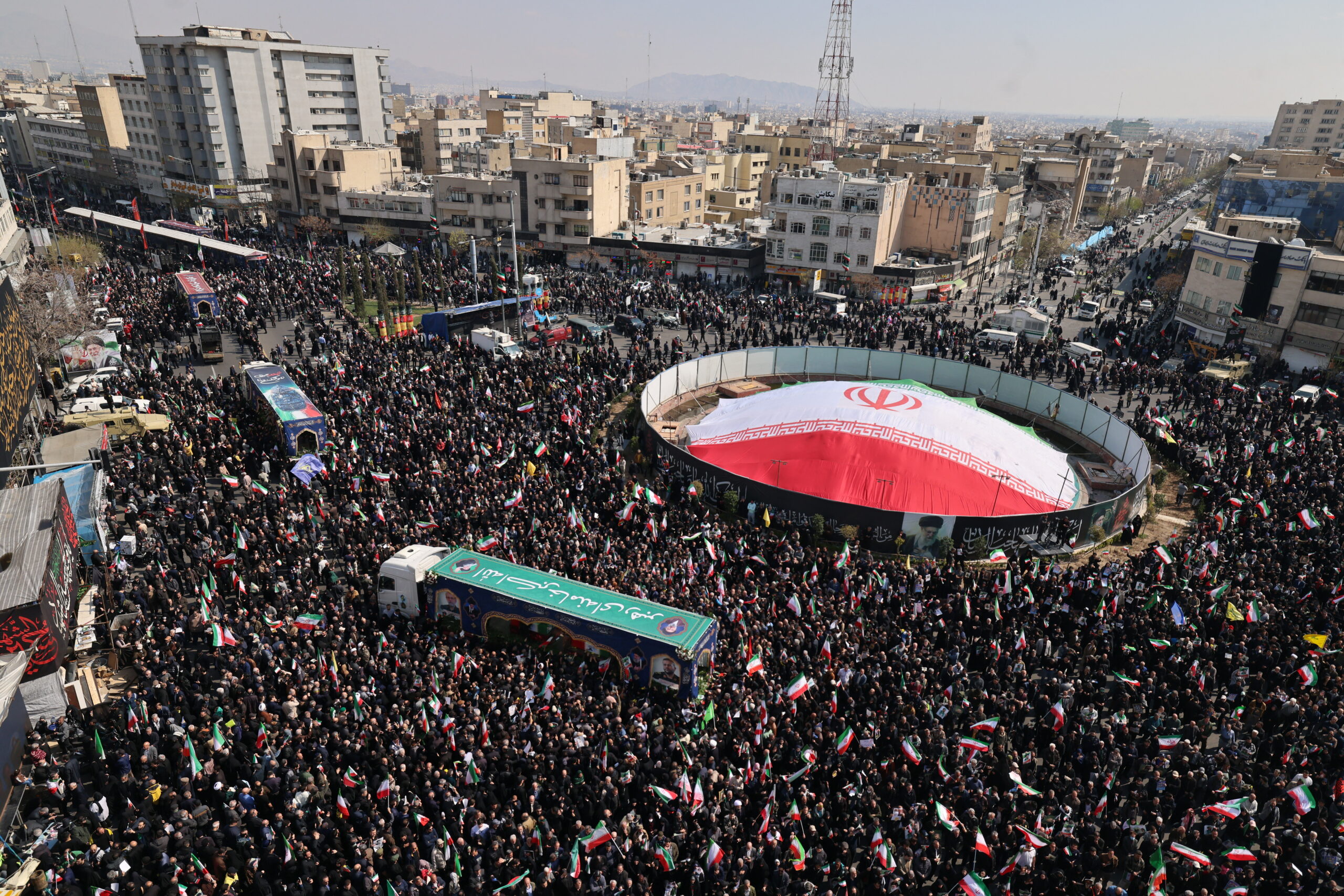
PICTURE | Iranian mourners gather during the funeral of Iran’s security chief Ali Larijani and Gholamreza Soleimani, a senior officer in the Islamic Revolutionary Guard Corps who commands Basij forces, in Tehran on March 18, 2026. (Photo by ATTA KENARE / AFP via Getty Images)