


Executive Summary:
The Iran war has exposed a critical vulnerability in India’s Gulf strategy. By prioritizing economic interests over maritime security, India remains without the defense capabilities needed to protect those interests in a region undergoing significant realignment. Oman, one of the few Gulf states with a neutral diplomatic stance toward Iran, access to ports outside the Strait of Hormuz, and a longstanding relationship with New Delhi, offers a means for India to mitigate its defense issues. Washington’s shift of its long-term Gulf defense responsibilities onto regional partners gives both India and Oman an opportunity to deepen their defense relationship while creating new avenues for them to jointly pursue burden-sharing with the U.S. India should strengthen its maritime and defense collaboration with Oman to build a more resilient security posture in the western Indian Ocean, transforming a historically economic partnership into an alliance suited to the region’s postwar realignment.
Introduction
For decades, India’s Gulf engagement focused on trade, energy imports, and a significant Indian expatriate workforce, while defense and security concerns remained secondary. This posture preserved New Delhi’s strategic flexibility but created a blind spot in its Gulf strategy as its economic interests were dependent on the security guarantees of other regional stakeholders.
Indo-Omani relations date back an estimated five millennia, maintained across joint naval exercises, maritime port access agreements, and a longstanding defense partnership. By deepening defense ties with Oman, India stands to gain a multi-aligned Gulf defense partner that offers it a means to rebuild its Gulf security approach in a post-Iran-war landscape. Muscat’s strategic neutrality, long-term defense relationship with New Delhi, and deep-water ports outside the Strait of Hormuz uniquely position Oman as a key partner for India amid the Gulf’s shift toward burden-sharing. As one of the Gulf’s top economic stakeholders, New Delhi should strengthen its maritime security capabilities to protect its significant economic investments across Gulf Cooperation Council (GCC) states.
Background: A Gulf Strategy in Transition
The closure of the Strait of Hormuz catalyzed the creation of new bilateral and trilateral defense pacts across the Gulf, emphasizing how rapidly conflict can reshape strategic calculations. From February 2026 onward, Iranian drone attacks targeting the Gulf exposed the fragility of the GCC’s defense capabilities, disrupting energy imports, trade, and the flow of remittances to key partners like India.
The economic consequences triggered by the closure of the strait underscore what is driving the shift toward a reimagined regional security order. As two historic allies and fellow maritime civilizations, India and Oman are well positioned to drive this shift: Oman as the Gulf’s key maritime security provider and India as a maritime security contributor in the western Indian Ocean.
Oman’s globally recognized mediator status and ownership of three ports just outside the strait have contributed to its emergence as a key player in peace negotiations between Tehran and Washington. The Duqm, Salalah, and Sohar ports provide Oman alternative maritime infrastructure, reducing its dependence on the strait. However, this does not fully insulate Muscat from the broader economic impact of its closure. Oman’s maritime connectivity remains closely tied to GCC shipping routes and regional economic conditions, where trade disruptions across the Gulf directly affect economic stability in Oman.
Instead of full immunity, Oman’s maritime port infrastructure offers the strategic flexibility it needs to broker a ceasefire or peace agreement between Tehran and Washington. Oman’s strategic geography positions it as an agile partner for both New Delhi and Washington in advancing peace and security across the Gulf and western Indian Ocean.
From Energy Security to Maritime Security
As Washington and Tehran negotiate a deescalation framework, India’s exposure to the economic consequences of the war emphasizes why stronger Indo-Omani cooperation is no longer optional. Prior to February 2026, nearly one-fifth of global oil and liquified natural gas (LNG) supplies transited the Strait of Hormuz. The Iran war fundamentally redefined the geopolitical significance of this maritime chokepoint, exposing the global community to the economic consequences of an escalating regional war.
On Aug. 17, 2026, the 60-day deadline to reach an end to the war under the ceasefire and negotiation framework between Iran and the U.S., focused on Iran’s nuclear capabilities and closure of the strait passed with no deal in place. Washington’s plan to intensify its economic pressure campaign on an increasingly isolated Iran also does not guarantee its compliance.
Muscat and Tehran have long maintained a diplomatic relationship. This conflict now tests its resilience, and by extension, the resilience of U.S.-Omani ties. While an end to the war and the full reopening of the strait is of global significance, Oman’s noninterventionist foreign policy could be key to restoring regional stability because of the respectful distance it has maintained from Iran’s foreign affairs historically. This is evidenced through Iran’s insistence on negotiating a resolution through Muscat as an intermediary, instead of directly with Washington.
In June 2026, three Indian seafarers died when U.S. forces struck vessels along the Omani coast that allegedly had violated the naval blockade. According to India’s Ministry of External Affairs (MEA), the death count for Indian seafarers operating vessels near the strait is around 10, with 166 still trapped on ships idled in the strait. Of those, 24 have been retrieved by Omani military search-and-rescue operations. Efforts by Oman to deploy its military resources to support Indian nationals signal the potential for a strong defense partnership, one in which India and Oman jointly prioritize intelligence sharing and coordinated evacuation protocols to reduce casualties in future crises. This underscores why it is an imperative for New Delhi to secure a stronger operational relationship with Muscat as future crises affecting the GCC would inevitably raise the risks for India.
India’s Expanding Maritime Role
As the second-largest supplier of seafarers in the world, India has a significant stake in maritime stability and has sought to expand its security presence in the western Indian Ocean. In February 2026, for example, an Indian naval officer assumed command of Task Force 154, with India hosting representatives from 10 partner nations aboard its naval missile destroyer INS Surat for maritime security training. India has also sought to deepen regional maritime cooperation through multilateral institutions. The Indian Ocean Rim Association (IORA), which includes Oman, Iran, the UAE, and India, among others, provides a platform for cooperation on the promotion of maritime security in the Indian Ocean, while the Indian-led Indian Ocean Naval Symposium (IONS), established in 2008, facilitates dialogue and relationship-building with Gulf partners, including Oman and Iran.
Such efforts do not necessarily translate to India’s immediate readiness to operate independently as a regional maritime security force. Instead, they indicate that New Delhi’s shifting role in a post-Iran war order may include more regional maritime security responsibilities, enabling it to assume greater burden-sharing.
India’s defense partnership with Oman differs from its defense partnerships with Saudi Arabia, Bahrain, the UAE, and Qatar. Muscat’s historic balancing act makes it uniquely positioned to maintain working relations with both Washington and Tehran. While Oman lacks the economic weight of Saudi Arabia and the UAE, its operational access to the Duqm, Sohar, and Salalah ports, position it as a critical enabler of India’s naval deployments in the western Indian Ocean. Of its three critical seaports, only India and the United Kingdom hold special permissions to utilize the port of Duqm as a naval defense base.
Why Oman Is India’s Defense Anchor
Alternative Trade Routes and Maritime Access
The open-water trade route between India and Oman spans directly between India’s west coast, from either Gujarat or Mumbai, across the Arabian Sea to the Gulf of Oman, providing a maritime link that does not depend on the Strait of Hormuz. India imported nearly 60% of its annual LNG consumption in 2025, with Qatar fulfilling 40% of that demand. Since the outbreak of war, Oman has increased the volume of LNG exports to India to meet its supply needs after Qatar’s Ras Laffan export facility was damaged, disrupting its production capacity. Oman cannot match the estimated 11.2 million tonnes Qatar exports to India annually. However, Oman’s ability to offset this shortage by exporting 489,000 tonnes of LNG to India in March 2026 reveals the growing potential of this diverse partnership, reinforcing how deeply intertwined economic resilience and defense cooperation are in India’s Gulf strategy. This shift from Qatar to Oman to support India during a period of acute need, exemplifies the value of greater burden-sharing between trusted allies.
Two developments prompted a worst-case scenario: Tehran’s missile and drone attacks targeting vessels transiting the Gulf, which disrupted commercial shipping, and Washington’s subsequent naval blockade of Iranian ports. Combined, the result has been sustained military control of critical maritime chokepoints that have weakened even the most militarily powerful global actors. In May 2026, Washington’s “Project Freedom” offered commercial vessels an alternative southern trade route outside of Iran’s waters, with protection from U.S. land, naval and air assets. Despite Washington’s partial success in facilitating commercial navigation while maintaining the blockade, this initiative faced significant obstacles after Iran attacked Oman and the UAE and Saudi Arabia denied the U.S. use of its airspace. Though Washington sought to protect its allies dependent on the strait, Tehran’s triangular coercion strategy of targeting Gulf states to gain leverage by raising the economic costs for third-party actors proved effective.
Oman’s Diplomatic Leverage as Trusted Mediator
The targeting of economic infrastructure and military installations by Iran across the Gulf presents a systemic dilemma for Gulf states, whose varying dependence on U.S. military protection shapes their vulnerability to regional conflict. Of the six Gulf monarchies, Oman presents itself as the least threatening to Tehran due to its historically pragmatic, business-centered dynamic. While Qatar retains a similar mediator status, seen in its shared custody with Iran of the North Dome gas field in the Persian Gulf, its total economic dependence on the strait for energy flows, like Kuwait and Bahrain, have weakened its posture. Iran’s direct attacks on Ras Laffan, its most vital LNG production and export facility, knocked out nearly 20% of its LNG output. With the Gulf under immense economic strain, Oman stands as the GCC partner most capable of alleviating this strain.
Between 2011 and 2013, Oman was credited with facilitating tacit negotiations between Washington and Tehran in Muscat, which laid the groundwork for the historic 2015 nuclear agreement between the Iran and the world powers. Muscat’s balancing act between Tehran and Washington, coupled with its globally recognized mediation capabilities, positions Oman as a potential interlocutor capable of negotiating a path to regional peace.
A History of Bilateral Defense Cooperation
Oman’s value as India’s defense anchor is not hypothetical but rather a relationship built upon a decade’s worth of expanding military defense cooperation. Historically, the Indo-Omani defense relationship proved atypical to India’s traditional economic and trade-focused partnerships with other Gulf partners. From 2015 onward, on a biennial basis, the Indian army and Royal Navy of Oman participated in the Al Najah exercise to enhance the defense capabilities of both national forces. In 2024, the Indo-Omani bilateral naval exercise Naseem-Al-Bahr was established to mutually enhance each other’s best naval practices, strengthening India’s naval presence in the Indian Ocean alongside a trusted Gulf partner.
By February 2026, this relationship encompassed all facets of bilateral defense cooperation across air, land, and maritime defense, cementing Oman’s status as India’s most strategic Gulf defense partner. Consistent efforts by New Delhi to bolster its maritime security capabilities by investing in naval cooperation with Oman and expanding its deployment of the Indian navy along Oman’s coast laid the groundwork for a partnership critical to India’s stability amid the regional chaos triggered by the strait’s closure.
Economic Stakes: Chabahar, Duqm, and CEPA
Access to trade routes is critical to India’s economic survival, especially during periods of instability. New Delhi invested $85.21 million and a $150 million credit line toward the Chabahar Port Project in 2016, a strategic connectivity corridor connecting India to Afghanistan and Central Asia, while bypassing Pakistan. India’s 23-year-long connectivity project at the Chabahar Port’s Shahid Beheshti terminal in Iran ended in April 2025 after the sanctions waiver issued by the U.S. for India’s continued use of this port expired.
The imminent threat of U.S. economic sanctions against India underscores the strategic rationale behind New Delhi’s renewed defense cooperation with Oman. To protect the millions of Indian nationals economically impacted by the Iran war, New Delhi can temporarily abandon its operational use of Chabahar and pivot toward operational use of Oman’s Duqm port, already familiar to the Indian navy. While Duqm offers India the next best alternative to Chabahar, it does not offer India an overland trade route to Central Asia. Despite the significant cost of losing access to Chabahar, Muscat’s reliability as a trusted partner, and the three maritime hubs it operates along the Gulf of Oman offer New Delhi a safe, low-risk alternative amid heightened U.S.-Iran tensions.
With around 9 million Indian nationals residing in the Gulf, stability across the GCC is in New Delhi’s immediate interests. Expanding defense and trade ties with Oman offers New Delhi a short-term means of mitigating the economic impact of the Hormuz disruption while positioning Muscat as a long-term strategic partner whose close ties with Washington could strengthen India’s regional security posture.
The Indo-Omani Comprehensive Economic Partnership Agreement (CEPA), concluded in 2025 and ratified on Feb. 15, 2026, will be significant after the Iran war. The agreement provides India and Oman with an economic lifeline as disruptions to trade through the strait threaten regional commerce. New Delhi’s efforts to diversify the tools of its soft-power diplomacy are evident in its growing investment in maritime security across the Indian Ocean. For Oman, dependence on its hydrocarbon sector, which accounts for 70-85% of government revenue, has driven efforts to diversify its economy through Oman Vision 2040.
India’s Gulf Strategy Is Becoming a Maritime Strategy
The most significant tenet under CEPA, besides its fortuitous timing, is its potential to position Oman as a gateway for Indian trade to the broader Gulf and East Africa. Beyond the aforementioned strait-independent access, Sohar, Duqm, and Salalah give India a foothold for expanding trade connectivity into new markets, extending its commercial reach beyond the Gulf.
The CEPA framework also includes a “Best-Ever Services Offer” clause, granting Indian professionals and startups access to Oman’s market across 127 service subsectors. The agreement aims to deepen Indian foreign direct investment and create supply chain and employment opportunities for Indian seafarers operating at Oman’s logistics hubs, while supporting Muscat’s broader diversification agenda.
In an increasingly unstable Middle East, the CEPA agreement reinforces why New Delhi must remain agile and open to pivoting away from its traditional Gulf strategy. Cooperation between Muscat and New Delhi led to the conclusion of CEPA, demonstrating the depth of this strategic alignment through their efforts to diversify economic ties ahead of the regional conflict. Further evidence of this partnership’s long-term potential lies in the 30-year-old proposal known as the Middle East-India Deepwater Pipeline (MEIDP), a 1,200-kilometer (745-mile) natural gas pipeline linking Gujarat to Muscat across the Arabian Sea.
As India’s economy relies heavily on imported energy, a large portion of which transits through the strait from Gulf suppliers. it would greatly benefit from an alternate deep-sea route that reduces its exposure to disruptions in the waterway. While the Iran war revived discussions around the plausibility of the MEIDP, the project remains a hypothetical, given its geopolitical obstacles and the engineering challenges of building pipeline at a depth of 3.5 kilometers. In June 2026, India’s Ministry of Petroleum and Natural Gas denied that the proposal is under active consideration.
A similar energy project involving India, the Turkmenistan-Afghanistan-Pakistan-India Natural Gas Pipeline (TAPI), has faced a slower-than-expected construction timeline, though progress is ongoing. TAPI seeks to export up to 33 billion cubic meters of natural gas per year through an 1,800-kilometer pipeline spanning Turkmenistan to Afghanistan, Pakistan, and India. New Delhi’s serial support for overland and deep-sea pipeline projects reveals that transport of natural gas is a top priority critical to the nation’s stability.
Demand for a direct energy corridor between India and Oman, which may also benefit the broader region, emphasizes why Oman has emerged as India’s most vital Gulf partner. Expanding this partnership may catalyze India’s maritime security growth while enabling Oman to meet its economic diversification goals by 2040.
Why This Matters for U.S. Strategy
The Middle East hosts at least 19 U.S. military bases. Of those, eight are permanent: located in Bahrain, Egypt, Iraq, Jordan, Kuwait, Qatar, Saudi Arabia, and the UAE. Contrary to the Gulf’s expectations prior to the war, the conflict exposed vulnerabilities within its traditional security architecture as U.S. military bases across the Gulf became targets of retaliatory strikes from Iran. These installations proved to be obvious targets in Iran’s defense calculus.
In April 2026, an assessment of wartime damage to U.S. military bases in the region estimated a repair cost of $5 billion. Based on the 2026 priorities laid out by Washington in its National Security Strategy and National Defense Strategy documents, burden-sharing, deterrence, and regional stabilization will remain central to U.S.-GCC relations, with reduced deployment of U.S. military personnel across the Persian Gulf. The Defense Department has signaled that Washington does not intend on restoring military bases to pre-Iran war conditions.
If Washington’s pivot from the Middle East is to promote burden-sharing among its trusted partners, this will alter the region’s security landscape significantly. Thus, this potential pivot reveals why strategic defense arrangements must take shape in anticipation of a security strategy that does not heavily rely on U.S. protection.
Starting in February 2026, established defense pacts included those between Saudi Arabia and Pakistan, the United Arab Emirates and India, and India and Oman, as well as the Mecca Joint Defense Pact among Pakistan, Türkiye, and Saudi Arabia. This pattern shows that some GCC countries recognize the traditional security architecture relying on defense support from Washington must be reassessed. While the U.S. remains of immense value to the Gulf’s security architecture, its ambitions beyond the region must propel Gulf states to explore alternative defense strategies.
In alignment with this emerging security architecture, stronger defense cooperation between India and Oman offers both South Asia and the Middle East a pivotal opportunity to transform their strategic blind spots into a robust defense strategy. In turn, this enables Washington to focus more on its own geopolitical priorities, with a lessened military presence in the Gulf.
The defense pacts announced since the Iran war indicate that Gulf leaders and their defense partners seek to test Washington’s burden-sharing concept. As the conflict lingers, restoring regional stability and security across the Gulf is the responsibility of its leaders, and most trusted regional partners.
Conclusion
Stronger defense alignment between India and Oman could create new opportunities for U.S.-India strategic convergence, particularly as New Delhi and Washington navigate their growing tensions. Oman’s ports offer India a potential lifeline for maintaining trade and maritime connectivity amid disruptions triggered by the strait’s closure. While the success of the emerging burden-sharing framework has yet to be determined, Iran’s tactical targeting of critical economic facilities and maritime chokepoints demonstrates the efficacy of economic disruption as a tool of regional leverage.
As maritime threats become more complex and geographically diffuse, India’s ability to maintain a strong regional footprint, rapidly respond to geopolitical crises, and collaborate with trusted partners will be increasingly tested. Although New Delhi has not officially taken on a maritime leadership role, its growing cooperation with Oman is steadily positioning it as a capable contributor to maritime security in the western Indian Ocean. The war has demonstrated that economic interdependence cannot substitute for maritime security.
Policy Recommendations
- New Delhi should formalize a standing maritime security framework with Muscat that builds on the existing Al-Najah and Naseem Al-Bahr exercises to include intelligence sharing and coordination of naval patrols. This will extend defense cooperation already underway into an operational partnership, protecting Indian vessels and seafarers who continue to transit the Gulf.
- The U.S. Department of Defense should incorporate Oman’s Duqm, Salalah, and Sohar ports into its regional burden-sharing strategy by investing in joint maritime security exercises, including search-and-rescue operations, maritime domain awareness training, and crisis-control drills. This will help enable Washington to reallocate its military resources from the Middle East to other equally important regions while retaining a strategic link to Oman’s maritime hubs outside the Strait of Hormuz, without requiring India to compromise its strategic autonomy.
- India and Oman should leverage the CEPA framework and Muscat’s diplomatic ties to Iran to open new opportunities for deescalation, enabling India to shift its maritime dependence from the Strait of Hormuz to Duqm. This will give India a lower-risk economic buffer in the eventuality of a future regional crisis while enhancing Oman’s role as the Gulf’s indispensable mediator.
The content and views expressed in this paper are those of the authors and should not be taken to reflect an official policy or position of the Middle East Policy Council.
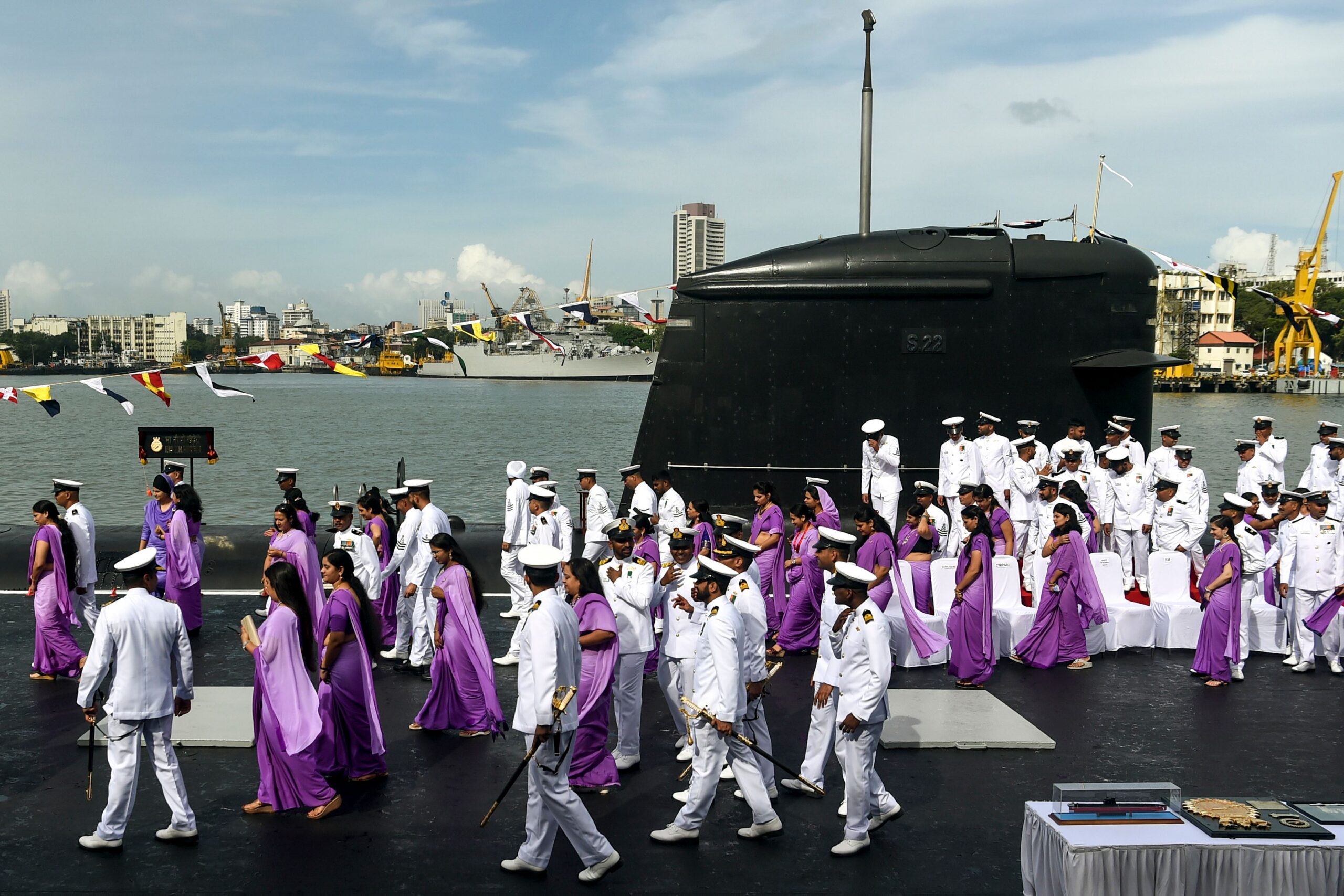
Photo | The crew of ‘INS Khanderi’, the second submarine of Project 75 (Yard 11876), leave after posing for a photograph with their family members during its commissioning ceremony into the Indian Navy at Mumbai naval base on September 28, 2019. (Photo by PUNIT PARANJPE/AFP via Getty Images)