

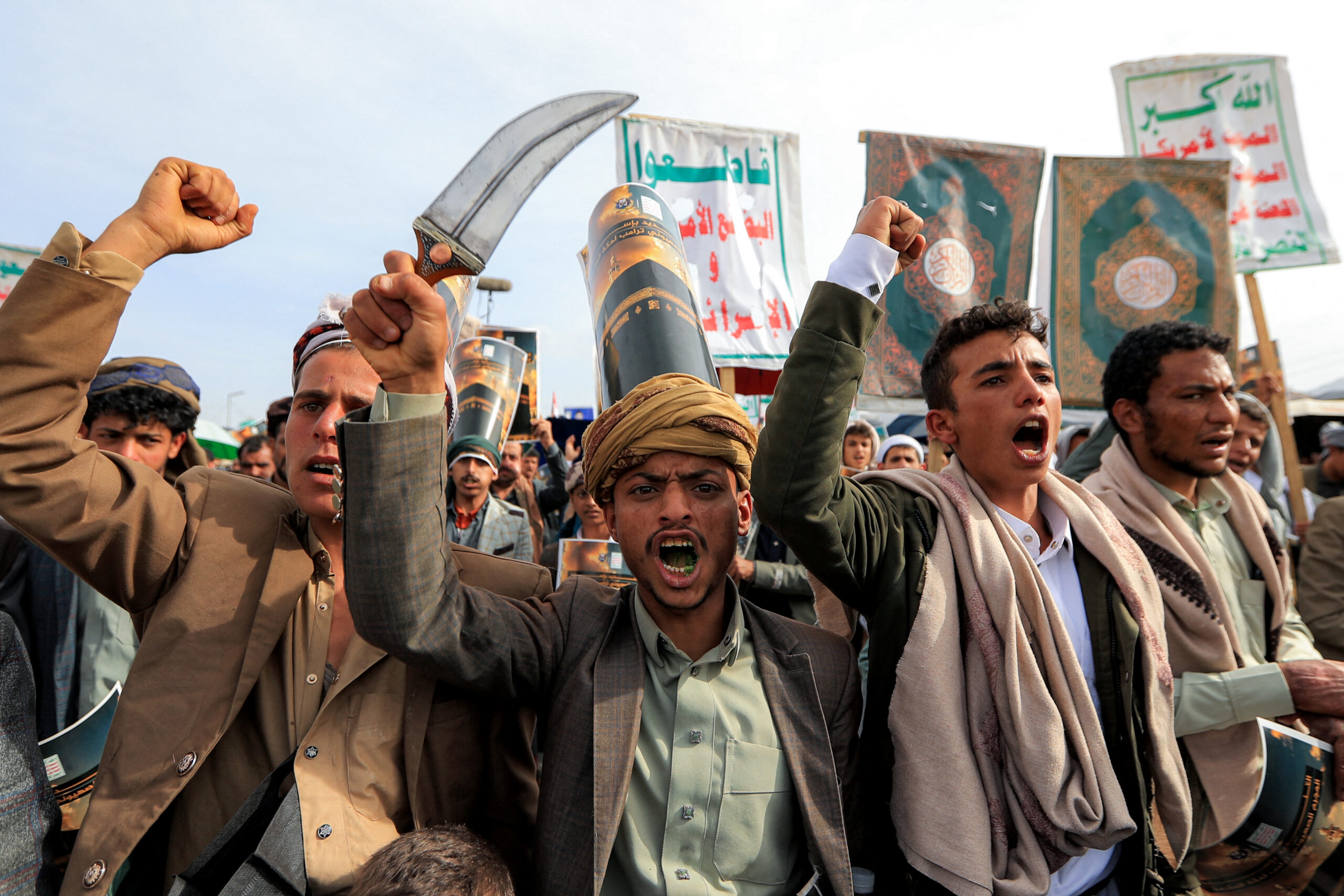


The Houthi naval blockade of Saudi Arabia that began in late July marks a shift in the group’s position from a local insurgency in Yemen to a regional force that can now impose costs on Riyadh itself. It raises the prospect of energy-market shocks, Iranian regional empowerment, and wider Middle East instability. Four Saudi miscalculations in Yemen contributed to this shift: framing the Houthis primarily as an Iranian proxy; choosing loyal domestic partners over effective ones; relying heavily on air campaigns; and imposing a comprehensive siege that deepened Yemen’s humanitarian catastrophe. To limit the Houthis’ further empowerment, Saudi Arabia must end its siege alongside credible security measures, prioritize inclusive and effective partnerships, impose strict protocols that protect civilians during military operations, and pursue sustained diplomacy that secures naval routes and restores a political process grounded in Yemeni sovereignty.
A New Balance of Power
On March 26, 2015, Saudi Arabia’s then-ambassador to the United States, Adel al-Jubair, announced the launch of Operation Decisive Storm– a sweeping military campaign led by the kingdom and regional allies and backed by the United States, the United Kingdom, and France. Its stated aim was to expel Houthi rebels from Sanaa and reinstate Yemen’s post-Arab Spring transitional government. More broadly, Riyadh sought to curb Iranian influence along its southern border. The ensuing naval, aerial, and land blockade, combined with fighting among aligned domestic factions, plunged Yemen into what the U.N. called “the world’s worst humanitarian crisis.” Seven years later, the Saudis and Houthis concluded an informal ceasefire that lasted for four years.
The conflict resumed in recent weeks with a new balance of power. On July 20, 2026, the Houthis declared a naval blockade against Saudi Arabia, and days later, they began striking Saudi vessels. Ever since, the conflict has escalated across maritime, energy, and cross-border fronts. Houthis have struck multiple Saudi oil tankers in the Red Sea and launched missile and drone attacks on Aramco oil facilities in Jizan and Yanbu. In early September, Houthi forces launched several attacks on multiple Saudi cities, disrupting energy facilities and injuring 73 people.
Saudi Arabia’s shift from an offensive posture against the Houthis one decade ago to being presently vulnerable to their naval disruption and strikes was caused by a series of strategic miscalculations that ultimately weakened Riyadh’s position and strengthened that of the Houthis.
Foreign Policy Miscalculations
The first of these strategic miscalculations in relation to this conflict is Saudi Arabia’s framing of the military campaign against the Houthis as an extension of its larger geopolitical confrontation with Iran. This framing is motivated by cutting off the Houthis’ regional support, thus depriving them of the resources the movement needed to survive, but it overlooks the movement’s history and its sources of domestic support. Historically, the Houthis are a political movement whose roots and presence predated the current geopolitical realignments. Though they are often conflated with the Twelver Shiism, the largest Shiite denomination, associated with the Shia in Iran, Iraq, and Lebanon, Houthis are Zaidis and thus religiously distinct and deeply embedded within the Yemeni social fabric with strong ties to major tribes in northern Yemen.
The Houthis, therefore, do not map neatly onto the broader fault line that shapes the regional proxy-war discourse. As a result, this regional framing gained very limited traction in Yemen. Imposing a regional lens onto a domestic struggle over power and resource-sharing created a disconnect between Saudi Arabia’s war discourse and the lived political experiences of most Yemenis. Though Houthi leaders might occasionally leverage the broader geosectarian and Iran-Saudi conflict environment to consolidate their power, their domestic standing is shaped by other factors, primarily conflict over power and resource sharing.
As a result, an important segment of Yemenis came to perceive Saudi Arabia’s campaign as little more than an external aggression by a powerful state against a fractured and impoverished neighbor. When the Houthis stepped up to counter this campaign, the dissociation between war discourse and lived reality provided a basis for Houthis recasting themselves from a rogue rebel group that had disrupted a democratic transition into defenders of Yemen’s sovereignty and breakers of the siege. This boosted their domestic popularity and attracted domestic allies.
This framing also helped empower the Houthis logistically and militarily. It precipitated the very outcome Saudi Arabia cited as justification for its intervention: a deepening of ties between the Houthis and Iran. Before the war, Iran’s presence and influence were limited and largely symbolic. Saudi Arabia’s casting of the campaign as a frontline battle in a regional, proxy war supplied the political rationale and operational necessity for closer coordination and cooperation between the Houthis and Tehran. If Riyadh had treated the conflict as a Yemeni civil war and less as an Iranian proxy offensive, Tehran would have had less incentive to turn its pre-2015 symbolic ties with the Houthis into a strategic and military alliance. Similarly, the Houthis would have had less political cover or military need to seek or accept deeper cooperation.
Cooperation between Iran and the Houthis has strengthened the group’s position within Yemen and regionally. It turned them from a local movement within the northern highlands of Sa’dah into a national force, boosting their regional traction among the “resistance” axis’ support base. The decisive shift in their regional standing inside the axis came after the Hamas attacks on Israel on Oct. 7, 2023. Houthi attacks on Israel and Red Sea shipping and the U.S.-led Operation Prosperity Guardian that followed recast them on the global stage as an Iranian partner able to impose costs on Israel and the United States. Ultimately, the Houthis’ military and logistical capabilities developed in ways that would have been less likely to achieve in the absence of external patronage.
A second and closely related miscalculation concerns Riyadh’s approach to selecting and sustaining domestic partnerships inside Yemen. This approach has centered on privileging factions and figures who demonstrated unequivocal fealty to the kingdom even when at times they are motivated by self-interest and with performance that diverged from Riyadh’s broader strategic needs. Many of these preferred partners, who are largely the old Saleh-era elite and affiliates of the Muslim Brotherhood-linked Islah party, are regarded by many Yemenis as self-serving. This loyalty-first approach came at the expense of more capable actors who enjoy genuine on-the-ground support and who might have proved more effective against the Houthis but are not fully aligned with Saudi Arabia’s preferences. For example, Aidarus al-Zubaidi was pivotal in pushing out Houthi forces from the south. However, when his push for independence clashed with Saudi preferences, he was quickly removed from the presidential council and charged with treason and the Southern Transition Council (STC) he built, an Aden-centered secessionist body formed in 2017 to restore an independent South Yemen, was dissolved.
The consequences of this approach have been twofold. First, alignment with factions regarded as compromised diminished the campaign’s domestic standing as the side of the conflict in charge of restoring the transitional democratic government and weakened its political traction within Yemen. More significantly, it undermined the kingdom’s military operations in the country. The bureaucratic body within the Saudi government that is a key player in the campaign, the Special Committee on Yemen (al-lajna al-khāṣṣa), has faced serious corruption allegations blamed for contributing to on-the-ground military defeats. Allegations include claims of large-scale financial mismanagement involving fictitious military units on official records with funds pocketed by Saudi and Yemeni personnel and diverting advanced weaponry to local factions, with some weaponry later reaching the Houthis and the black market. The second consequence was the sidelining of more credible and militarily capable partners, which inadvertently paved the ground for Houthi advances politically and on the battlefield, further consolidating the movement’s domestic position.
This preference for loyal partners over potentially more autonomous yet more efficacious ones has also strained Saudi Arabia’s regional partnerships, the most important of which is with the United Arab Emirates. In late 2o25, when Abu Dhabi attempted to advance its own interests by supporting southern Yemeni forces, specifically the STC, which had been effective in repelling the Houthis, Riyadh responded by backing the call by Yemen’s internationally recognized government for the departure of forces from the UAE – Saudi Arabia’s most important regional partner in this operation – to leave within 24 hours. Though the STC has secessionist aspirations, its leaders have stated that pursuing this goal would come after the Houthis are defeated and the internationally recognized government is restored. Losing a key regional partnership in this conflict has weakened Saudi Arabia’s military position in this war and, combined with earlier factors, contributed to strengthening that of the Houthis.
A third strategic miscalculation relates to the kingdom’s military operations, which have been heavily reliant on air campaigns. Between late March 2015 and April 2022, Saudi Arabia and other coalition members conducted 25,054 air raids in Yemen, seeking to weaken Houthi military capacity. However, in the process, airstrikes have been associated with significant civilian casualties that have negatively affected Saudi Arabia’s perception in Yemen and reputation on the global stage.
Among these strikes is an attack on Aug. 9, 2018, that hit a bus carrying mostly schoolboys in the northern province of Sa’dah, killing 29 children under the age of 15 and wounding 48 people. Two years earlier, a double-tap airstrike hit a funeral hall in Sanaa, killing at least 100 people and injuring over 500 others. These tragedies, noted Saudi officials, have been due to faulty targeting and intelligence data. On the ground, these tragedies have acted as powerful catalyzing events for public mobilization against the broader Saudi campaign. They rallied greater segments of the Yemeni population, including those who were apolitical or were anti-Houthis, who came to identify with the Houthi movement because of having suffered loss or simply knowing those who had.
Saudi Arabia’s reliance on air power and the attendant human cost therefore contributed to undermining the standing of the kingdom’s military campaign even when it claimed, among its primary objectives, restoring a democratic government representative of Yemenis. Simultaneously, this military strategy contributed to strengthening the Houthis domestically by deepening their repositioning from a rogue group to self-branded defenders of Yemen’s sovereignty.
A final strategic miscalculation is Riyadh’s reliance on an aerial, land, and naval blockade of Yemen as a military tactic to weaken the Houthis. This measure has resulted in high humanitarian costs: 70% to 80% of Yemen’s civilian population lives in Houthi-controlled areas, and because Yemen imports roughly 90% of its food and most fuel and medicine, restrictions on ports, airspace, and roads have thus affected the majority of Yemenis. These restrictions have delayed shipments, disrupted supply chains for medical and essential goods, and driven up prices of basic necessities. By the end of 2021, of 377,000 estimated war-related deaths, 60% were from hunger and lack of healthcare. Currently, more than 17 million Yemenis face acute food insecurity, around 2.2 million children under 5 suffer acute malnutrition, and 80% experience poverty.
This civilian suffering, largely a result of the siege, has broadened domestic support for Houthis even when most fundamentally reject their ideology and rule. Worsening conditions have given Houthis a basis to portray the blockade as an external punishment and deflect blame for their domestic failures and crimes, such as the 11-year siege of Taiz. Additionally, these conditions have deepened Yemenis’ dependency on the Houthis’ authority for basic needs. Together, these dynamics have contributed to fortifying rather than undermining the Houthis’ domestic grip.
Regional and Global Implications
These strategic miscalculations are not exhaustive. Other factors, such as the Houthis’ internal cohesion as a movement and adaptive military learning, as well as the chronic structural weaknesses in anti-Houthi Yemeni factions, certainly played a role in empowering the Houthis and affecting Saudi Arabia’s position in this conflict. However, the interlocking miscalculations – against the kingdom’s core imperatives of securing its southern border, protecting Red Sea shipping lanes, and containing cross-border threats – have been consequential in transforming once-powerful Saudi-led intervention into a strategic reversal where now the Houthis now are a regional power threatening the kingdom. This reversal is not a mere battlefield setback; it has major implications for Saudi Arabia’s geopolitical position and for the stability of the Middle East as a whole. Should the Houthis continue to blockade and attack Saudi Arabia, the world’s largest oil exporter, the economic and political effects will extend beyond the immediate conflict.
Yemen sits strategically astride the Red Sea and the Bab al-Mandab, through which at least 12% of the world’s trade passes. Since the outbreak of the Gaza war in October 2023, the Houthis have attacked more than 300 ships in solidarity with the Palestinians, forcing many to divert around the Cape of Good Hope. Recent escalations targeting Saudi ships have resulted in disruptions to energy and, by extension, food supplies and higher shipping costs, with cascading effects on international markets.
Politically, if the Houthis continue to pose a security threat to Saudi Arabia, one of the most important U.S. allies in the Middle East, the kingdom’s weakened position will embolden Iran and its regional partners. The effects of these emerging dynamics could raise the risks for other U.S. partners and undermine Middle East stability.
Policy Recommendations
- Saudi Arabia and key international partners should lift the prolonged siege in Yemen in conjunction with credible security and diplomatic constraints. Lifting the siege will cut Houthi leverage and ease the humanitarian crisis. The accompanying constraints will limit any military windfall for Houthis.
- Saudi Arabia should change its partner-selection strategy in Yemen to one that prioritizes inclusivity, credible partnership, and effective performance over loyalty and an elites-first approach. This will improve local perception and its longer-term position vis-à-vis the Houthis.
- Saudi Arabia should prioritize safeguarding civilian lives when carrying out operations. The United States and its partners should investigate previous strikes. Taken together, these actions will serve to rebuild the campaign’s credibility as well as the Houthis from using civilian deaths as mobilizing grievances.
- The United States, regional states, and relevant international actors should engage in sustained multilateral diplomacy to secure Red Sea shipping lanes and embed any ceasefire in a political process that prioritizes Yemeni sovereignty and humanitarian recovery. This will contribute to conflict resolution and prevent further regional destabilization.
The content and views expressed in this paper are those of the authors and should not be taken to reflect an official policy or position of the Middle East Policy Council.
Photo | Supporters of the Iranian-backed Houthi movement gather at a mass rally, denouncing what they perceive to be derogatory comments by the U.S. president regarding the Muslim holy city of Mecca, in Yemen’s capital Sanaa on June 16, 2026. (Photo by Mohammed HUWAIS / AFP via Getty Images)