

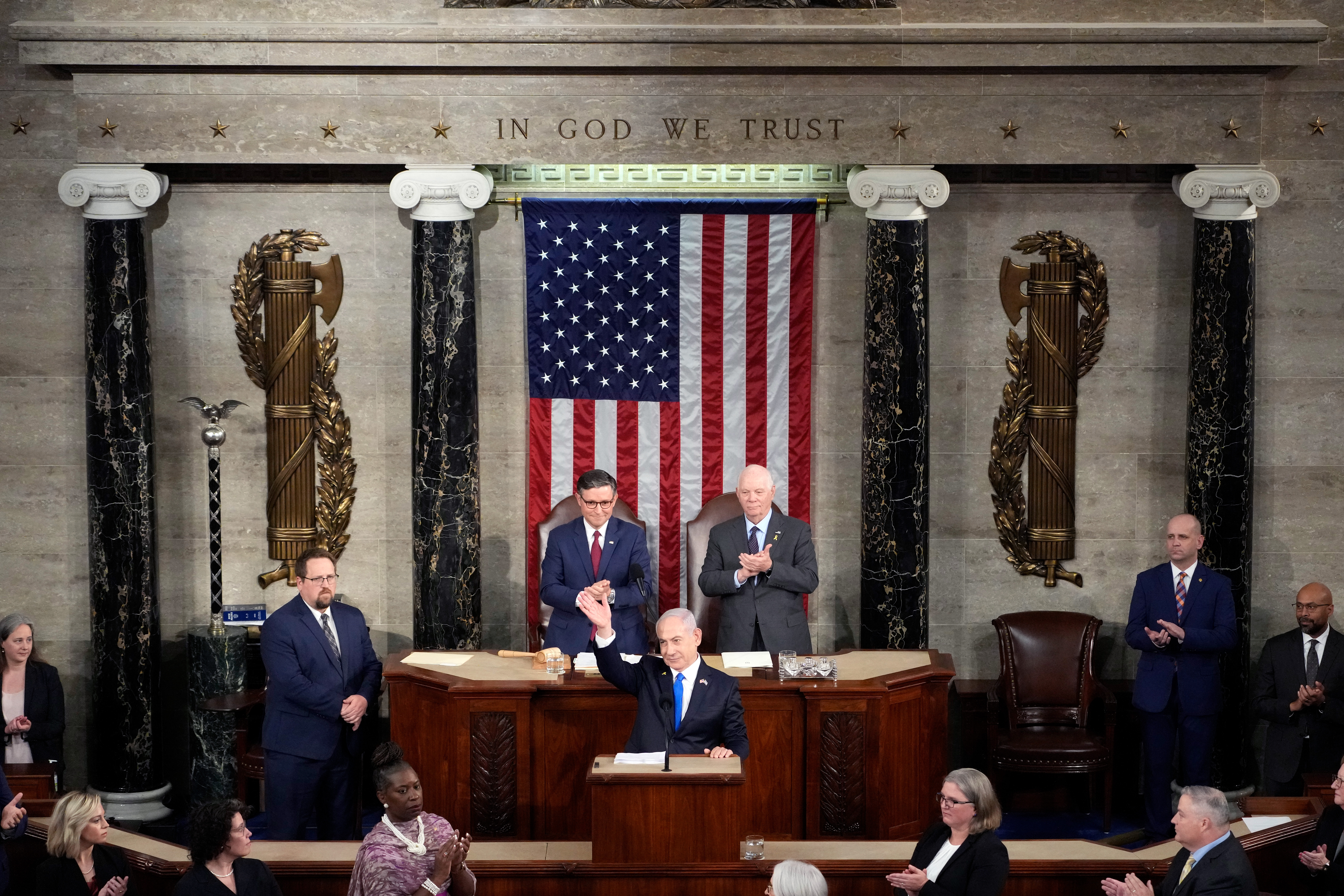


For decades, the State of Israel has enjoyed strong and seemingly unwavering bipartisan support across both political parties whether Democrats or Republicans controlled the White House or Congress. Largely, military assistance to Israel had been accepted as a permanent fixture of U.S. foreign policy, and one that was considered a net positive in terms of securing U.S. national security interests in the Middle East and North Africa. Attempts to challenge the U.S.-Israel relationship, including calls to reassess U.S. military and financial support, were generally confined to the farthest-left margins of Congress. Frequently, any attempt to even raise the issue was dismissed outright or condemned as antisemitic, as Congress and the U.S. political system writ large continued to accept the Israeli state’s purposeful conflation of its national identity with that of the entire global Jewish community. For decades, the political risk of challenging the U.S. foreign policy status quo toward Israel was, for many, too high.
While congressional disagreement over the scale and scope of the diplomatic and military commitment to Israel has grown over the last 20 years, the 119th Congress has revealed that the consensus is not just weakening but actively breaking down. Congress is currently simultaneously debating whether to scale back or further entrench the U.S.-Israel military relationship. When the 120th Congress convenes in January, this debate will likely be its defining foreign policy question.
In the aftermath of Israel’s response to Hamas’ Oct. 7, 2023, attack on Israel, the shift in the American public’s views of Israel, its actions, and the direct U.S. complicity in enabling them through provision of military assistance and diplomatic cover has been dramatic. Largely because of Israel’s continued conduct in Gaza, for which overwhelming documentation affirms meets the legal definition of genocide and its expansion into a war across the Middle East, polls indicate that support for Israel among Americans has dropped. One survey conducted in February and March found Israel was viewed positively only by about a third of respondents, and just 13% of those identifying as Democrats. A poll conducted in 2025 showed that Democratic voters were more sympathetic to the Palestinians than they were to Israel, a stunning reversal from the political landscape that existed prior to October 2023. This positioning is coupled with additional data from a recent poll in which a third of the American public believe that “Israel’s military actions in Gaza constitute genocide.”
U.S. voters are increasingly calling for Washington to end military and financial assistance to Israel for multiple reasons, including the fact that from October 2023 to the present, the U.S. has provided more than $20 billion in support for Israel’s wars and military operations across the region. The issue of military assistance is also tied to the White House’s decision to join Israel’s military campaign against Iran – with 52% saying Israel had “too much influence” on U.S. President Donald Trump’s decision to launch strikes. The operation has consumed significant amounts of U.S. offensive and defensive precision munitions – including Tomahawk cruise missiles, THAAD and Patriot interceptors, and Standard Missile interceptors – prompting defense analysts to warn that depleted inventories could reduce U.S. readiness for a major contingency elsewhere, particularly in the Indo-Pacific, until stockpiles are replenished.
The significance of this shift in sentiment extends beyond public opinion; it is reshaping debates in Congress and across the broader U.S. political landscape. It’s also making or breaking elections across the country, as evidenced by primary victories by Democratic candidates who support Palestine, criticize Israel, or both. These include Claire Valdez in New York’s 7th Congressional District, Brad Lander in New York’s 10th, and Melat Kiros in Colorado’s 1st, not to mention New York City Mayor Zohran Mamdani’s historic election. The 120th Congress is increasingly likely to include a larger group of lawmakers who either oppose U.S. military assistance to Israel outright or favor conditioning that assistance on specific policy requirements.
In response to these shifts, an unprecedented amount of legislation challenging the existing U.S.-Israel relationship has been introduced during the 119th Congress, reflecting the growing recognition among Democrats that the model of unconditional support for Israel is politically unsustainable. One of the clearest examples is The West Bank Violence Prevention Act of 2025 (H.R. 3045), filed in tandem with its affiliated Senate bill (S.2672). This bill would establish a framework for imposing sanctions against individuals responsible for “endangering United States national security and undermining prospects for a two-state solution by committing illegal violent acts.” While the bill could target any individual, it has largely focused on sanctioning violent Israeli settlers who have escalated their attacks against Palestinians and their property and have murdered four U.S. citizens since 2024. While the Senate version, introduced by Democratic Sen. Peter Welch of Vermont has only four co-sponsors, the House legislation, introduced by Democrat Jerry Nadler of New York, has 161 Democratic co–sponsors, an overwhelming majority of House Democrats, including historically staunch supporters of Israel such as Minority Leader Hakeem Jeffries.
Other filed bills go further, targeting the very foundation of the relationship and the most criticized facet of U.S.-Israel foreign policy: U.S. weapons and military assistance. The Block the Bombs Act (H.R. 3565), introduced by Rep. Delia Ramirez, an Illinois Democrat, would restrict the transfer of certain offensive weapons to Israel that have been used in Gaza and linked to mass civilian death and destruction, including but not limited to BLU-109 “bunker buster” bombs, Joint Direct Attack Munition (JDAM) assemblies, and a variety of tank ammunition. The bill has 80 co-sponsors, with Rep. Thomas Massie of Kentucky the only Republican among them. Both the measure itself and the number of co-sponsors reflect the fundamental shift among Democratic lawmakers and the growing discomfort around the fact that U.S. weapons are being used to carry out violations of international law.
Meanwhile, staunchly pro-Israel lawmakers on both sides of the aisle are pursuing or supporting legislation designed to further entrench U.S. military assistance and cooperation with Israel. One measure that has gained attention is the addition to the FY2027 National Defense Authorization Act (NDAA) of Section 219, also called the “United States-Israel Defense Technology Cooperation Initiative.” This provision would expand U.S.-Israeli military and defense cooperation, permanently integrating Israeli technologies into U.S. military defense programs and supply chains. By embedding this cooperation agreement within the NDAA, this legislation would move key decisions out of visible foreign aid authorization channels, reducing Congress’s ability to provide effective oversight. It would lead to opaque procurement and contracting pipelines and enmesh U.S. and Israeli military programs and supply chains in a way that would be difficult to untangle. It is notable that the Senate recently rejected a procedural vote to advance the 2027 NDAA, an unusual outcome given the legislation’s long history of bipartisan support.
While Section 219 would deepen the U.S.-Israel relationship in the long term, what continues to sustain the relationship now are Foreign Military Financing (FMF) appropriations that provide Israel with $3.3 billion annually through FY2028 to purchase U.S.-made weapons and defense technology at U.S. taxpayer expense. This arrangement, which operates as the financial underpinning of the U.S.-Israel military relationship, faced an existential challenge posed by a historic amendment filed by Massie that the House voted on Wednesday night.
The Massie amendment to the FY2027 State Foreign Operations, and Related Programs (SFOPS) Appropriations Act sought to eliminate the FMF allocation for Israel, a direct confrontation with the status quo that has made financing the Israeli military a relatively unquestioned feature of U.S. policy. While the amendment failed to pass, the result of the vote itself marks a historic turning point in the Democratic Party’s relationship with Israel. The amendment received 103 votes in favor from House Democrats, while another 10 voted “present.”
The Democrats who voted to pass the amendment offered a variety of rationales and expressed different degrees of enthusiasm for their support. California’s Ro Khanna, a potential presidential candidate, was among its strongest supporters. He cited his recent violent encounter with West Bank settlers armed with U.S. weapons as an example of the consequences of unconditional support for Israel. Meanwhile, former Speaker of the House Nancy Pelosi, who also voted yes, called her decision an “unfortunate choice” she made between approving the amendment (described by some as “vague” and “poorly written”) or continuing to arm the government of Israeli Prime Minister Benjamin Netanyahu. Like others who expressed discomfort with Massie’s amendment, Pelosi still chose to vote against providing military assistance.
The significance of the vote does not rest solely in the sheer number of Democrats who supported it but also in the gap it exposes between lawmakers willing to restrict specific, offensive weapons transfers and those willing to end the overall financial assistance framework. The amendment received 23 more Democratic votes in favor than the number of co-sponsors for the Block the Bombs Act. Therefore, the vote should not only be perceived as a historic testament to the Democratic Party’s shifting relationship with Israel or as a failed attempt to eliminate U.S. military assistance but also as a roadmap for future congressional advocacy initiatives.
While voting for a single amendment is a less-potent political statement than sponsoring legislation, the results of the vote provide a clear indication of which congressional offices may be willing to take more meaningful steps to support Palestinian rights and self-determination beyond the status quo. For the congressional advocates who have worked for years to move the needle on these issues, the vote illuminates a revised map of the political terrain in Washington and will aid in identifying offices that can be pushed to take more consequential positions and those who may become newfound allies. Ideally, it will result in the viability of concrete legislative action that moves the party away from an era in which it effectively supported giving a blank check to Israel for weapons.
This gap has already become an important issue for the Democratic Party heading into the 2026 midterm elections, and ultimately the 2028 presidential election. Democratic voters across generational divides have significantly moved away from supporting Israel. Therefore, Democratic candidates will continue to face increasing pressure to make clear their positions on Israel, its actions and policies, and the future of U.S. military assistance to support them.
The makeup of the 120th Congress will determine whether the legislative efforts put forward by the 119th Congress regarding the degree of U.S. commitment and support for Israel could become viable means for direct policy change. Bills that accumulated significant support but have failed to advance out of committee, such as the Block the Bombs Act and other efforts to restrict or scale back military assistance to Israel, are likely to be reintroduced. While their success will depend largely on the outcome of the midterms, the number of returning and newly elected co-sponsors will provide an indication as to whether the Democratic Party’s evolving rhetorical stance on support for Israel will translate into tangible initiatives challenging existing policy. Whether or not such initiatives pass, they will continue to send a clear message to Israel that the era of unconditional U.S. support is ending.
The 119th Congress has made it clear that the consensus on unwavering support for Israel is no longer intact. It will be the 120th Congress that reveals whether growing public and congressional opposition to its unconditional military support will begin to translate into concrete legislation and, ultimately, a foundational change to the U.S.-Israel relationship.
The views expressed in this article are those of the authors and not an official policy or position of the Middle East Policy Council.
PICTURE | Israeli Prime Minister Benjamin Netanyahu addresses a joint meeting of Congress in the chamber of the House of Representatives at the U.S. Capitol on July 24, 2024 in Washington. (Photo by Kent Nishimura/Getty Images)