



Background
In June 2025, Israel and the United States coordinated an aerial campaign known as the “12-day War” intended to destroy Tehran’s nuclear enrichment capabilities. After the strikes had ended, U.S. President Donald Trump declared that Tehran’s nuclear facilities had been “obliterated.” Nine months later, a second U.S.-Israel offensive against Iran has commenced, this time with only a 27% approval rate from Americans.
With no declared end date for the current offensive and a rising casualty count, conflicting reports have circulated assessing the likelihood of Kurdish-Iranian opposition groups offering support for a ground incursion into Iran from Iraqi Kurdistan. Despite heavy speculation, Trump confirmed on March 7 that the Kurdish forces will not support “Operation Epic Fury,” the U.S. military’s identifier for the offensive.
Civil Unrest
If the goal of the current offensive is to dismantle the Islamic Republic’s security apparatus, the U.S. and Israel achieved a major objective on Feb. 28 with the assassination of Supreme Leader Ayatollah Ali Khamenei. Since then, unrest has surged across Iran, particularly among its ethnically diverse minority communities, putting these vulnerable groups in further jeopardy.
The Islamic Republic has long targeted its Iranian-Kurdish population, which it deems susceptible to foreign influence and untrustworthy because of their ambitions toward self-determination. The Iranian Kurds’ history of expressing grievances against the central government have led to their being targeted by the state both during the Pahlavi era and after the Islamic Revolution.
Along Iran’s shared border with Iraq, taking advantage of a new military front to orchestrate a Kurdish-led ground incursion with U.S.-Israeli aerial support remains a plausible scenario, despite Trump’s announcement that Washington would not work with Kurdish forces in that regard because the “war is complicated enough.”
Iranian Kurds
The Kurds, often described as the largest stateless nation in the world, have faced systematic oppression across the nation states in which they reside, especially in Iran, where Kurds have been disproportionately targeted by oppressive measures. Decades of cultural, social, economic, and political marginalization have steadily deepened resentment toward the central Iranian state, which has consistently framed Kurdish identity as an inherent threat to national unity.
Kurdish political gains over recent decades in Iraq and Syria have stoked hopes among Iranian Kurds hoping to achieve similar levels of autonomy. The Islamic Republic’s intensified security crackdowns on ethnic minorities following the June 2025 offensive, compounded by its brutal suppression of protests, have further sharpened calls for regime change and self determination among Iran’s Kurds and other marginalized minorities.
The Iranian Kurdish coalition
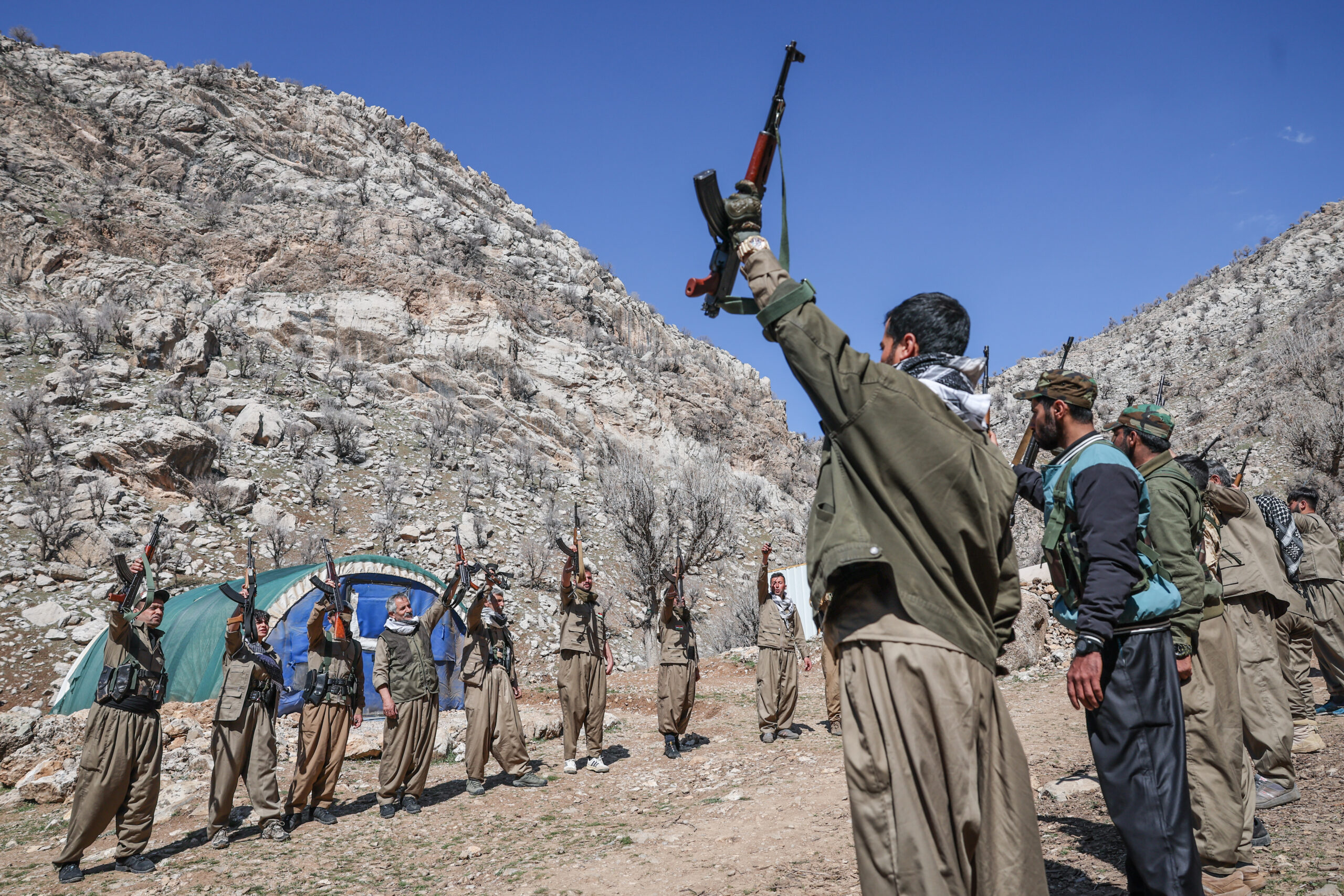
Recently, six major Iranian Kurdish opposition parties – The Democratic Party of Iranian Kurdistan (PDKI), Kurdistan Free Life Party (PJAK), Kurdistan Freedom Party (PAK), the Khabat Organization, Komala-Toilers of Kurdistan, and the Komala Party of Iranian Kurdistan – announced the formation of the Coalition of Political Forces of Iranian Kurdistan after months of groundwork.
The coalition’s framework centers on liberating Iran’s Kurdish regions and establishing democratic governance through coordinated operations of Kurdish peshmerga and guerilla forces under a unified command. It seeks to ally with other Iranian opposition groups on the condition that Kurdish self-determination is non-negotiable. The coalition has also repeatedly stated it does not have separatist objectives but rather is working to protect Kurdish rights within a democratic Iran.
Multiple Iranian Kurdish opposition parties operate in exile from the Kurdistan Region of Iraq, each with military capabilities and each having fought against the Islamic Republic. PAK has received U.S. military training and played an important role in the battle against the Islamic State in Iraq. Similarly, PJAK – a group the U.S. has designated as a terrorist organization on the basis of its affiliation with the militant Kurdistan Workers’ Party – had fought the Islamic State in both Iraq and Syria and is assessed to be the most well-positioned party in geographic spread and demographic weight among the Iranian Kurdish parties.
Conflicting Media Reports
Reports of alignment by Iranian Kurdish opposition forces with the U.S. and Israel remain conflicting, and unverified. However, these reports have already had consequences for the Kurdistan Region of Iraq. Scores of missile and drone attacks launched by pro-Iranian forces have targeted the region as a result of hosting both U.S. personnel and Iranian Kurdish opposition groups.
Trump spoke by phone with officials from Iraq’s Kurdistan Regional Government (KRG) and with PDKI leader Mustafa Hijri shortly after the campaign began. Unnamed KRG officials later told The Washington Post that Trump had urged Kurdish leaders in Iraq to explicitly choose a side in the conflict However, the KRG was seemingly unwilling to take that step. Given its tenuous geopolitical situation, the region has long maintained working relations with Tehran while remaining a close U.S. ally, making the decision to abide by Trump’s demands far too precarious.
Other reports have suggested that the U.S. is counting on Kurdish opposition groups to spark a nationwide uprising in Iran. However, on several occasions, Iranian citizens have staged large-scale protests, each met with brutal suppression and none leading to regime change. The Iranian Kurdish coalition has called for restraint and vigilance rather than urging people into the streets. Additionally, it remains highly unlikely that ordinary Iranians would mobilize during an active air campaign.
Statements by members of Iranian Kurdish opposition groups point to a willingness to partner with the U.S. and Israel in a ground offensive, though a concrete agreement between the parties does not yet appear to be in place. What has become clear, however, is that the Kurdistan Region of Iraq has not consented to its territory being used as a launchpad for operations in Iran, and no credible evidence of fighters crossing the border has emerged since the U.S.-Israeli campaign began. In fact, the KRG has hosted Iranian Kurdish groups for years under the explicit understanding that the groups maintain a ceasefire with the Islamic Republic.
The Iranian Kurdish opposition represents a legitimate political opposition to the Islamic Republic, with parties that have existed for decades and that draw their membership primarily from Iranian Kurds. Media coverage that clusters all Kurdish actors without differentiating among the distinct nation-states they have been part of for over a century risks producing a distorted picture of the region’s political landscape.
What’s in It for the Kurds?
Kurds in Iraq and Syria have managed to establish varying degrees of autonomy following U.S. interventions. Partnerships between the U.S. and different Kurdish groups have been mutually beneficial when their interests have aligned. The Kurds have proved themselves a reliable partner to Washington, as was evident in the fight against the Islamic State.
If this newly reported partnership exists, the Iranian Kurdish opposition would most likely benefit from U.S. and Israeli strikes that weaken the Iranian regime’s military capabilities in Iranian Kurdistan, potentially paving the way for the Kurdish coalition to establish de facto governance.
Risk Factors
The risks to Kurdish groups of a U.S. disengagement from the current conflict run high. It is unclear whether the U.S. and Israel have agreed on the final objectives of this military campaign. The Kurds, who have witnessed shifting U.S. priorities in foreign interventions, would be left with no guarantees of protection from a weakened Islamic Republic or regional actors opposed to Kurdish autonomy should Washington abruptly disengage. It is unlikely that Kurdish groups would agree to fight without an agreement in place obligating the U.S. to safeguard Kurdish territories in Iran and Iraq.
Several factors could precipitate such a withdrawal. The White House’s justification for the current U.S.-Israeli offensive as a preemptive action against the Iranian regime has drawn criticism from a Trump’s domestic supporters as well as the wider public, with many drawing parallels to the 2003 Iraq invasion. Although U.S. casualty counts have remained limited, additional deaths could intensify domestic opposition.
In Iraq, the KRG is in a sensitive position geopolitically and geographically. Iranian-Kurdish opposition groups operating out of the KRG lack air defense systems sufficient to effectively defend against Iranian strikes. One senior Iranian official threatened strikes targeting KRG facilities if Iranian-Kurdish opposition forces there cross the border into Iran. Given Trump’s denial of a U.S.-Israeli-Kurdish alliance, it is likely that the Washington has recalculated its strategic approach given that a ground offensive would require a long-term commitment of U.S. forces. A statement from Shanaz Ibrahim Ahmed, Iraq’s first lady, an ethnic Kurd, and member of the Patriotic Union of Kurdistan, summed up current Kurdish sentiment: “Leave the Kurds alone. We are not guns for hire.”
Another factor limiting Kurdish enthusiasm for cooperation with Washington is the relatively small contingent of 10,000 Iranian-Kurdish fighters in the KRG, insufficient to counter possible Iranian retaliation there. Embroiling Iranian Kurdish forces in this conflict would inevitably lead to civilian casualties in the KRG, potentially triggering a civil war that would affect Kurds on both sides of the Iran-Iraq border. The Kurdish reluctance stems from the consistent lack of commitment by the U.S. to defend Kurdish interests or shield the KRG from external forces after previous military cooperation. After all, if the Kurds did decide fight on behalf of the U.S. and Israel but the Iranian regime survived, they would be at risk for retaliation by Iran and Iranian-backed Shia militia groups within Iraq.
In courting Kurdish cooperation, Washington must also consider Türkiye’s regional interests and red lines, particularly considering Israel’s preference for regional fragmentation. NATO’s interception of an Iranian ballistic missile headed toward Türkiye on March 4 highlights the risks of regional expansion of hostilities. Under NATO’s Article 51, Ankara could have sought intervention from the alliance, but it refrained from invoking the measure. Indeed, one factor constraining Washington’s military cooperation with Kurdish forces is preventing further expansion and prolongation of regional instability. If Washington still seeks to avoid “forever wars” in the Middle East, it must consider the interests of its key regional allies. At a time when regional balance is under significant strain, Turkish involvement would only add uncertainty to an already unpredictable and volatile situation.
Policy Considerations
- Prioritize civilian and minority protection:
U.S. policymakers should incorporate civilian protection and minority risk assessments into their strategic calculations to ensure that escalation does not make minorities in Iran and Iraq vulnerable to collective punishment.Strikes targeting U.S. assets have already impacted civilian sites across the Kurdistan Region of Iraq, underscoring the urgent need for civilian protection, including a possible deployment of air defense systems to areas in which civilians are most vulnerable to Iranian attacks.
- Clear Messaging on Kurdish Involvement:
The perception that Iraqi Kurdistan is being used as a staging ground for operations against Iran has already drawn retaliation from the Islamic Republic. Washington should prioritize coordination with the KRG to retain transparency on the boundaries of what unfolds within its territory, as well as reinforcing through official messaging that that the Iraqi Kurdistan region is not a party to the conflict.
The views expressed in this article are those of the authors and not an official policy or position of the Middle East Policy Council.
PICTURE | Members of Komala of the Toilers of Kurdistan, a Kurdish Iranian dissident group, are seen during the motivation ceremony at their military bases hidden among the mountains on March 12, 2026 in Khalifa, Erbil Province, Iraq. The group is part of the Coalition of Political Forces of Iranian Kurdistan, an alliance of major Iranian Kurdish parties headquartered in Iraq. (Photo by Sedat Suna/Getty Images)