

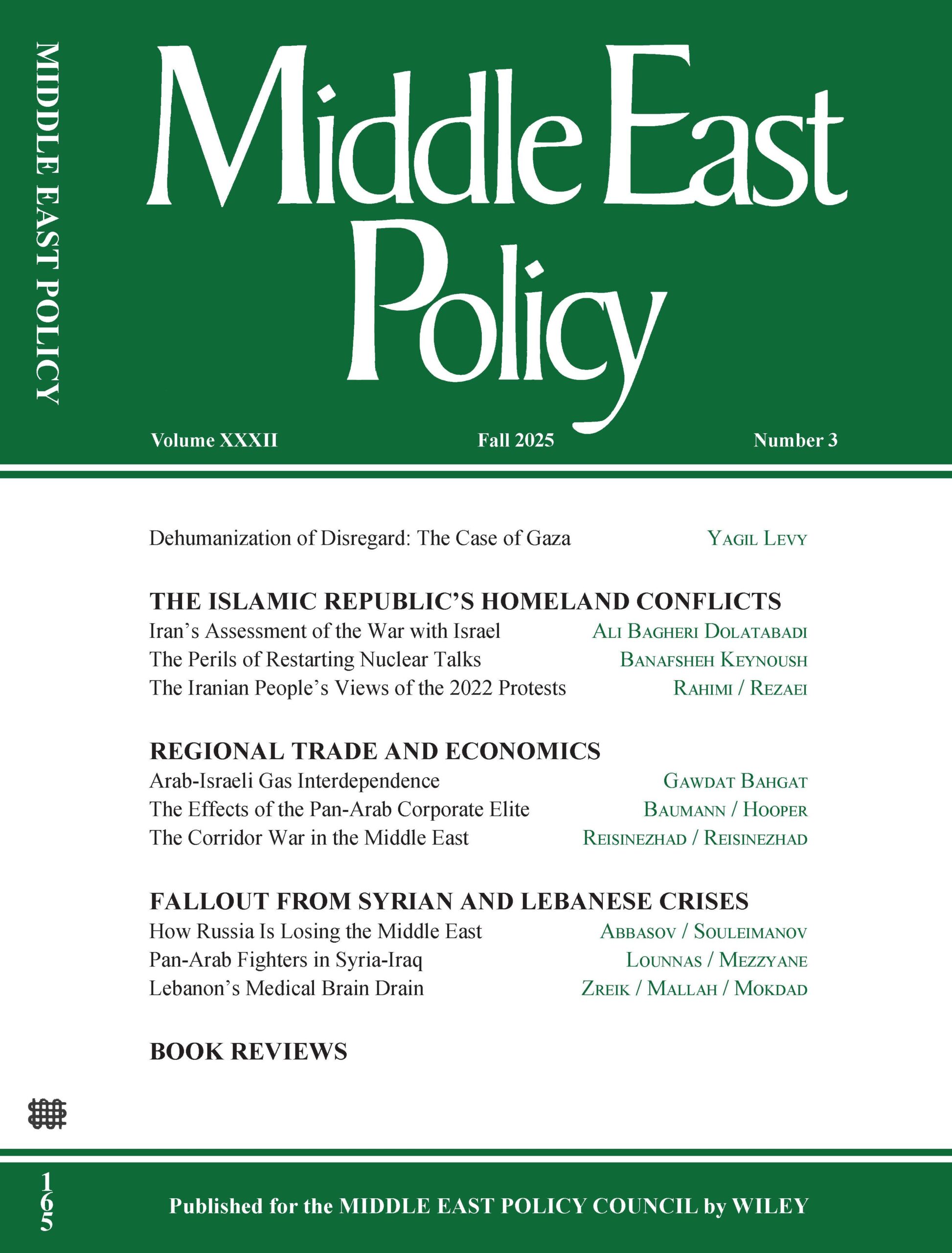

Demonstrations in cities across Iran appear to be panicking the regime, leading to internet blackouts and fears of reprisals over the biggest protests since the Woman, Life, Freedom movement. Analyses in Middle East Policy—including interviews with Iranians who took to the streets in 2022—show that while protesters in the earlier uprisings called for individual rights, many were motivated by the deteriorating economy and sclerotic political system. However, it is far from clear that, even if leadership changes, the regime will soon collapse.
In addition to this coverage of Iran, Middle East Policy just released its Winter 2025 issue, featuring analyses of the new regional order, the Israeli peace movement, and challenges to Turkey’s domestic politics. Also available are our special issues, The Israel-Iran War and The October 7 Emergencies. Please follow us on the social media sites X, Bluesky, and LinkedIn.
In their in-depth interviews with Iranians who demonstrated in fall 2022, Rauf Rahimi and Sajjad Rezaei find that some felt compelled to act due to the killing of a young woman, Mahsa Amini, accused by the religious police of violating laws on head coverings. However, while this was a proximate cause, it awakened latent demands for change. “Violation of rights is not a sufficient cause for rebellion, but it is a source of dormant rage,” one participant tells the analysts. “If the violation of women’s rights had occurred for the first time, there would have been no uprising.”
Indeed, the state’s actions compounded personal frustrations, the interviews show. “In my opinion, the death of Mahsa Amini made people realize that something like this could happen to them or their loved ones,” a demonstrator observes, “which causes individuals to worry about their future and their loved ones. Everyone protested because this personal feeling permeated their actions.”
Rahimi and Rezaei discover that most of those driven to confront the state were less concerned about cruelty or women’s rights than the government’s refusal to take responsibility for Amini’s death. More important, they blamed the regime for poor management and lack of capacity to address Iran’s problems. The authors write:
Accusations of inefficiency and incompetence were recurring themes. “The government and its officials are ineffective and incapable of managing and organizing the country’s affairs in all fields,” P2 claimed. This was echoed by P20, who remarked that “the officials are inept and incompetent in handling the country’s affairs.” The dishonesty of officials was also criticized, with P4 stating, “By telling open lies to the people, the officials somehow insulted people’s intelligence and infused them with anger.”
Above all, the analysis indicates that most interviewees complained of unbearable economic conditions, including unemployment, insufficient welfare provision, inflation, and a lack of hope for improvement due to sanctions.
P4 expressed alarm over the depreciation of the national currency: “All goods have become expensive.” The interviewee highlighted the insecurity in household budgets, noting, “There is no balance between people’s monthly income and expenses.” P12 further elaborated on the anxieties around individuals’ earnings: “Salaries and benefits have not significantly increased in comparison to inflation.”
Mahmood Monshipouri and Ramtin Zamiri argue similarly that the 2022 protests may have been sparked by Amini’s death but revealed a simmering rage: “The unwillingness of the government to respond to demands for change has for a decade frustrated Iranian youth, who awaited the opportune moment to vent their anger.”
While the security forces were able to crack down on protesters and protect the state, the authors contend, the Woman, Life, Freedom movement was broad and deep, establishing a foundation for further, effective collective action. “The familiar tactics of the regime to divide the protesters along political, social, and ethno-sectarian lines have stalled and are not likely to regain momentum,” they write. At the same time, Monshipouri and Zamiri caution that “the regime is incapable of reinventing itself,” suggesting that today’s demonstrations could be more likely to spark repression and violence than reform.
Indeed, as the protesters tell Rahimi and Rezaei,
The divide was being driven by the government’s not being responsive to the citizenry. Indeed, the state’s reliance on revenues from oil and gas means that it is not financially dependent on the people and therefore less likely to accommodate them. In addition, the system cannot shift toward changes in society, and laws do not align with modern-day behavior. And while the state holds a lot of power, there are few nodes where individual feedback can affect government behavior and policy.
As we have shown in other articles, analysts are concerned that regime change could lead to military dictatorship and more repression instead of less. At the same time, as Alex Vatanka has told us, there may be elements of the security forces, perhaps a younger cadre, that are not committed to the current ideology. The question, he says: “How do you get as many people inside this regime to see the light that this regime is bankrupt?”
This means outside actors have to balance support for the Iranian people with calculated restraint. “Supporting the protesters can be managed without co-opting the protest movement,” Monshipouri writes in an analysis coauthored with Giorgio Davide Boggio. “There is an urgent need for Washington to pursue a prudent policy while seeking ways to engage with the Iranian civil society.”
Middle East Policy, Winter 2025
THE REGIONAL REORDERING
From Rebuilding to Restoring Political Order: A New Agenda for Failed Arab States
Guilain Denoeux | Robert Springborg—open access!
Saudi Arabia’s US-China Hedging Strategy and Its Regional Impact
Xiaoyu Wang | Salman K. Al-Dhafeeire | Degang Sun
Maritime Disruption in Yemen: The Making of a Hybrid Red Sea Order
Federico Donelli—open access!
The Struggle for Syria: Strategic Rivalry and the Risks of Escalation
Buğra Sari | Avnihan Kirişik
THE STRUGGLE FOR PALESTINE
The Israeli Peace Movement in a Time of Crisis
Natalya Philippova—free to read!
The Role of Postage Stamps in Palestinian National Identity and History
Ido Zelkovitz | Yehiel Limor—open access!
TURKISH NATIONALISM AND DOMESTIC POLITICS
Why the New Turkey-PKK Peace Process Is Likely to Fail
Michael M. Gunter
Turkey’s March 19 Protests: An End to Competitive Authoritarianism?
Göktürk Tüysüzoğlu
Athlete Queens of Modern Turkey: Beauty Pageants and Modernization
Muhammet Nurullah Çakmak
Countering Extremism in Iraq: The Influence of Ali Sistani
Hogr Tarkhani | Isaac Andakian
BOOK REVIEWS
Sareta Ashraph, Carmen Cheung Ka-Man, and Joana Cook, Holding ISIL Accountable: Prosecuting Crimes in Iraq and Syria
Reviewed by Usman Anwar | Muhammad Atif
Samer Bakkour, The End of the Middle East Peace Process: The Failure of US Diplomacy
Reviewed by Hamdullah Baycar