



Palestinians in the West Bank, the largest portion of the occupied Palestinian territory, face a silent war being waged by Israeli settlers and the Israeli Defense Forces (IDF) with the tacit backing of the Israeli government. Since Hamas’ Oct. 7, 2023, attack on southern Israel, settler violence, land confiscation, and movement toward official Israeli annexation of the territory have sharply escalated while international attention has remained on the destruction and devastation in the Gaza Strip. Settler attacks targeting Palestinians have been concentrated in strategically important areas that the Israeli state has identified for annexation, particularly surrounding Jerusalem and in Areas B and C of the West Bank. These attacks have been especially prevalent and violent in the Bethlehem governorate, where large, established Israeli settlement blocs have ambitions to expand. These areas are home to most of the Palestinian Christian minority, a small and ever-shrinking community in the Holy Land currently subject to increased land theft, intimidation, and violence by Israeli settlers and Israeli forces. The Palestinian Christian population in the West Bank, after decades of violence, instability, and uncertainty caused by Israeli expansion, has dwindled significantly. Christians make up just 1 to 2% of the entire West Bank population, and at least 400 families have applied for visas to emigrate, contributing to the steady decline of the community.
Israeli settler terrorism, often referred to as settler violence, has significantly increased during U.S. President Donald Trump’s second term, following his administration’s policies reinforcing a sense of impunity among Israeli settlers. These include the removal of sanctions targeting perpetrators of violence in the West Bank and a refusal to condemn the widespread violence both enabled and carried out by Israeli military and police forces, who often turn a blind eye to settler violence or aid and abet settlers with their attacks.
While Trump has made it clear in recent months that he opposes Israel’s annexation of the territory, his political appointments, particularly that of U.S. Ambassador to Israel Mike Huckabee, who has signaled a religious allegiance to Israeli settlement in the West Bank (which he refers to as Judea and Samaria), suggest a different stance. The Trump administration and its allies have stressed the need for religious minority protections in the Middle East but have been silent when it comes to the plight of Palestinian Christians in the Holy Land. This approach has deepened instability and violence in the West Bank, pushing conditions to their worst recorded levels. If the Trump administration intends to uphold its stated commitment to protecting and advocating for religious minorities in the Middle East, it must explicitly condemn and confront – through U.S. government policies and legislation – Israeli settler violence and moves toward annexation as soon as possible.
Rising Settler Violence
Settler violence in the West Bank has been on the rise, as Israeli settlers and the government seek to expand settlements and depopulate Palestinian villages in areas that Israel has designated for annexation. Israeli settlements in the West Bank and East Jerusalem are considered illegal under international law. More than 4,000 Palestinians have been displaced within the West Bank since the Oct. 7 assault, because of attacks by Israeli settlers, with at least 44 communities erased. This does not include the more than 31,000 Palestinians displaced from the northern part of the West Bank because of Israeli military operations or the over 1,000 Palestinians killed by Israeli forces and settlers in the West Bank since Oct. 7. Antagonistic political rhetoric and a negligent martial oversight system have contributed to this increase. Israeli politicians and activists have increased calls for the forced removal of Palestinians, while a deeply flawed justice system has not held Israelis involved in violence accountable, for the most part.
The justice system in the West Bank is dissimilar to that in Israel proper, as Palestinians are subject to military courts and are not afforded the same judicial liberties as Israeli citizens. In early 2026, Israel moved to increase civilian judicial oversight in the territory, transferring some administrative duties from the IDF and the Defense Ministry to the Ministry of Justice. The transfer of these responsibilities, however, has not improved Palestinians’ rights in the territory. The Israeli government, instead, has used it to expedite land registration in Area C – a tactic enabling the seizure of any land for which a resident cannot provide proof of ownership. The bar for proof of ownership is exceedingly high, and an estimated 70% of the West Bank is estimated to be unregistered, providing the Israeli settler apparatus with a highly efficient annexation tool.
In addition to legal hurdles, Israeli settlers have used a variety of tactics to harass and abuse Palestinian communities. Settlers have been documented damaging property, harming livestock, disrupting olive harvests, seizing tens of thousands of acres of land, and causing bodily harm. The Israeli government refuses to curb those settlers, who at times descend on Palestinian villages by the score, destroying property and killing or injuring residents in what are, in effect, modern-day pogroms.
It is not uncommon for IDF soldiers to aid in the attacks. Soldiers have often been documented protecting attacking settlers and arresting Palestinians trying to protect themselves or their property. Moreover, since the Oct. 7 attacks, the lines between civilians and IDF personnel have been blurred with the rise of a phenomenon dubbed “settlers in uniform.” Settlers, either on leave from the IDF or embedded within its reserve forces, have donned IDF uniforms and conducted violence with the impunity granted to members of the military. Despite the government’s official statements disavowing the violence, the attacks are only rarely investigated, and their perpetrators are rarely prosecuted. Between 2016 and 2025, Israeli police investigated only 22.7% of the nearly 2,500 complaints brought to them, and only 23 resulted in indictments. The lack of accountability in the system discourages victims from filing reports, further enabling the violence.
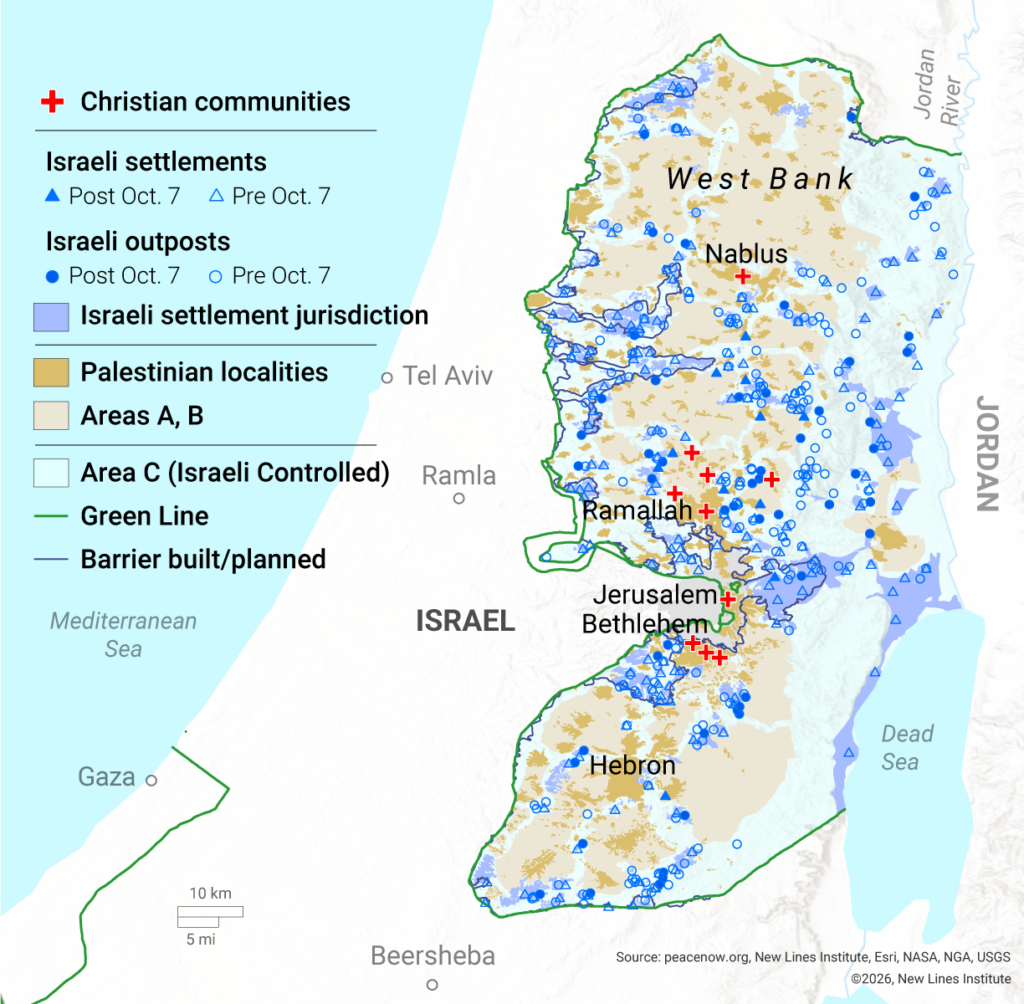
Map of the West Bank showing the distribution of Israeli settlements and outposts, including expansion before and after Oct. 7, alongside Palestinian localities and areas under varying administrative control.
Settler Attacks Targeting Christians
Settler attacks targeting all Christian communities in the West Bank and East Jerusalem have surged since Oct. 7, given the proximity of their villages to the large settlement blocs that the Israeli government aims to expand and annex. Settlers have become more emboldened by a lack of accountability, leading to a rise in both the severity and frequency of attacks in the West Bank. This unprecedented intensification has included incidents targeting both the members of Christian communities and the physical symbols of the faith. In East Jerusalem, regional conflicts have decreased tourism, leaving the Christian community exposed to higher rates of harassment. Clergy have reported instances of physical and verbal assaults and property destruction. Israeli officials are also targeting the Christian community in East Jerusalem through the tax code, freezing assets and closing churches that don’t comply in an attempt to seize their properties. In the West Bank, the expansion of settlements into traditionally Christian areas has created friction between the two groups, bringing increasing settler violence face-to-face with Christian communities.
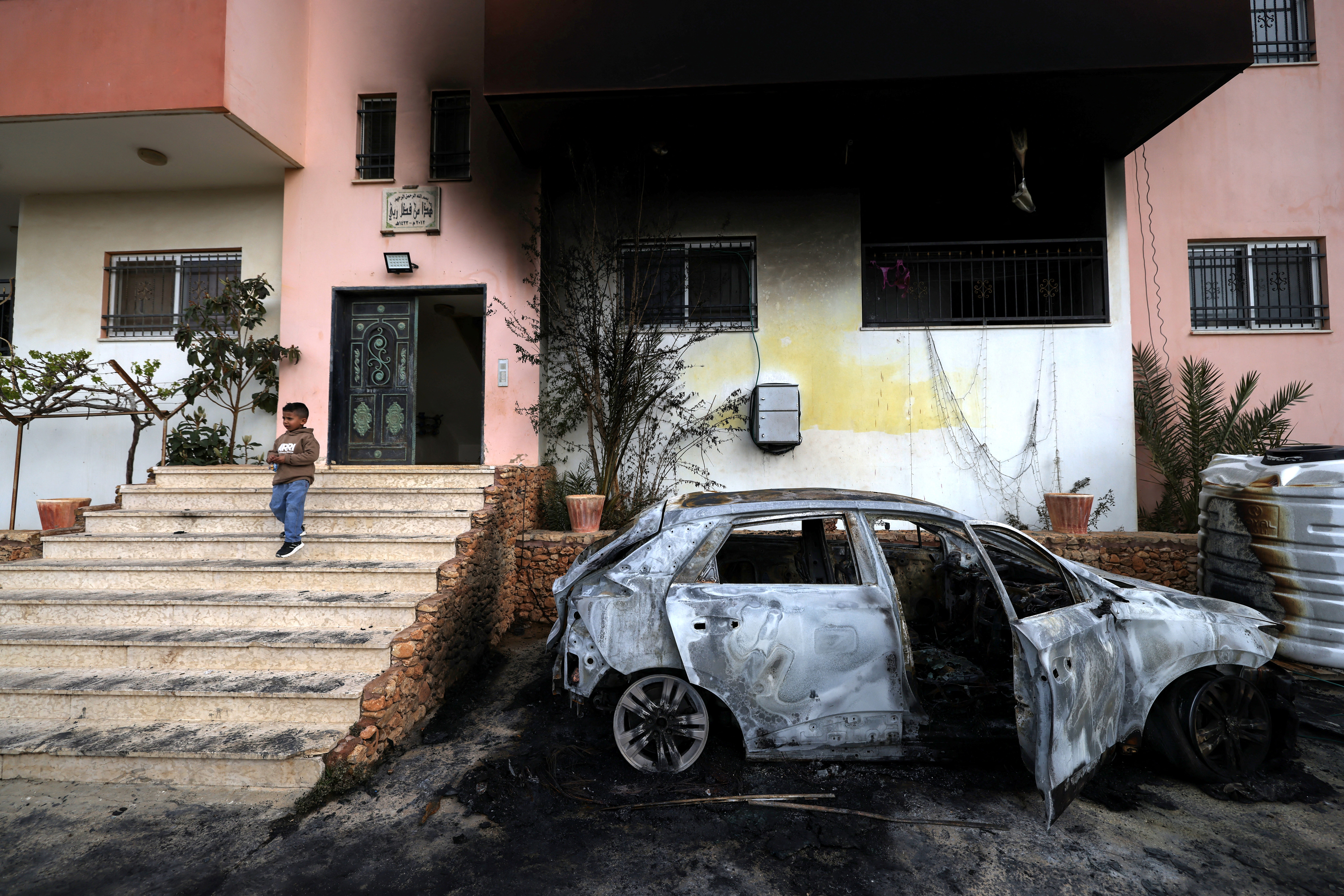
Since the onset of the war between Iran and the U.S. and Israel, settler violence has exploded in the West Bank, with multiple attacks reported each day. The war with Iran, which has captured most Middle East international media attention, has emboldened the settlers to ramp up violence. On March 21, 2026 alone, 20 villages were attacked in a mass pogrom in which settlers burned homes, vehicles, and other property, and 11 Palestinians were injured. Yesh Din, an Israeli human rights organization, reports that since the start of the U.S./Israeli war with Iran, there have been more than 170 incidents of settler violence leaving six Palestinians dead at the hands of settlers, with another five slain by Israeli soldiers.
Palestinian Christian communities are also experiencing an increase in attacks and harassment. The only fully Christian town left in the West Bank, the village of Taybeh, has been isolated from the rest of the West Bank. On March 2, 2026, Israeli security forces placed a large iron gate at the entrance to the village, minimizing movement and cutting the population off. In the following weeks, settlers have been repeatedly reported blocking the entrance to the village and attacking cars attempting to enter.
The tension points between Israeli settlers and Palestinian Christians revolve around a small number of villages where the fewer than 50,000 Christians remaining in the West Bank are concentrated, including East Jerusalem, Bethlehem, Beit Jala, Beit Sahour, Ramallah, Bir Zayt, Jifna, Ein Arik, and Taybeh. An increasing number of outposts – considered illegal under Israeli law – in these areas, which the Israeli government has begun to legalize, including a new settlement in Beit Sahour known as “Yatziv,” adds to the pressure on Palestinian Christians. Recently, many of those communities have faced attacks, with the most well-publicized one being a 2025 mass settler raid on Taybeh in which settlers set fire to the local church. These attacks have brought renewed international scrutiny to the U.S. response to settler violence and have raised questions about its commitments to religious freedom in the region.
U.S. Policy and Diplomacy
The assault on Taybeh drew rare criticism from Huckabee, who described it as sacrilegious and “an act of terror,” centering his condemnation around the assault on the church itself with no mention of those injured or the other forms of property damage. Moreover, members of Congress outlined details of the attack in a report from the offices of U.S. Sens. Chris Van Hollen and Jeff Merkley, condemning the actions of the Israeli government towards Palestinians. Following this attack, members of the Council of Patriarchs and Heads of Churches of Jerusalem visited Taybeh, demanded an investigation into the attack, and held Israeli authorities responsible because they “facilitate and enable [settlers] presence around Taybeh.” U.S. government officials rarely criticize settler violence, even when it is directed against Christians and U.S. citizens, a dynamic counter to stated U.S. foreign policy. The Trump administration’s foreign policy strategy advocates for the freedom of religion to “never be infringed.”
The White House has repeatedly expressed and acted on the importance of minority protections, including for Christians. In February 2026, Secretary of State Marco Rubio affirmed the administration’s goals in Syria. He stated support for “a Syria that is stable, at peace with its neighbors, and protects the rights of all its ethnic and religious minority groups.” A year earlier, Trump had signed a presidential order to eradicate anti-Christian bias. In Nigeria, this aim has been pursued: The United States conducted airstrikes and deployed hundreds of troops, which Trump stated was in the defense of Christians.
However, regarding Israel and the Palestinian territory, the administration’s mixed messaging complicates its policy stance on religious protections. Following new Israeli settler policies and the escalations in settler violence against Palestinians and Palestinian Christians, the Trump administration released a statement condemning the full annexation of the West Bank. Soon after, however, Huckabee expressed his indifference if Israel were to seize more land in the Levant and described Area C of the West Bank as Israel. The U.S. government and the Trump administration apply rhetoric and pressure to protect minorities and defend Christians around the world. However, this treatment is not afforded at the same rate in the West Bank.
U.S. Response to Israeli Settler Violence
For over 30 years, the United States has been committed to a two-state solution to the Israel-Palestinian conflict. However, Washington’s consistent lack of accountability for Israel and its role in settler violence has clouded and obstructed this aim. The current administration’s peace plan for the region places an Israel-Palestinian solution at its core, with Trump presiding over the Board of Peace, an initiative created by Trump to reconstruct and promote peace and stability in the Gaza Strip and eventually solve the Israeli-Palestinian conflict. Simultaneously, he has resolutely stated he “will not allow” an annexation of the West Bank. Yet, the administration fails to act upon the near-daily erosion of the Palestinian quality of life and the systematic displacement of the population from the West Bank. This dynamic of overarching frameworks undercut by calculated negligence is detrimental to U.S. peace policy in the territory and region.
The Trump administration’s limited response to settler violence extends to acts affecting U.S. citizens. Since 2022, Israeli soldiers or settlers have killed nine American citizens in the West Bank. In early 2026, Palestinian American Nasrallah Abu Siam died of injuries sustained in a settler attack in a central West Bank village. His death follows the deaths of three other U.S. citizens in West Bank settler attacks in 2025. The Israeli government has not arrested or prosecuted anyone in those incidents, and the U.S. government has not conducted investigations into the 2025 deaths. Huckabee issued the strongest U.S. condemnation in those cases with a social media post urging the Israeli government to investigate Sayfollah “Saif” Musallet’s death, notably referring to it as an act of “terrorism.”
Israeli investigations into the deaths have yielded few results. In the case of Musallet, no arrests or charges have been made. Nor has action been taken in the most recent incident. In the absence of U.S. pressure, the Israeli government has not and likely will not pursue accountability in these cases.
Impunity as Policy
The escalation of settler violence, the concurrent increased targeting of Palestinian Christians, and the absence of accountability for the deaths of U.S. citizens in the West Bank collectively point to a deeper problem: Impunity has, for all practical purposes, become a feature of U.S. policy toward Israel’s actions in the West Bank. The second Trump administration has removed sanctions on violent settlers and settler organizations, declined to issue public condemnations, and avoided launching U.S.-led investigations into the killings of U.S. citizens, including the high-profile death of Palestinian-American journalist Shireen Abu Akhleh in 2022 at the hands of the Israeli military. These actions have clearly signaled that the U.S. will not impose diplomatic or material costs on the Israeli government for settler violence, Israeli military violence, and settlement expansion.
This has been compounded by mixed messaging from Washington. Trump’s statements opposing Israeli annexation of the West Bank has not addressed the realities of what is happening on the ground. Over the last year alone, the Israeli government has approved massive settlement expansions, land seizures, and laws expanding Israeli civil control over the occupied territory, all while settlers ramp up violence in these areas. Additionally, Huckabee has continued to express ideological support for Israeli settlements, including extending U.S. consular services to illegal settlements, extending increased legitimacy for them despite their violation of international law. Huckabee has delivered these messages while largely refraining from condemning or demanding accountability for settler violence, even when it targets members of Christian communities. These inconsistencies undermine any claim that Washington is actively working to deter settler violence or prevent Israel from furthering its de facto annexation policies.
The consequences of this impunity are visible in the steady erosion of the Palestinian Christian presence in the West Bank. These communities sit largely astride key settlement corridors where expansion plans have already begun, making them especially vulnerable to settlement tactics such as intimidation, land confiscation, restrictions on freedom of movement, and forced displacement. Violence targeting these Christian communities has accelerated precisely because Israeli settlers and the Israeli government have learned that it carries little political risk, despite the increased international media attention it has begun to receive.
This impunity undermines U.S. foreign policy credibility in the Middle East, as it runs counter to the Trump administration’s stated imperatives of minority protection and religious freedoms. However, in the West Bank, where Christians are harassed, displaced, and attacked, this state-sanctioned violence is met with silence or low-level condemnation with no associated action, highlighting the selectivity of U.S. commitments to religious freedom and minority protection, which, in turn, undermines U.S. grand strategy.
Policy Recommendations
Violence mitigation in the West Bank is necessary for regional stability and any progress in rebuilding and establishing effective governance in Gaza and across the Palestinian territory. Reducing the violence requires clarity, consistency, and enforcement from the United States, including retracting the impunity it has so far provided the Israeli government, military, and settlers. The cost of not doing so will lead to an escalation of settler violence, contribute to the decline of the Palestinian Christian community, and further disconnect U.S. policy from its stated values and strategic interests in the region.
- The Trump administration should reimpose targeted sanctions against individuals and groups credibly implicated in acts of violence that contribute to the eroding security situation in the West Bank.
- Washington must publicly and consistently condemn settler violence when it occurs, including when it targets the Palestinian Christian community and U.S. citizens, and oppose de facto Israeli annexation policies that have exacerbated and encouraged settler attacks.
- The Department of Justice and FBI should conduct investigations into the killings of U.S. citizens in the West Bank.
- The U.S. government should push the Israeli government to rescind changes to municipal tax codes that are being used to penalize and potentially bankrupt church institutions in Israel and Jerusalem, in addition to formally declaring that it will ensure all parties enforce the Status Quo Agreement.
- The State Department should re-establish the Office of Palestine Affairs at the U.S. Embassy level to ensure a proper diplomatic channel through which the heads of churches and wider Palestinian Christian community can directly interface with the government.
- U.S. officials must include Palestinian Christians in policy related to minority protection in the Middle East to ensure credibility in any framework that claims to defend religious freedom.
The views expressed in this article are those of the authors and not an official policy or position of the Middle East Policy Council.
PICTURE | A Palestinian child stands outside a destroyed car and burnt out home following a reported attack by Israeli settlers in the village of Deir al-Hatab, east of the city of Nablus, in the Israeli-occupied West Bank on March 23, 2026. (Photo by JAAFAR ASHTIYEH / AFP via Getty Images)