

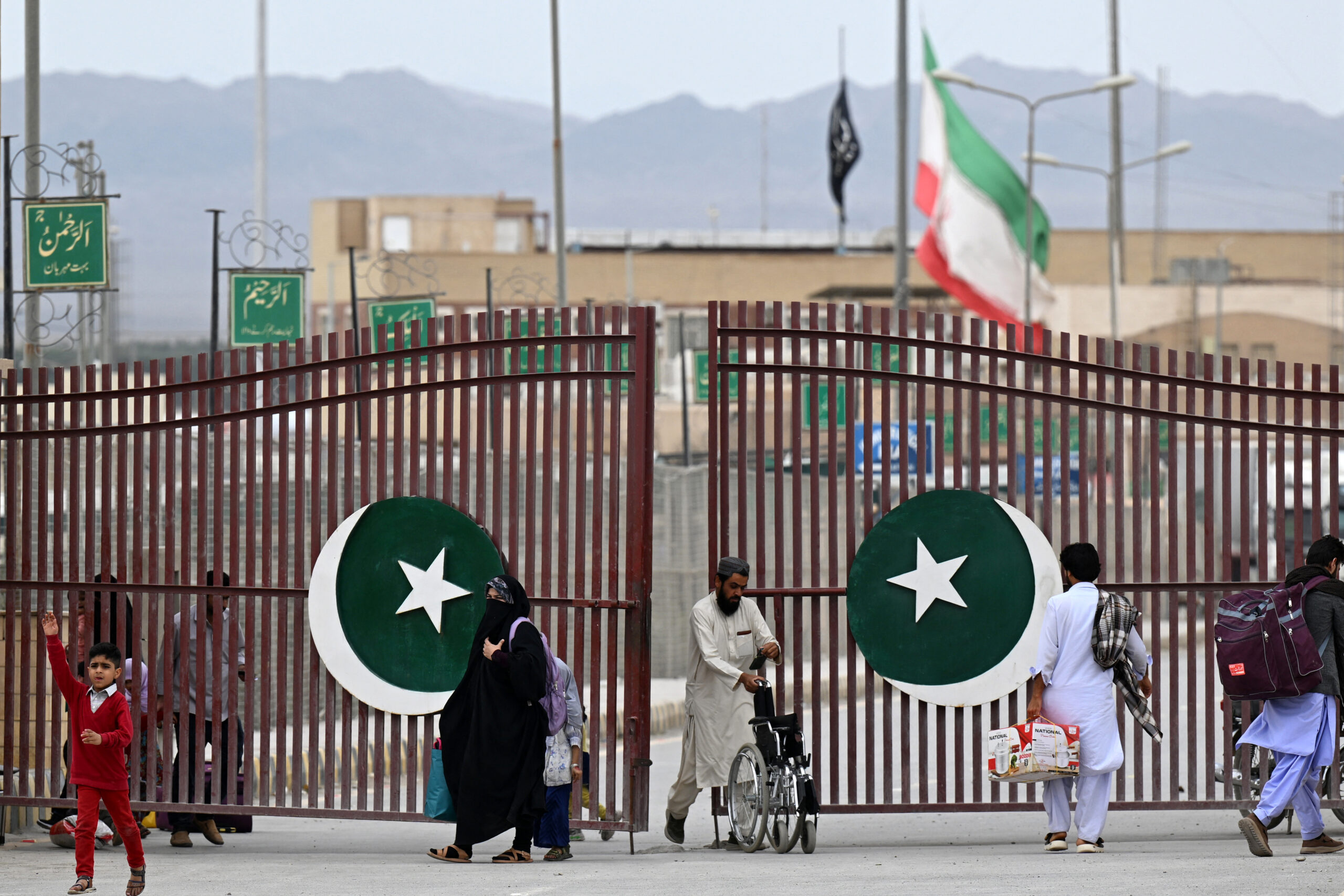

An Iranian regime collapse precipitated by direct military intervention by the United States and Israel is a paradigm-shifting geopolitical moment for the wider Middle East and South Asia. Pakistan is closely tracking developments that could reshape Iran’s near- to medium-term trajectory. Pakistan’s elites have pursued a strategic posture of tense coexistence with the theocratic regime in Iran. For decades, competing dynamics of border security, religious influence, militancy, and regional politics have shaped Pakistan’s delicate engagement with Iran. Even now, Pakistan is facilitating contacts between Iran and the U.S. to avert state collapse as the regime weakens. The go-between role of Pakistan highlights the complex challenges facing Pakistan’s decision-makers, as the existential threat facing Iran’s ruling regime and the prospect of a dissolution of central authority across Iran would directly impact Pakistan’s internal security and stability, posing risks to its regional posture, border security, internal stability, and Balochistan’s political economy.
Securing Borderlands Amid Ungoverned Spaces
The 909-kilometer (565-mile) shared Pakistan–Iran border links Pakistan’s Balochistan province with Iran’s Sistan va Baluchestan region and extends to the Arabian Sea coastline in Pakistan’s Makran Division. A collapse of authority within Iran’s theocratic security state would transform this frontier into a volatile, contested zone, creating immediate strategic and operational challenges for Islamabad. Pakistan’s border security managers would be compelled to maintain heightened vigilance along the entire border, stretching their already limited and dispersed resources.
First, the disintegration of Iran’s border security apparatus would dissolve the existing coordination protocols jointly managed by Islamabad and Tehran. Currently, liaison officers stationed in Zahedan, Iran, and Turbat, Pakistan, facilitate communication and help manage routine frictions. In the absence of Iranian counterparts, Pakistan would face increased risks of inadvertent localized clashes with rogue Iranian units, militants, and smugglers. To prevent disorder, Pakistan would need to significantly reinforce paramilitary deployments and craft new border management protocols tailored to a fluid and unpredictable frontier environment.
Second, a major concern would be the emergence of competing warlords and former Iranian military commanders who would replace Iran’s Ministry of Interior officials, intelligence operatives, and Islamic Revolutionary Guard Corps (IRGC) personnel. Pakistan’s security apparatus would have to track their movements, map their networks, and assess possible linkages with militant groups operating along the border and in Afghanistan. Former Iranian intelligence and military operatives – armed with resources, training, and knowledge of insurgent dynamics – could attempt to reorganize militant networks or mount resistance campaigns from the border region.
Third, Islamabad would need to reassess and closely monitor the activities of Sunni Baloch militant groups in Sistan va Baluchestan and the Baloch Liberation Army (BLA) and its affiliates in Pakistan. The collapse of Iran’s security structure would remove a critical, if mistrusted, coordinating partner that had helped both states manage militant activity within informal limits. Pakistan would now need to independently track Jaish al-Adl, the BLA, and their potential connections to militant groups in Afghanistan. The BLA may attempt to seize weapons from abandoned Iranian depots and exploit the vacuum in Sistan va Baluchestan to acquire strategic depth and escalate attacks in Pakistan.
Finally, Iran’s splintering would heighten Pakistan’s threat perceptions regarding India. Islamabad already believes Indian intelligence had previously used Iranian territory to foment unrest in Balochistan. New ungoverned spaces could intensify regional security dilemmas, prompting rival powers to intervene or back proxy groups. This would accelerate militant-group fragmentation and proliferation across the region, contributing to deeper instability along the Pakistan–Iran frontier.
The Risks of Illicit Border Economy
The frontier between Pakistan and Iran is defined not merely by border security management, but also by a massive, deeply entrenched illicit economy. At the core of this border economy lies the smuggling of heavily subsidized Iranian petroleum products and trade of food supplies into Pakistan’s Balochistan province. This trade is not a peripheral criminal activity; it is an industrialscale enterprise supported by entrenched networks spanning law enforcement agencies, regional power brokers, and organized criminal groups. While the smuggling of Iranian petroleum products has declined in recent months due to intensified crackdowns and episodic enforcement, the fragmentation of authority on the Iranian side would lower barriers to entry and coordination, making a rapid resurgence of fuel smuggling highly plausible.
Despite its corrosive effects on state revenue and governance, this trade sustains some of the most impoverished communities in Pakistan. Approximately 2.4 million people in insurgency-hit Balochistan depend directly or indirectly on cross-border fuel smuggling and goods trade for their livelihoods. Given that Baloch militant factions draw heavily on local grievances and chronic underdevelopment, any unplanned disruption to this economic lifeline carries serious socio-political implications. Even with the recent contraction in fuel smuggling, a fragmented border lacking coherent Iranian oversight would re-create permissive conditions for militant taxation and allow cartels to monopolize renewed flows.
Crucially, Pakistan’s border districts – especially the Makran Division – also rely on Iranian supplies of essential food and daily use commodities. In recent months, following closures and disruptions on the Pakistan-Afghanistan frontier, Iranian food products have traversed far beyond border markets, reaching as far north as Islamabad. This pattern underscores an emergent dependence: if border and barter trade with Iran is disrupted, Pakistan faces not only localized distress but the prospect of acute food supply shortages in the mainland’s urban centers and border districts..
In the event of a regime collapse or even a significant erosion of Iranian state authority along its eastern flank, Tehran would prioritize security along its more vulnerable western frontier. This would force Islamabad to face a dual economic and security crisis. First, the removal of Iranian border guards and IRGC units would allow militant cartels, warlords, and ethnonationalist groups to swiftly monopolize the smuggling routes. These actors already tax grey zone fuel convoys to finance operations. With the disappearance of Iranian state oversight, illicit border capital would surge directly into militant coffers, enabling weapons procurement, recruitment, and escalated kinetic activity against the Pakistani state. Parallel pressures in the food commodity trade would provide additional taxable revenue streams for armed groups, further entrenching insurgent finance.
Conversely, if civil conflict in Iran disrupts refinery operations or severs the logistical chains supplying petroleum to the border, Pakistan would confront a sudden economic shock. The abrupt collapse of cheap Iranian fuel and food supplies, combined with ongoing Pakistani efforts to regulate or formalize border trade, would devastate local livelihoods in border districts. Beyond the border region, a simultaneous interruption of food and basic goods flows would magnify the shock, tightening household budgets and intensifying scarcity effects across Pakistan’s major urban centers. In the absence of alternative economic sources, hundreds of thousands of young men across Balochistan would find themselves abruptly disenfranchised, creating a vast, combustible pool of potential recruits for insurgent groups.
Cascading Destabilization
Iran’s historic role as the ideological center of global Shia geopolitics ensures that its collapse would carry profound political and sectarian effects inside Pakistan. In recent decades, Islamabad’s overriding priority has been to prevent regional sectarian proxy conflicts from spilling into Pakistan. A state implosion in Iran would generate a refugee surge, with distinct populations carrying different security, political, and social implications for Pakistan.
First, Sunni Baloch civilians from Sistan va Baluchestan could move into ethnically contiguous districts in Pakistan’s Makran Division – Kech, Panjgur, and Gwadar – where administrative capacity is thin and economic opportunities and services are already scarce. Among them, adherents of the more religiously conservative Deobandi sect could potentially find ideological common ground with the Taliban groups extending their influence into Balochistan. This will complicate Pakistan’s already fraught effort to contain Taliban activity across the province. In parallel, Shia refugees comprising Persians, Azeris, Hazara, clerical figures, activists, and former security personnel could seek protection inside Pakistan, with high sectarian salience in Karachi, Quetta, and Parachinar. This would saturate Balochistan’s infrastructure and border towns.
Second, beyond refugees, if instability in Iran after a regime collapse acquires sectarian overtones, for example, through hardline Sunni groups targeting Shia communities, or through fragmentation within Shia structures – domestic sectarian polarization in Pakistan will deepen. Shia political and religious organizations are likely to mobilize in Karachi, Lahore, Quetta, and Gilgit-Baltistan, demanding visible state protection, humanitarian support to Shia communities in Iran, and guarantees against spillover of violence.
Third, in parallel, domestic Sunni sectarian outfits would frame Shia arrivals as the expansion of “Iranian influence,” exploiting the moment to accelerate recruitment, fundraising, and disinformation campaigns. Here, geo-sectarian competition and sectarian conflict could spark targeted assassinations, retaliatory bombings, inter-community clashes, and attacks on places of worship and symbolic sites, amplified by disinformation, cross-border propaganda, and diaspora activism. To mitigate, Pakistan’s law enforcement and security apparatus would have to intensify their current efforts to track the activities of sectarian outfits. Beyond a law-and-order maintenance response, financial and digital surveillance of sectarian groups and their facilitators should expand. Mobilization should be pre-empted through proactive engagement with clerical leaders from both Shia and Sunni groups and local political leaders to manage and prevent sectarian polarization.
Fourth, an Iranian collapse would also reverberate along the Arabian Sea littoral. The dissolution of central authority in Iran’s southern coastal regions would expose Chabahar port to institutional paralysis, temporarily disrupting Indian access to the port. In turn, it would neutralize a key instrument of Indian regional influence, while boosting Pakistan’s strategic confidence in long-term competitiveness of the adjacent Gwadar port. However, the resulting governance vacuum would simultaneously expose the Makran coastline to piracy, weapons smuggling, and unregulated maritime movement, directly threatening Gwadar’s security and activities in Gwadar linked to the China-Pakistan Economic Corridor. Consequently, Pakistan’s naval assets would need to intensify patrolling along the coastal belt to prevent armed non-state actors from establishing a maritime foothold. Pakistan’s active participation in Combined Task Force-150 under the U.S. military’s Combined Maritime Forces presents a ready institutional opportunity to expand cooperation with CENTCOM on securing Arabian Sea routes. Besides, given Beijing’s developmental stakes in Gwadar, Islamabad would also need to engage China directly on contingency planning for the port’s continued security and viability.
- Formalize border trade: Establish legal frameworks for cross-border fuel and food trade, prioritizing pilots of regulated corridors in the Makran Division to deny militant groups access to taxable smuggling revenues and protect frontier livelihoods.
- Fortify the western frontier: Reinforce paramilitary deployments, build new border management protocols for a post-collapse environment, and assess whether current corps-level command structures centered on Quetta and Peshawar require enhancement via deployment of additional forces.
- Enhance maritime vigilance: Intensify naval patrolling along the Makran coastline in coordination with CENTCOM and engage China directly on contingency planning for Gwadar’s protection.
- Preempt sectarian mobilization: Expand financial and digital surveillance of sectarian outfits and build proactive communication channels with Shia and Sunni clerical leaders before a crisis erupts.
- Map nonstate actor networks: Intensify intelligence efforts tracking the BLA, Jaish al Adl, and emerging warlord structures in Iranian territory.
- Engage regional partners: Work with Gulf states, China, and Türkiye to prevent outside powers, chiefly India, from exploiting Iran’s collapse to back proxy groups at Pakistan’s expense.
Conclusion
As the geopolitical architecture of the Middle East undergoes a profound reshaping, Islamabad cannot afford a posture of strategic drift. It must urgently formalize and regulate border trade, fortify its western frontier through layered security and screening mechanisms, and pursue proactive diplomatic ring-fencing with regional partners. Only a calibrated blend of economic stabilizers, security hardening, and anticipatory diplomacy can insulate Pakistan from the turbulence of a collapsing neighbor and preserve strategic equilibrium in the emerging regional order.
The views expressed in this article are those of the authors and not an official policy or position of the Middle East Policy Council.
PICTURE | Pakistanis walk across the Taftan border as they return from Iran, in Balochistan province, on March 9, 2026 amid ongoing US-Israel strikes on Iran. (Photo by Banaras KHAN / AFP via Getty Images)