


Neoliberal restructuring has dismantled state-led development strategies from Morocco to the Gulf, and privatization has created new business elites who have gained economic and political influence. A new open-access article in Middle East Policy traces a pan-Arab corporate elite radiating out from the Gulf and extending across the region, a development that reshapes incentives for political and socioeconomic contestation.
The Fall 2025 issue of Middle East Policy is now available in an Early View. The journal’s 165th installment analyzes dehumanization in the Gaza war, the effects of Israel’s June bombings on Iran, and the potential for both regional integration and further division across sectors of economics, trade, and social services.
If you find this newsletter useful, please forward to others you believe will benefit and follow us on the social media sites X, Bluesky, and LinkedIn.
In their article on the corporate elite, Hannes Baumann and Alice Hooper observe, “Internationalization of capital also creates new transnational connections between capitalists, including the elites who run the corporations.” They further explain how we know whether an actor is part of this class:
A person who sits on the boards of two different firms creates a link between these two entities—an “interlock.” If the two companies are headquartered in different countries, the interlock is transnational. The directors who create such transnational interlocks are thus part of the transnational corporate elite.
Baumann and Hooper therefore conduct a social network analysis of “interlocking directorships.” Examining the 135 largest firms in the region, they trace the network created among some of the 1,111 directors. The authors find
136 national interlocks, those between firms within an Arab country. There are 18 transnational ties, representing interlocks between firms in different Arab countries. Combining the two gives us a total of 154 for the Arab world.
Through this analysis, the article also depicts the corporate networks within states and across boundaries, as well as the differences between networks among Gulf Cooperation Council members and those outside the subregion:
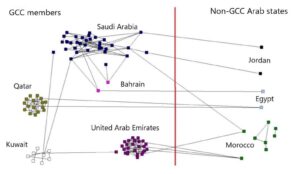
Corporate networks in Arab states, including national and transnational interlocks (isolates have been deleted).
Most important, Baumann and Hooper name names: the elites who serve as nodes between firms situated in different states across the Middle East. This is worked out in a clear plot featured in the article, laying out the transnational elite and how their interlocks work.
In addition providing compelling visualization of the authors’ data, the article contends that the network is likely to expand with foreign direct investment. This will have implications for the types of pressures that governments will face. Leaders of domestic businesses tend to rely on the goodwill of their home regimes. Transnational capitalists, by contrast, are far more difficult to control. However, their demands are unlikely to focus on democratization or other direct challenges to authority. Instead, Baumann and Hooper conclude, “transnational corporate elites are more likely to push for further neoliberal restructuring and regional economic integration.”
The Fall 2025 issue of Middle East Policy includes three other open-access pieces: Yagil Levy’s examination of the Israeli dehumanization of Palestinians through disregard; Banafsheh Keynoush’s analysis of the future of Iran nuclear talks; and Namig Abbasov and Emil A. Souleimanov’s examination of how the new regime in Syria signals the marginalization of Russia in regional geopolitics.
There is still time to check out our special issue on the Israel-Iran War, featuring 14 original articles and four book reviews—all free to read for a limited time.
Middle East Policy, Fall 2025 Early View
Dehumanization of Disregard: The Case of Gaza
Yagil Levy—open access!
THE ISLAMIC REPUBLIC’S HOMELAND CONFLICTS
The June 2025 Israeli War: Iran’s Assessment and Regional Consequences
Ali Bagheri Dolatabadi
The Perils of Nuclear Talks after the US-Israel War on Iran
Banafsheh Keynoush—open access!
The 2022 Iran Protests: The View from the Streets
Rauf Rahimi | Sajjad Rezaei
EFFECTS OF REGIONAL TRADE AND ECONOMICS
Arab-Israeli Gas Diplomacy: Interdependence and a Path Toward Peace?
Gawdat Bahgat
The Development and Political Effects of a Pan-Arab Corporate Elite
Hannes Baumann | Alice Hooper—open access!
The Corridor War in the Middle East
Arash Reisinezhad | Arsham Reisinezhad
FALLOUT FROM SYRIAN AND LEBANESE CRISES
After Assad: How Russia Is Losing the Middle East
Namig Abbasov | Emil A. Souleimanov—open access!
Forgotten Fighters in Their Own Words: Pan-Arab Volunteers in Syria-Iraq
Djallil Lounnas | Israa Mezzyane
The Factors Driving Lebanon’s Medical Brain Drain
Mohamad Zreik | Houssein Mallah | Mohamad Mokdad
BOOK REVIEWS
Javad Heiran-Nia, Iran and the Security Order in the Persian Gulf
Reviewed by Mahmood Monshipouri
Rob Geist Pinfold, Understanding Territorial Withdrawal: Israeli Occupations and Exits
Reviewed by Nathaniel Shils
Steffen Hertog, Locked Out of Development: Insiders and Outsiders in Arab Capitalism
Reviewed by Ahalla Tsauro
Gilbert Achcar, Gaza Catastrophe: The Genocide in World-Historical Perspective; and Erik Skare, Road to October 7: A Brief History of Palestinian Islamism
Reviewed by A.R. Joyce