

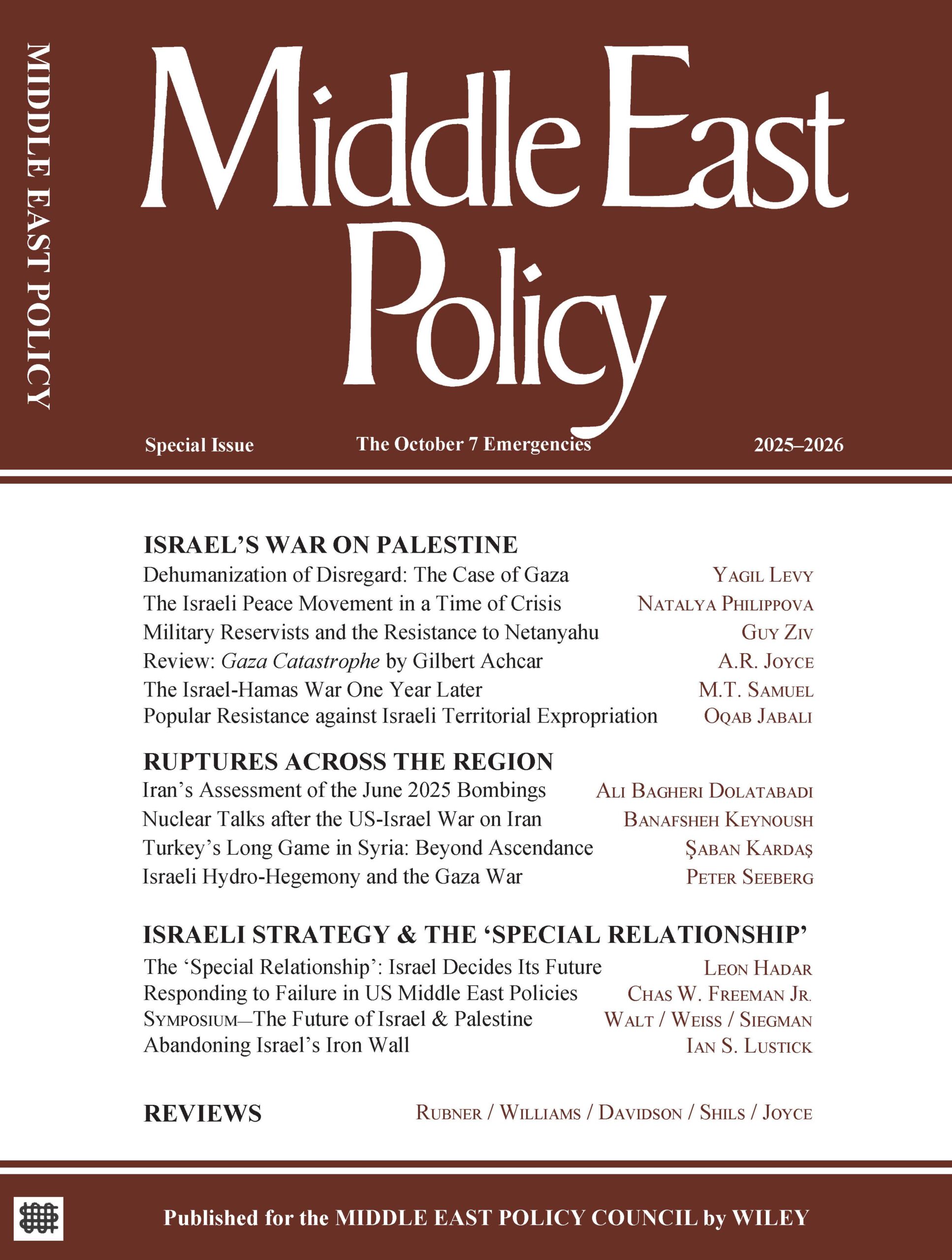

As Israel and Hamas agree to end hostilities, Middle East Policy announces a special issue full of critical insights into the likelihood of success for the American 20-point plan to end the Gaza war and create a lasting peace. Our coverage of the conflict inside and outside the occupied territories will help readers understand the complexities underlying each component and the historical patterns that will have to be subverted.
The October 7 Emergencies features eight articles published since October 7, 2023, on Israel’s internal rifts, its dispossession and dehumanization of Palestinians, and the expansion of the Gaza war across the region and into Iran. Six of those are free to read, even without a subscription. Four of the five archival analyses, delving into Palestinian resistance and the US-Israel relationship, are also available for one month at no charge.
Each piece in this special collection comments directly on the 20-point plan issue by President Donald Trump, the first few points of which appear to be gaining some traction among key stakeholders.
The issue kicks off with Yagil Levy’s powerful takedown of the Israeli mindset, “Dehumanization of Disregard: The Case of Gaza.” Levy contends that discounting the agency of Palestinians led to the Hamas attacks and exacerbated the response. There are signs in the 20-point plan that this dehumanization could continue. Point 2 does emphasize that “Gaza will be redeveloped for the benefit of the people of Gaza,” which suggests a turn away from dehumanization.
But who will be making decisions? Point 9 notes that “Gaza will be governed under the temporary transitional governance of a technocratic, apolitical Palestinian committee.” It is not clear which Palestinians will be involved, but it is notable that the group will be led by Trump and former British Prime Minister Tony Blair. As Levy asserts, “The path to sustainable peace requires more than the instrumental recognition of Palestinians for security optimization or methods of control over the Gazan population. It demands genuine acknowledgment of their full humanity, political agency, and right to self-determination.”
We also investigate the movements inside Israel for Palestinian empowerment and against the extreme rightward turn of the government. A new analysis by Natalya Philippova shows that the pro-peace movement has been hampered by a set of laws hostile to their activities, but her interviews with activists show that they are persisting. Point 18 of the Trump plan advocates a dialogue “to try and change mindsets and narratives of Palestinians and Israelis by emphasizing the benefits that can be derived from peace.” Will Israel’s pro-Palestine movement be a part of this?
Guy Ziv’s evaluation of the challenge to Israeli Prime Minister Benjamin Netanyahu suggests that the general tenor of the 20-point peace plan could relieve some pressure on the Israeli military and security forces, whose reservists have protested right-wing initiatives as well as the maximalist ambitions of the most extreme ministers. “Moshe Yaalon, once Netanyahu’s defense minister, told an interviewer that ‘we are being dragged into annexation and ethnic cleansing in the Gaza Strip,’” Ziv writes.
Point 16 of the Trump blueprint includes a general schedule for Israeli forces to loosen the occupation, which could lead reservists to soften their positions and, crucially for the state, not resist their duties. However, there are no guarantees, as Israel is allowed “a security perimeter presence that will remain until Gaza is properly secure from any resurgent terror threat.”
While the 20-point plan calls for a “reformed” Palestinian Authority, M.T. Samuel reminds us that Netanyahu has long demonized the organization. As well, he notes, in the first year of the Gaza war, Israel forced Palestinian civilians off of “thousands of acres in the West Bank.” On this, the Trump initiative appears to be silent, despite the Israeli push for de facto or even de jure annexation. In a free-to-read analysis, Oqab Jabali notes that the designs of the Israeli right may require Palestinians to return to the methods of the first intifada in order to prevent the aggrandizement of their territory.
The 20-point plan also has little to say about Israel’s attacks on Iran and Syria. Our articles on the June 2025 12-day war, the fate of nuclear talks between Tehran and the West, and the fall of Bashar al-Assad suggest that Israel sees an advantage in destabilizing neighbors.
The October 7 Emergencies demonstrates that there are several other components of the 20-point proposal that will come under immediate strain if they are not dead on arrival:
Point 7 calls for “full aid” to resume immediately once all sides approve the deal. However, as Peter Seeberg illuminates, Israel’s increasing hegemony over water resources from the occupied territories to Jordan reduces “incentives for a comprehensive peace with the Palestinians that could resolve the resource crisis and enable two states to live side by side.”
Point 13 says, “Hamas and other factions agree to not have any role in the governance of Gaza, directly, indirectly, or in any form.” But A.R. Joyce’s review of new books on the war, including Gilbert Achcar’s Gaza Catastrophe, shows that these factions are deeply entrenched and messianic. Moving away from Islamism will require more than just destroying weapons but demonstrating a respect for Palestinian self-determination.
Most important, but least surprising, it is not until the end of Trump’s proposal that we get anything like a nod toward Palestinian sovereignty. While point 19 acknowledges “the conditions may finally be in place for a credible pathway to Palestinian self-determination and statehood, which we recognize as the aspiration of the Palestinian people,” the final point seems to slam on the breaks: “The United States will establish a dialogue between Israel and the Palestinians to agree on a political horizon for peaceful and prosperous coexistence.”
The new special issue includes analyses by Ian S. Lustick, Chas W. Freeman Jr., and Stephen M. Walt, Philip Weiss, and Henry Siegman that illustrate the false promises of Israeli lip service and Washington’s inability or unwillingness to pursue an evenhanded dialogue between the parties. Indeed, as Leon T. Hadar points out in the first issue of the renamed Middle East Policy in March 1992, the United States would be crucial in resolving the conflict and fostering the conditions not just for peace but for prosperity:
The United States should not fall into the trap that Israel’s radical Zionists are setting for it. Instead, continued pressure on the Likud government could promise at least a chance for Israel to move towards recognizing Palestinian national rights. It could create conditions for an Israeli-Palestinian reconciliation and a comprehensive Arab-Israeli peace. These developments could in turn lead to political cooperation among the Middle Eastern countries and to an economic renaissance for the entire region.
As Hadar’s words and the entire special issue remind us, these agreements will only work if there is sustained engagement from the United States and if it is willing to exert pressure on Israel. The vague hints at a path toward statehood, coming at the very end of the 20-point plan, do not suggest that the historical pattern will be shattered.
Middle East Policy, The October 7 Emergencies
ISRAEL’S WAR ON PALESTINE
Dehumanization of Disregard: The Case of Gaza
Yagil Levy—open access!
The Israeli Peace Movement in a Time of Crisis
Natalya Philippova—free to read!
Military Reservists and the Resistance to Netanyahu’s Legal Overhaul
Guy Ziv—free to read!
Review: Gaza Catastrophe by Gilbert Achcar; Road to October 7 by Erik Skare
A.R. Joyce
The Israel-Hamas War One Year Later: Mass Violence and Palestinian Dispossession
M.T. Samuel
Popular Resistance against Israeli Territorial Expropriation: Beita as a Model
Oqab Jabali—free to read!
RUPTURES ACROSS THE REGION
The June 2025 Israeli War: Iran’s Assessment and Regional Consequences
Ali Bagheri Dolatabadi—free to read!
The Perils of Nuclear Talks After the US-Israel War on Iran
Banafsheh Keynoush—open access!
Turkey’s Long Game in Syria: Moving beyond Ascendance
Şaban Kardaş—open access!
Israeli Hydro-Hegemony and the Gaza War
Peter Seeberg—open access!
ISRAELI STRATEGY AND THE ‘SPECIAL RELATIONSHIP’
The ‘Special Relationship’: Israel Decides Its Future
Leon T. Hadar—free to read!
Responding to Failure: Reorganizing US Policies in the Middle East
Chas W. Freeman Jr.—free to read!
Symposium: The Future of Israel and Palestine: Expanding the Debate
Stephen M. Walt | Philip Weiss | Henry Siegman
Abandoning the Iron Wall: Israel and ‘the Middle Eastern Muck’
Ian S. Lustick—free access!
BOOK REVIEWS
Rashid Khalidi, The Hundred Years’ War on Palestine
Reviewed by Michael Rubner
Somdeep Sen, Decolonizing Palestine
Reviewed by Tim Williams
Nathan Thrall, The Only Language They Understand: Forcing Compromise in Israel and Palestine
Reviewed by Lawrence Davidson
Rob Geist Pinfold, Understanding Territorial Withdrawal: Israeli Occupations and Exits
Reviewed by Nathaniel Shils