


Within more than a month of the Iran war, two attacks by Shia actors on U.S. soil point to a type of threat that sits outside standard counterterrorism understanding. Unlike the ISIS or al-Qaeda-inspired lone wolf model, the current Shia attackers leave no ideological trail. This is a potential emerging threat that requires a different approach to detect and prevent.
On March 12, Ayman Mohamad Ghazali, a Lebanese-born U.S. citizen, rammed a truck loaded with fireworks and flammable liquid into Temple Israel in West Bloomfield, Michigan. Ten days earlier, an Israeli airstrike in Lebanon had killed two of his brothers and multiple young family members. According to a source cited by CBS News, both brothers were members of a Hezbollah rocket unit, though this could not be independently verified.
On March 1, Ndiaga Diagne shot dead three people outside a bar in Austin, Texas. The day before, U.S. and Israeli forces launched the operation that killed Iranian Supreme Leader Ali Khamenei. Reports indicated Diagne was wearing an undershirt bearing the Iranian flag. His motive remains under investigation, but the circumstantial picture is difficult to ignore.
Neither case fits the template U.S. counterterrorism was built around. U.S. and Israeli airstrikes have eliminated and disrupted top Shia leadership, weakening the theological discipline that ordinarily governs Shia political violence. This is opening a new space for grief-driven lone actors.
Not the Jihad You Know
For two decades, the dominant framework for lone wolf terrorism in the United States was shaped around the Sunni jihadist threat, primarily actors inspired or directed by al-Qaeda and later the Islamic State. That model is ideologically self-sustaining. It requires no operational chain of command and no clerical sanction beyond the general calls issued by jihadist leaders to kill Americans. Personal grievance can be a facilitating factor, something that eases recruitment, but it is not the trigger. An individual absorbs the doctrine, accepts the theological framing of individual obligation, and acts. The pipeline runs through online content, social media, propaganda videos and encrypted messaging channels, not through mosques or militia structures.
Shia political violence does not work that way. As a theological tradition, it is rooted in jurisprudential hierarchy. Central to Shia practice is the concept of Taqlid, the obligation of a believer to follow the rulings of a recognized senior religious authority, a Marja al-Taqlid, on matters of law and conduct. This is not a peripheral tradition. It shapes how Shia communities relate to religious and political authority at every level, and it has been translated directly into the command structures of Shia militant groups. Political violence, within this framework, carries a requirement of sanction from recognized authorities. The concept of Wilayat al-Faqih, (Guardianship of the Jurist), developed by Ayatollah Khomeini and institutionalized in the Islamic Republic, is the most significant political expression of that principle. It is the framework through which the legitimacy of armed action is adjudicated. Hezbollah, for example, does not operate as a franchise. It operates as a disciplined armed wing within that chain of authority. That applies internally too. A member of a specific unit does not act independently.
Tehran-sponsored, Hezbollah-linked attacks in the Gulf, Europe, and Latin America in the 1980s and 1990s were mostly centrally organized. A more recent and rare attack by a Shia lone-wolf actor points to the same underlying logic: Even in the absence of a political order, a religious ruling remains the reference point for action.
The case of Hadi Matar illustrates how far that authority can reach. Matar, a Lebanese-American Shia Muslim, attacked the British-American writer Salman Rushdie in 2022, acting in reference to a fatwa Khomeini had issued in 1989, nine years before Matar was born. The ruling targeted Rushdie specifically, not apostates in general. That specificity is characteristic of how Shia religious authority operates. Sunni jihadist attacks, by contrast, have frequently been carried out based on broad rulings directed at categories of people or nations rather than named individuals.
This is precisely what makes the Michigan case analytically significant. Ghazali did not act within that chain. He acted outside it, driven not by doctrine but by grief. His brothers were killed. He responded. That is a different category of violence entirely.
Why the Iran War Changes the Calculation
The assassination of Khamenei did not just remove a political leader. It fractured the top of the chain of authority that governs the legitimacy of Shia political action. This is not without precedent. The assassinations of Hezbollah’s senior leadership, most significantly Hassan Nasrallah in 2024, produced a similar disruption at the organizational level. When institutional structures are under existential pressure, the theological restraint that ordinarily disciplines individual Shia actors is weakened. Reactive attacks by individuals sitting at the margins of that world become more likely, precisely because the structures that would normally absorb or direct that impulse are no longer functioning.
The Blind Spot
U.S. counterterrorism frameworks were designed to detect Sunni radicalization. The monitoring tools, the community engagement models, and the early warning indicators all point toward online Salafi-jihadist content, mosque networks, and the ideological markers associated with groups like the Islamic State and al-Qaeda. These measures have their own challenges, but they broadly work for the threat they were built around. None of them, however, are calibrated for a Lebanese American man who has never expressed jihadist ideology and becomes a threat only when a specific and personal event occurs on the other side of the world.
The Shia reactive actor is effectively invisible to the current system. Addressing this kind of potential threat requires three main approaches:
A different set of indicators: The signals here are not ideological but personal. The recent attacks point to emotional radicalization, rather than doctrinal orders, linked to grief over the conflict or undisclosed family ties to Shia militant networks.
A different diaspora engagement strategy: Behavioral threat assessment brings together police, mental health professionals, and community partners to identify and manage risk before violence occurs. In the Shia context, this framework has an additional channel that does not exist in Sunni counterterrorism efforts. Clerical authority carries genuine weight in Shia communities in a way that proved difficult to replicate with Sunni sheikhs, whose condemnations had limited practical effect. The Department of Homeland Security and FBI community liaison offices should establish direct relationships with senior Shia clerical figures in the United States, mapping Taqlid affiliations within diaspora communities to create early warning and de-escalation channels before a crisis occurs, not in response to one.
A new threat model: The FBI’s Behavioral Threat Assessment Center operates on the principle that mass attackers do not just snap, they move along a pathway to violence that produces observable signals. The Shia reactive actor fits that pathway model more closely than a jihadist model. The indicators are not ideological but personal and situational: acute grief connected to a specific conflict event, combined with known family ties to Shia militant networks. Extending existing Behavioral Threat Assessment and Management frameworks of the FBI to include these situational triggers and integrating them with post-trauma community outreach in affected diaspora communities, would bring this profile into the existing prevention architecture without requiring new surveillance infrastructure.
The Shia reactive actor looks less like a jihadist and more like a mass shooter, a person in acute personal crisis, acting outside any organizational structure. Grief and personal loss need to be treated as radicalization that triggers on its own, distinct from ideological recruitment.
The recent attacks on U.S. soil reveal a contradiction at the heart of this emerging threat profile: Violence that breaks from the religiously and politically sanctioned framework that normally governs Shia militancy that is driven instead by individual grief. The Iran war has activated a new form of threat. The tools exist, from behavioral threat assessment to clerical engagement, but they are pointed the wrong way. Redirecting them costs less than ignoring the problem.
The views expressed in this article are those of the authors and not an official policy or position of the Middle East Policy Council.
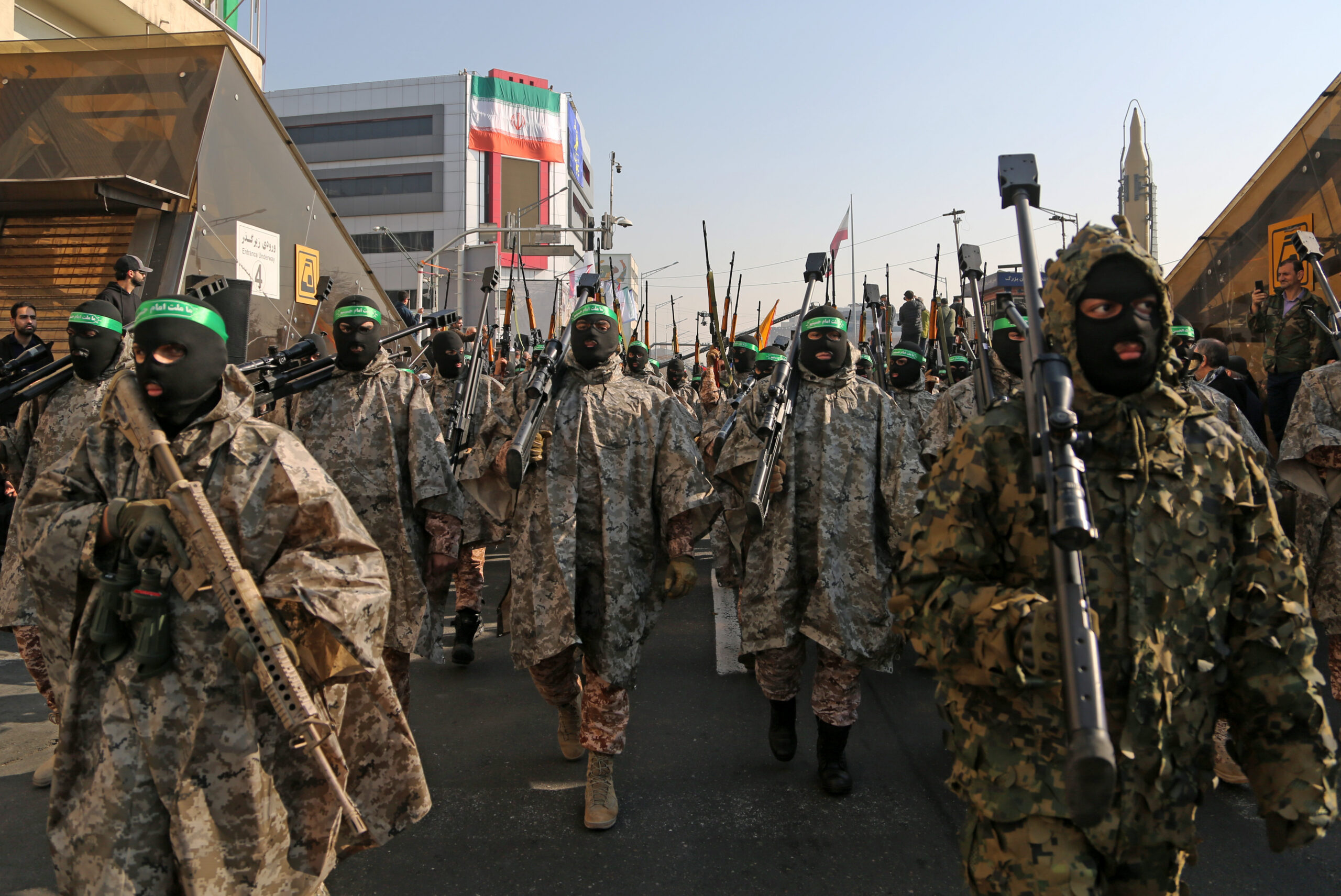
PICTURE | Hundreds of Iraninan carrying banners take part in a demonstration against Israel and the United States as they march through Enghelab Street in capital city Tehran, Iran on January 10, 2025. (Photo by Fatemeh Bahrami/Anadolu via Getty Images)