

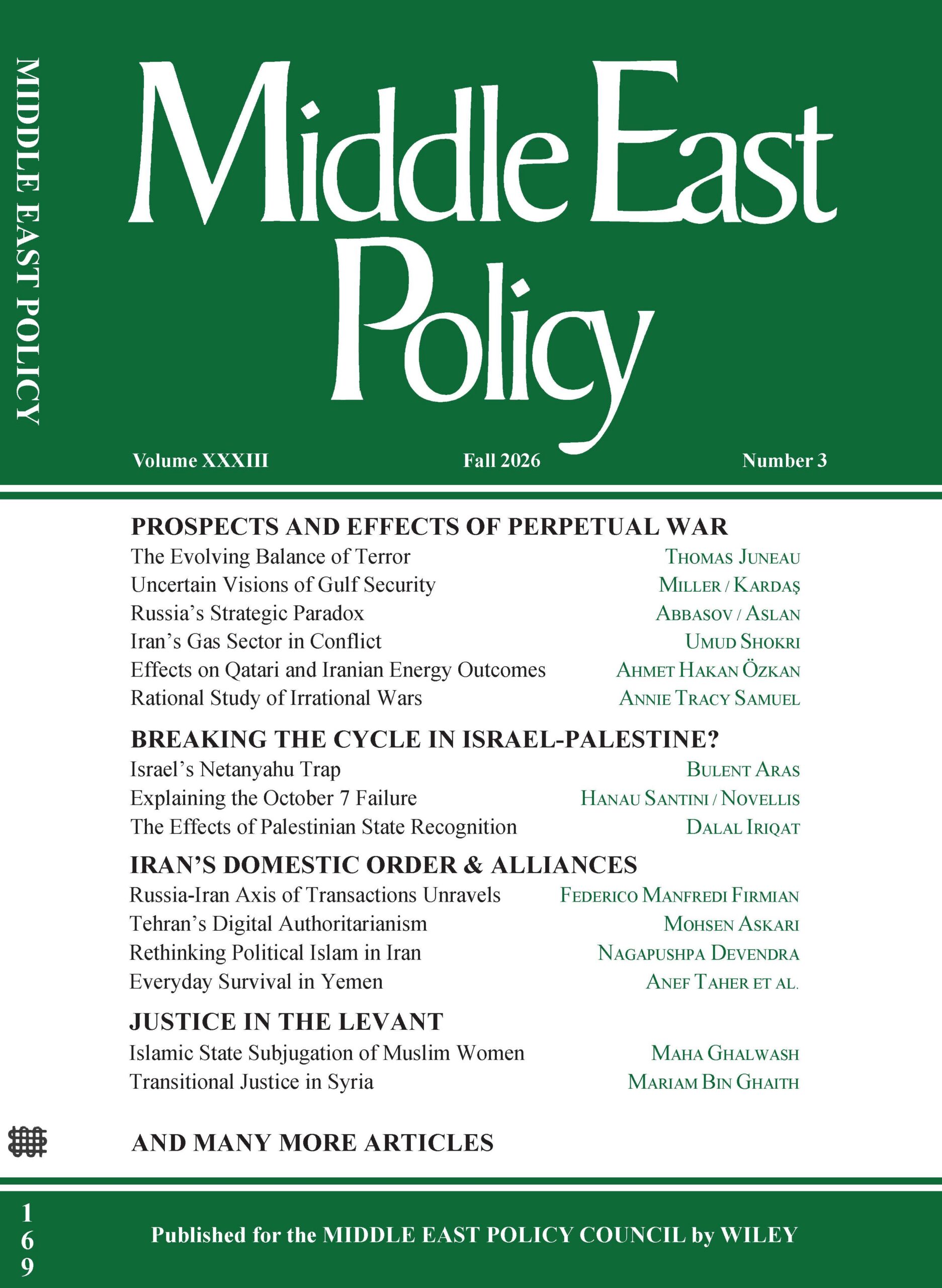

As the Iran War expands toward the Red Sea, Middle East Policy announces its new double issue, featuring 23 studies of regional conflict and social and political developments; more than half of the articles are free to read, even without a subscription. The pieces examine how the Iran War is affecting calculations about the Gulf’s security and economic order, US interests and sources of power, and the Islamic Republic’s economic and domestic strengths and weaknesses, as well as Israeli leadership and global recognition of Palestine, justice in the Levant, and Turkey’s challenges inside and out.
The table of contents of our Fall 2026 installment is below. Readers can still access our special publication on the origins of the Iran War as well as our double summer issue. If you find this article useful, please forward it to others you believe will benefit. You can register to receive our weekly updates here. And please follow us on the social media platforms X and LinkedIn.
The new issue of Middle East Policy kicks off with Thomas Juneau’s analysis of how the Iran War has eroded American and Israeli strategic advantages and restored what he terms the “balance of terror” in the region. “Overwhelming American and Israeli firepower could not defeat Iran in the first half of 2026,” Juneau writes, “and continued limited attacks on Iran will fail to do more than tinker with the new order: destroying a few additional missile launchers or IRGC boats will not remove the Islamic Republic’s ability to close the Strait of Hormuz.” The University of Ottawa scholar lays out his prescription for how Washington can compensate for its strategic blunder.
Regardless of the chaos and uncertainty in the Gulf, Rory Miller and Şaban Kardaş argue, the GCC states’ reliance on the United States remains the worst regional security system—aside from all the others. “Despite the crisis precipitated by the Iran War,” they assert, “the structural obstacles that historically prevented the emergence of an autonomous Gulf security and defense arrangement remain largely intact.” Although key states such as Saudi Arabia are seeking alternatives, Miller and Kardaş examine the history of such moves and find substantial obstacles to creating both the capacity and trust required to reduce US influence.
In further analyses of the war, the new issue examines both the opportunities and risks for Russia, whose support for the Islamic Republic has proved to be mostly transactional. Other articles explore Tehran’s imposition of domestic order through digital authoritarianism, and how political Islam in Iran is continually reshaped through competition among hard-line authorities, reformers, and everyday practitioners.
As Benjamin Netanyahu struggles to hold power in the fall elections, the journal turns to the Israeli prime minister’s manufacture of external threats, as well as his government’s creation of an environment in which the threat from Hamas was played down before the October 7 attacks. And it explains the importance of global recognition of the Palestinian state, even while the illegal Israeli occupation persists.
The balance of the fall journal illuminates the quest for justice and reconciliation in post-Assad Syria after the horrors of the civil war; the Islamic State’s subjugation of Muslim women; and Turkey’s torturous peace process with Kurdish rebels, narrowly defined but robust commitment to NATO, and relations with key states in the Gulf and the Horn of Africa.
Middle East Policy, Fall 2026—Double Issue!
PROSPECTS AND EFFECTS OF PERPETUAL WAR
Open access!
The Stability-Instability Paradox and the Evolving Balance of Terror in the Middle East
Thomas Juneau
Open access!
Visions of Gulf Security in an Era of Uncertainty: Between External Alignment and Regional Autonomy
Rory Miller | Şaban Kardaş
Open access!
Russia’s Strategic Paradox: Short-Term Gains, Long-Term Risks from the Iran War
Namig Abbasov | Emil S. Aslan
Open access!
Iran’s Gas Sector in Conflict: Infrastructure Vulnerability & Market Implications
Umud Shokri
Open access!
Qatar and Iran: Market Access Under Geopolitical Conflict
Ahmet Hakan Özkan
The Scholar’s Dilemma: Rational Study of Irrational Wars
Annie Tracy Samuel
BREAKING THE CYCLE IN ISRAEL-PALESTINE?
Open access!
Israel’s Netanyahu Trap
Bulent Aras
Paradigm Lock-In and Strategic Surprise: Explaining Israel’s October 7 Intelligence Failure
Ruth Hanau Santini | Andrea Novellis
Beyond Symbolism: The Effects of Palestinian State Recognition
Dalal Iriqat
IRAN’S DOMESTIC ORDER & ALLIANCES
Russia and Iran: The Axis of Transactions Unraveled
Federico Manfredi Firmian
Open access!
Iran’s Revolutionary Situation and Digital Authoritarianism: 1979 vs. 2026
Mohsen Askari
Open access!
Rethinking Political Islam in Iran: Contestation, Authority, and Reform
Nagapushpa Devendra
Social Perceptions in Yemen: Fragmented Power and Everyday Survival
Anef Taher | Ahmed Alduais | Muhammed Al Khayyatt
JUSTICE AND RIVALRY IN THE LEVANT
Islamic State and the Subjugation of Muslim Women
Maha Ghalwash
Transitional Justice in Syria: Prosecuting Bashar al-Assad and Senior Leaders
Mariam Bin Ghaith
GEOPOLITICAL AND ECONOMIC SHIFTS
The Reconfiguration of Sunni Alignments: A Multi-Track Theory
Ahmed Khalfa
Open access!
Gulf Energy Transition: The UAE and Saudi Arabia
Ahmet Hakan Özkan
Saudi Arabia’s Economic Diversification and Geopolitical Risk
Osama D. Sweidan
TURKISH PERCEPTIONS OF THREAT
The Torturous Turkey-PKK Peace Process
Michael M. Gunter
Open access!
Strategic and Discursive Shifts in Türkiye’s Perceptions of NATO, 1952–2020
Melih Nadi Tutan
ANKARA’S REGIONAL PARTNERSHIPS
Open access!
From Competition to Compartmentalization: Rethinking Türkiye-Gulf Relations
Betul Dogan-Akkas
Open access!
Foreign Aid as Statecraft: Muslim Donors in the Horn of Africa
Yunus Turhan
Open access!
The Türkiye-Qatar Partnership: From Ottoman Roots to Strategic Alliance
Ismail Köse | Fatma Alghussein
BOOK REVIEWS
The Wretched of the Earth: Rashid Khalidi, Omer Bartov, and the Palestinian Tragedy
Review essay by Mohammed Ayoob
Cheterian, The 44-Day War: Armenia, Azerbaijan, and the Struggle for Nagorno-Karabakh
Reviewed by M. Hakan Yavuz
Manfredi Firmian, War in Syria and the Middle East: A Political and Economic History
Reviewed by Bahram P. Kalviri
Strand, Israel and the Gaza Strip since 1967: A History of Occupation, Domination and Unilateralism
Reviewed by Abdulgani Bozkurt
Walter, Contested City: Citizen Advocacy and Survival in Modern Baghdad
Reviewed by Yasir Kuoti
Knudsen and Tobin, Urban Displacement: Syria’s Refugees in the Middle East
Reviewed by Zubair Hussain
Faghih et al., The Persian Gulf: Historical Perspectives, Maritime Silk Road, and Hydropolitics
Reviewed by Ahmed Bux Jamali
Harmon et al., A Daring Enterprise: A US-Egyptian Partnership and the Case for Soft Power
Reviewed by Robert Springborg
Ahmad, Trajectories of Extremism: Child and Youth Radicalization and Recruitment in the Shadow of ISIS
Reviewed by Usman Anwar and Muhammad Atif