

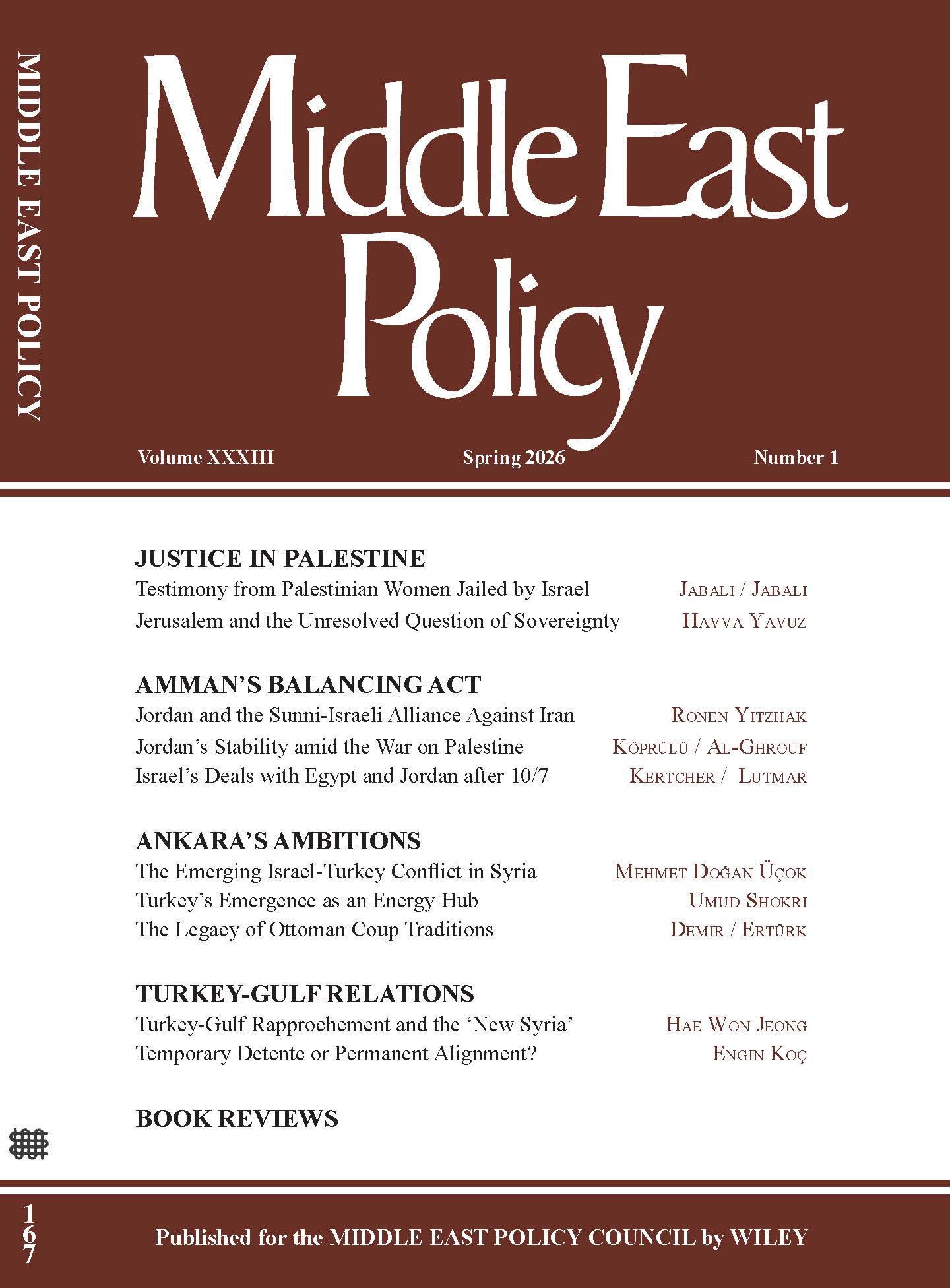

As President Donald Trump blinks and Tehran claims victory over the United States and Israel—while 90 million Iranians face economic collapse—Middle East Policy announces its Spring 2026 journal. The 167th issue covers vital regional issues, including the treatment of Palestinian women in the Israeli carceral system; the potential for justice in East Jerusalem; the perils of Jordan’s position between Israel and Iran; and Turkey’s geopolitical and geoeconomic opportunities amid a shifting order. Four articles are free to read, even for those without a subscription.
Readers can still access our free special issue, Washington’s War on Iran, featuring 14 analyses of the conflict, including Tehran’s response to the June 2025 war, the voices of protesters against the Islamic Republic, and parallels with the 2003 Iraq invasion, especially the groupthink that produced the American folly. If you find this article informative, please forward it to others you believe will benefit; register to receive our weekly updates here. And please follow us on the social media platforms X and LinkedIn.
The new issue kicks off with an examination of the Israeli carceral system. Oqab Jabali and Saqer Jabali’s interviews with 50 formerly imprisoned Palestinian women reveal beatings, strip searches, solitary confinement, and denial of medical care, often in overcrowded, unsanitary conditions with little access to legal support. The authors call for global action to ensure accountability, protect detainees’ rights, and secure the release of all Palestinian female prisoners. The article is free to read for the next month.
The issue also analyzes another key element of the occupation: Israel’s de facto annexation of East Jerusalem through a legal-administrative architecture. Havva Yavuz explores policy levers that could salvage Palestinian control of this contested area, which is intended to be the capital of a purported future state.
From there, the journal examines Jordan’s tenuous position since the October 7 attacks and Israel’s launch of the ongoing regional wars. In a free-to-read article, Ronen Yitzhak details Amman’s role in creating a Sunni-Israeli alliance against Iran over the two decades following the US removal of Saddam Hussein from power in Iraq. While this provided some benefits to Jordan, it risked the ire of Tehran—and it is unclear how the 2026 war on Iran will affect the Gulf states’ approaches to Israel and the Palestinian question. This section also provides insights into Jordan’s stability since the October 7 attacks, as well as why its peace agreement with Israel did not collapse due to the Gaza war. This latter article is open access.
The journal concludes with two sections on Turkey’s geopolitical and geoeconomic position. Mehmet Doğan Üçok explores the intensifying rivalry between Israel and Turkey, tracing how energy resources, maritime zones, and proxy alignments have evolved into a militarized contest for regional hegemony. Umud Shokri’s open-access analysis puts the energy issue into context, probing Ankara’s three main objectives: enhancing its geopolitical position, expanding its domestic production and renewable energy capacity, and becoming a natural gas hub linking producers from the Middle East, the Caspian region, and Russia to European markets. And Sertif Demir and Yaşar Ertürk investigate how developments during the late Ottoman Empire normalized military coups as instruments of national salvation in the Turkish republic.
The issue concludes with the first installment in a series analyzing Turkey-Gulf relations. Hae Won Jeong examines how Turkey and key Gulf states can collaborate in the rebuilding of post-Assad Syria through a two-pronged division of labor: bolstering Syria’s security sector through expanded partnerships and coordination, and mobilizing Gulf financing and Turkish operational capacity to accelerate reconstruction. Engin Koç makes a much different argument: Turkey has grown closer to the Arab Gulf states due to their shared economic interests, but this entente is likely to be temporary due to their fundamental ideological differences.
You can find other incisive examinations in our free special issue, Washington’s War on Iran, and in The Israel-Iran War, our coverage of the 2025 campaign against the Islamic Republic’s nuclear program. And check out the Middle East Policy Council’s website for insights from its analysts.
Middle East Policy, Spring 2026
JUSTICE IN PALESTINE
‘I Thought I Would Die’:
Testimony from Palestinian Women Jailed by Israel
Oqab Jabali | Saqer Jabali—free to read!
Jerusalem and the Unresolved Question of Sovereignty
Havva Yavuz
AMMAN’S BALANCING ACT
Jordan’s Role in Establishing a Sunni-Israeli Alliance Against Iran
Ronen Yitzhak—free to read!
Jordan’s Stability and Regime Survival amid the War on Palestinians
Nur Köprülü | Fadi Al-Ghrouf
Explaining the Post-October 7 Durability of Israel’s Peace Deals with Egypt and Jordan
Chen Kertcher | Carmela Lutmar—open access!
ANKARA’S AMBITIONS
Regime Change in Syria and the Emerging Israel-Turkey Conflict
Mehmet Doğan Üçok
Geopolitics and Aspirations for Sustainability: Turkey’s Emergence as an Energy Hub
Umud Shokri—open access!
Ottoman Coup Traditions and the Republican Army’s Legacy
Sertif Demir | Yaşar Ertürk
TURKEY-GULF RELATIONS
Geopolitical Rebranding of the ‘New Syria’ amid the Turkey-Gulf Rapprochement
Hae Won Jeong
Turkey’s Relations with Gulf States: Temporary Shift or Permanent Alignment?
Engin Koç
BOOK REVIEW
Gülistan Gürbey et al., Between Diplomacy and Non-Diplomacy: Foreign Relations of Kurdistan-Iraq and Palestine
Reviewed by Hogr Tarkhani
Daniel Drewski and Jürgen Gerhards, Framing Refugees: How the Admission of Refugees is Debated in Six Countries across the World
Reviewed by Emrah Atar
Peter Beinart, Being Jewish After the Destruction of Gaza: A Reckoning; and Omar El Akkad, One Day, Everyone Will Have Always Been Against This
Reviewed by A.R. Joyce