

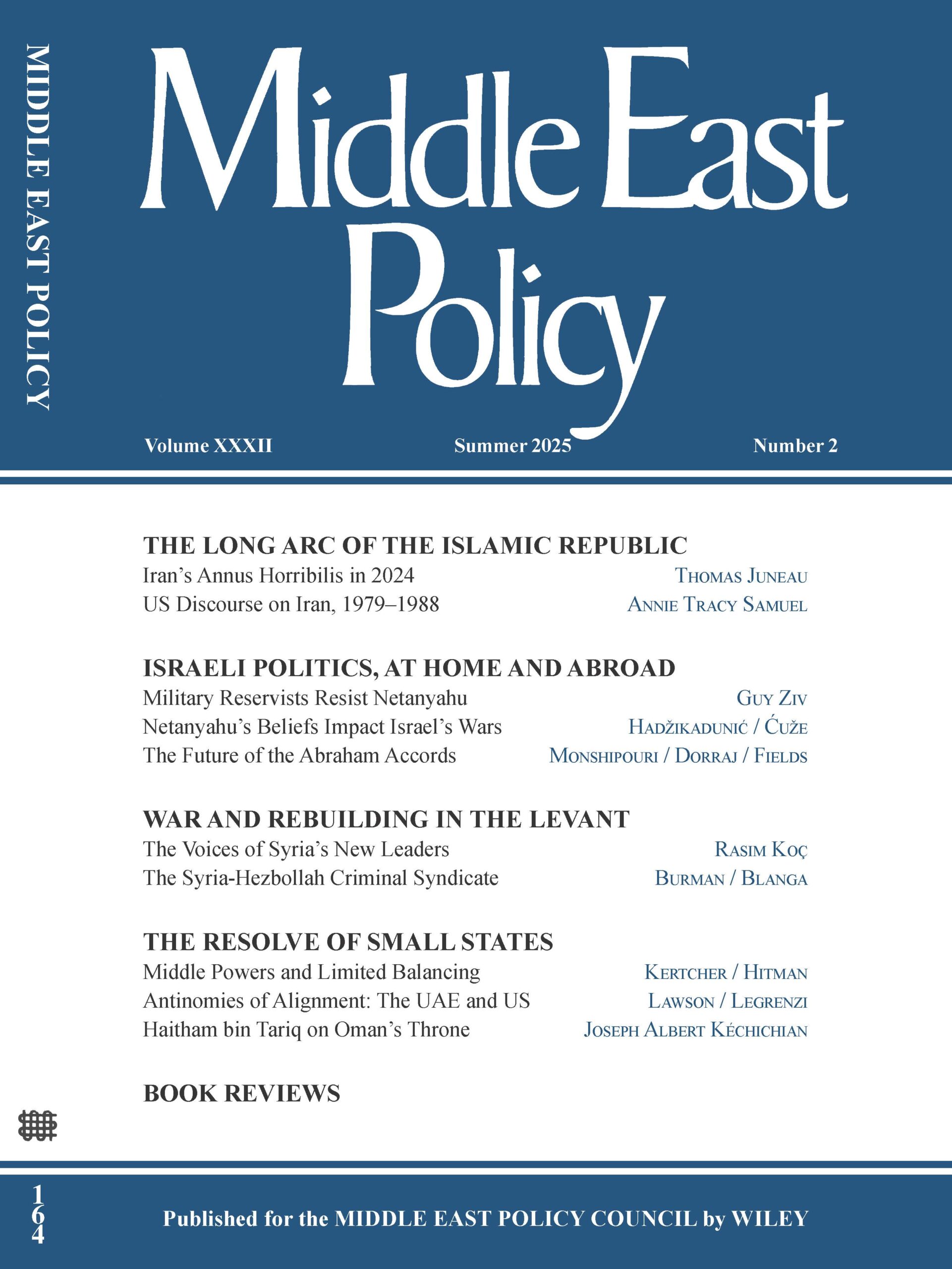

Middle East Policy’s Summer 2025 journal features 10 original articles analyzing Iran’s existential struggle, Syria’s regime change and Hezbollah’s money trail, Netanyahu’s domestic and regional backlash, and the strategies of middle powers. Six pieces and one book review are free to read, even without a subscription.
The new edition is anchored by coverage of Iran, beginning with Thomas Juneau’s open-access analysis of the Islamic Republic’s “annus horribilis” in 2024. Even after the devastating blows to its territory, homeland defense and, most recently, nuclear program, it is too early to assume that Tehran will capitulate to Western demands. “The coming years will undoubtedly see aggressive Iranian efforts to claw back its losses,” Juneau writes.
If there were any doubt that Washington was more likely to take the military than the diplomatic route in June 2025, Annie Tracy Samuel provides historical evidence that the groundwork was laid for US-Iran enmity during the conflicts of the early 1980s. “The narrative constructed by policy makers and the press significantly impacted US-Iran relations, and this established patterns of discourse and action that have persisted to this day,” Tracy Samuel writes. “This process helped solidify the official and popular conception of Iran as a dangerous threat antithetical to US values and interests, necessitating a policy of enmity and confrontation.” Tracy Samuel’s piece is free to read for the next two months.
The journal’s summer issue continues its coverage of Israel’s wars with an examination of Prime Minister Benjamin Netanyahu’s political turmoil at home and military and diplomatic challenges abroad. Guy Ziv analyzes the political power of Israeli reservists, explaining their role in protesting the religiously inspired overhaul of the judiciary before the October 7 attacks. More important, these warfighters have continued to pressure Netanyahu as he rejects Palestinian autonomy and maneuvers to perpetuate his rule. “The reservist rebellion in 2023, as well as the prominence of civil-society leaders with military backgrounds in the 2024–25 anti-government protests, demonstrate the national-security community’s substantial role in fighting for the liberal, democratic values on which Israel was founded,” Ziv writes.
As for the wider region, Emir Hadžikadunić and Marko Ćuže conduct a sweeping analysis of Netanyahu’s speeches over the first year of the war to understand his belief system and how this has affected his approach to retaliation for the October 7 attacks. They find that the Israeli prime minister believes his country is better able to control events and will benefit from an aggressive use of power. More important, perhaps, he perceives that Israel’s enemies are playing a game of chicken and will back down. This article is free to read for the next two months.
This has not led to a cessation of hostilities in Gaza, nor has it made regional normalization with Israel very likely. Mahmood Monshipouri, Manochehr Dorraj, and John Fields argue “that the Gaza war has returned Palestinian statehood to center stage and demonstrated that the Israeli-Palestinian conflict remains a barrier to achieving peace.” The authors show that Netanyahu and his far-right government have not simply bombed Gazans but made an array of moves that major Arab states like Saudi Arabia, which has not yet joined the accords, cannot ignore: pressing for Greater Israel, calling for the annexation of large parts of the occupied territories, and moving deeper into Lebanon and Syria.
Among the other open-access articles in the Summer 2025 issue are Iftah Burman and Yehuda Blanga’s examination of Hezbollah’s criminal enterprise from 1985 to 2005; Chen Kertcher and Gadi Hitman’s explanation of how middle powers like Israel and Syria try to achieve their interests; and Fred H. Lawson and Matteo Legrenzi’s analysis of the shifting relationship of the United States and United Arab Emirates, a dyadic protectorate that has allowed the smaller state to slowly gain confidence in forging its own path.
In addition to the journal’s summer installment, Middle East Policy’s special issue, The Israel-Iran War, continues to be available for free, even for those readers without a subscription. The mix of new and archival articles provides a comprehensive look at how the conflict developed, and how it could have been avoided.
Middle East Policy, Summer 2025
THE LONG ARC OF THE ISLAMIC REPUBLIC
Iran’s Annus Horribilis in 2024: Beaten, but Not Defeated
Thomas Juneau—open access!
Conjuring an Enemy: US Discourse and Policy on Iran, 1979–88
Annie Tracy Samuel—free to read!
ISRAELI POLITICS, AT HOME AND ABROAD
Military Reservists and the Resistance to Netanyahu’s Legal Overhaul
Guy Ziv
The Impact of Benjamin Netanyahu’s Beliefs on Israel’s War against the Axis of Resistance
Emir Hadžikadunić, Marko Ćuže—free to read!
The Gaza War and the Future of the Abraham Accords
Mahmood Monshipouri, Manochehr Dorraj, John Fields
WAR AND REBUILDING IN THE LEVANT
Hayat Tahrir al-Sham: Voices of Syria’s New Leaders
Rasim Koç
Lessons from the Syria-Hezbollah Criminal Syndicate, 1985–2005
Iftah Burman, Yehuda Blanga—open access!
THE RESOLVE OF SMALL STATES
Middle Powers and Limited Balancing: Syria and the Post‐October 7 Wars
Chen Kertcher, Gadi Hitman—open access!
Antinomies of Alignment Redux: The United Arab Emirates and the United States
Fred H. Lawson, Matteo Legrenzi—open access!
The Making of a Ruler: Haitham bin Tariq on the Omani Throne
Joseph Albert Kéchichian
BOOK REVIEWS
Omar Ashour, How ISIS Fights: Military Tactics in Iraq, Syria, Libya and Egypt
Reviewed by Manoug Antaby
Birol Başkan, The Politics of Islam: The Muslim Brothers and the State in the Arab Gulf
Reviewed by Gökhan Çınkara
Mohammad Dawood Sofi, The Tunisian Revolution and Democratic Transition: The Role of al-Nahdah
Reviewed by Mohammad Irfan Shah
Hilmi Ozan Özavcı, Dangerous Gifts: Imperialism, Security, and Civil Wars in the Levant, 1798–1864
Reviewed by Hasim Tekines
Max Boot, Reagan: His Life and Legend
Reviewed by A.R. Joyce—free to read!