


This week, Israel expanded its control over the West Bank, and it sent soldiers to prevent Palestinians from plowing their lands. While global figures, including the American president, warned against the moves, some of the sharpest denunciations came from within Israel, as groups like Peace Now, Emek Shaveh, and Youth Against Settlements condemned de facto annexation. A new Middle East Policy article features interviews with these anti-occupation activists on the front lines, who share their strategies and frustrations as Israel continues to scuttle the prospects for a just solution.
The Winter 2025–26 Middle East Policy features analyses of Washington’s new model for rebuilding failed states (open access); US-Saudi relations in light of China’s increasing influence; the new order in the Red Sea (open access); the roiling Israel-Turkey conflict in Syria; the symbols of Palestinian nationalism (open access); the likelihood of failure in the detente between Turkey and Kurdish nationalists; Ankara’s crackdown on the opposition; and many other issues of vital interest. Also available are our special issues, The Israel-Iran War and The October 7 Emergencies. Please follow us on the social media platforms X, Bluesky, and LinkedIn.
In her article for the current issue of Middle East Policy, Natalya Philippova explores the methods of and challenges faced by civil-society groups operating within an increasingly polarized and hostile environment. In her interviews with more than 40 representatives from Israeli and Palestinian nongovernmental organizations focusing on peace, she finds that they perceive a declining effectiveness of people-to-people initiatives amid growing mutual mistrust and radicalization in society. However, despite government policies and right-wing attacks aimed at sidelining these actors, the author shows that this has actually led them to seek more collaboration across ideological lines.
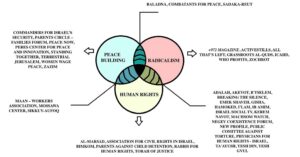
Philippova places the key activist groups operating in Israel and the occupied territories into three categories:
- Peace Building: Organizations that contend that ending the occupation and halting settlement expansion are essential for ensuring Israel’s security, maintaining its status as a Jewish and democratic state, and fostering coexistence between Jews and Palestinians. Their actions typically include organizing demonstrations, publishing reports to promote the “two states for two peoples” solution, hosting cultural and educational activities, and collaborating with Palestinians on trust-building projects.
- Human Rights: Groups within this frame advocate for ending the occupation because it undermines Palestinians’ fundamental rights. Such activists focus on providing legal support, raising awareness about violations of Palestinian rights, and advocating for legal accountability.
- Radicalism: Actors that label Israel as a colonial or apartheid state and its policies as war crimes, demanding sweeping systemic change. Strategies include economic boycotts, promoting the refusal to serve in the Israeli military, and pushing for recognition of the 1948 dispossessions and the Palestinian refugees’ right of return.
These categories are not mutually exclusive. Philippova provides a Venn diagram showing where the groups fit into one basic category or a mixture of two:
Philippova’s interviewees air their frustrations over the decline of a once-promising Oslo process and enumerate the challenges they face from the increasingly right-wing Israeli society and its elected government. But in their determination to fight for justice, they also indicate the areas where they have continued to be effective.
Some activists contend that the Oslo peace process was doomed from the start or was not intended to result in a two-state solution. But even those who believe that it was ever viable acknowledge that there is little potential for an internationally backed negotiation between equal partners aiming to live side by side. “If you go to a 20-year-old today who wasn’t even born when Oslo was signed and you ask them, ‘What do you think about a two-state solution?’ they’re incredibly skeptical,” laments one peace builder. “Partly that’s because they haven’t seen any real breakthrough in the negotiation process since then.”
Many respondents describe the decreasing space for peace activism over the last decade, worsened by a shift to the right and a government obstructing NGOs if not outlawing key aspects of their work. Israeli nationalists have doxed groups and their members. Organizers say they have little recourse to defend their freedom of assembly or prevent impositions on their fundraising. According to one peace advocate reflecting on the difficulties of staging public events:
There are always [right-wing] professional provocateurs. Now the police are fully and openly on their side. They are constantly trying to pass various bills that would prevent us from working. For example, a year and a half ago they tried to pass a bill, according to which donations from foreign sources will be taxed at 60 percent. But although no law forbids it, when donations come in, we have to negotiate with the bank for several weeks to get the money. They ask for documents that no one has ever asked for before.
Philippova’s interviews and analysis document how government and right-wing agents have made activists’ work more difficult. Indeed, the target audiences for many of these groups are not Israelis but sympathetic international actors.
Still, since the beginning of the Gaza war, these groups have pressed ahead with their missions, she shows:
Bassam Aramin and Rami Elhanan, a Palestinian and an Israeli, each of whom lost a daughter decades before October 7, have been speaking to young people about the conflict through their work with Parents Circle-Families Forum….Breaking the Silence, an NGO founded by veterans of the Israel Defense Forces (IDF), collects firsthand accounts from soldiers and officers detailing violations of Palestinian rights and the human cost of the occupation….HaMoked, which stands at the intersection of human rights and radicalism, reports that requests from Palestinian families to find loved ones held by Israeli authorities quadrupled between the start of the Gaza war and the end of 2024.
In this vitally important analysis, Philippova finds a split between two sets of activists. “Palestinian respondents,” she writes, “remained pessimistic about peace.” Israeli interviewees were more determined, believing that they were preventing a much bigger slide into war and injustice. “You still have somewhere between 30 and 40 percent of the Israeli population and somewhere between 30 and 50 percent of the Palestinian population saying that they prefer the two-state solution over any other option,” noted one advocate. “I don’t know what you call that, except credit to the peace camp.”
Middle East Policy, Winter 2025
THE REGIONAL REORDERING
From Rebuilding to Restoring Political Order: A New Agenda for Failed Arab States
Guilain Denoeux | Robert Springborg—open access!
Saudi Arabia’s US-China Hedging Strategy and Its Regional Impact
Xiaoyu Wang | Salman K. Al-Dhafeeire | Degang Sun
Maritime Disruption in Yemen: The Making of a Hybrid Red Sea Order
Federico Donelli—open access!
The Struggle for Syria: Strategic Rivalry and the Risks of Escalation
Buğra Sari | Avnihan Kirişik
THE STRUGGLE FOR PALESTINE
The Israeli Peace Movement in a Time of Crisis
Natalya Philippova—free to read!
The Role of Postage Stamps in Palestinian National Identity and History
Ido Zelkovitz | Yehiel Limor—open access!
TURKISH NATIONALISM AND DOMESTIC POLITICS
Why the New Turkey-PKK Peace Process Is Likely to Fail
Michael M. Gunter
Turkey’s March 19 Protests: An End to Competitive Authoritarianism?
Göktürk Tüysüzoğlu
Athlete Queens of Modern Turkey: Beauty Pageants and Modernization
Muhammet Nurullah Çakmak
Countering Extremism in Iraq: The Influence of Ali Sistani
Hogr Tarkhani | Isaac Andakian
BOOK REVIEWS
Sareta Ashraph, Carmen Cheung Ka-Man, and Joana Cook, Holding ISIL Accountable: Prosecuting Crimes in Iraq and Syria
Reviewed by Usman Anwar | Muhammad Atif
Samer Bakkour, The End of the Middle East Peace Process: The Failure of US Diplomacy
Reviewed by Hamdullah Baycar