

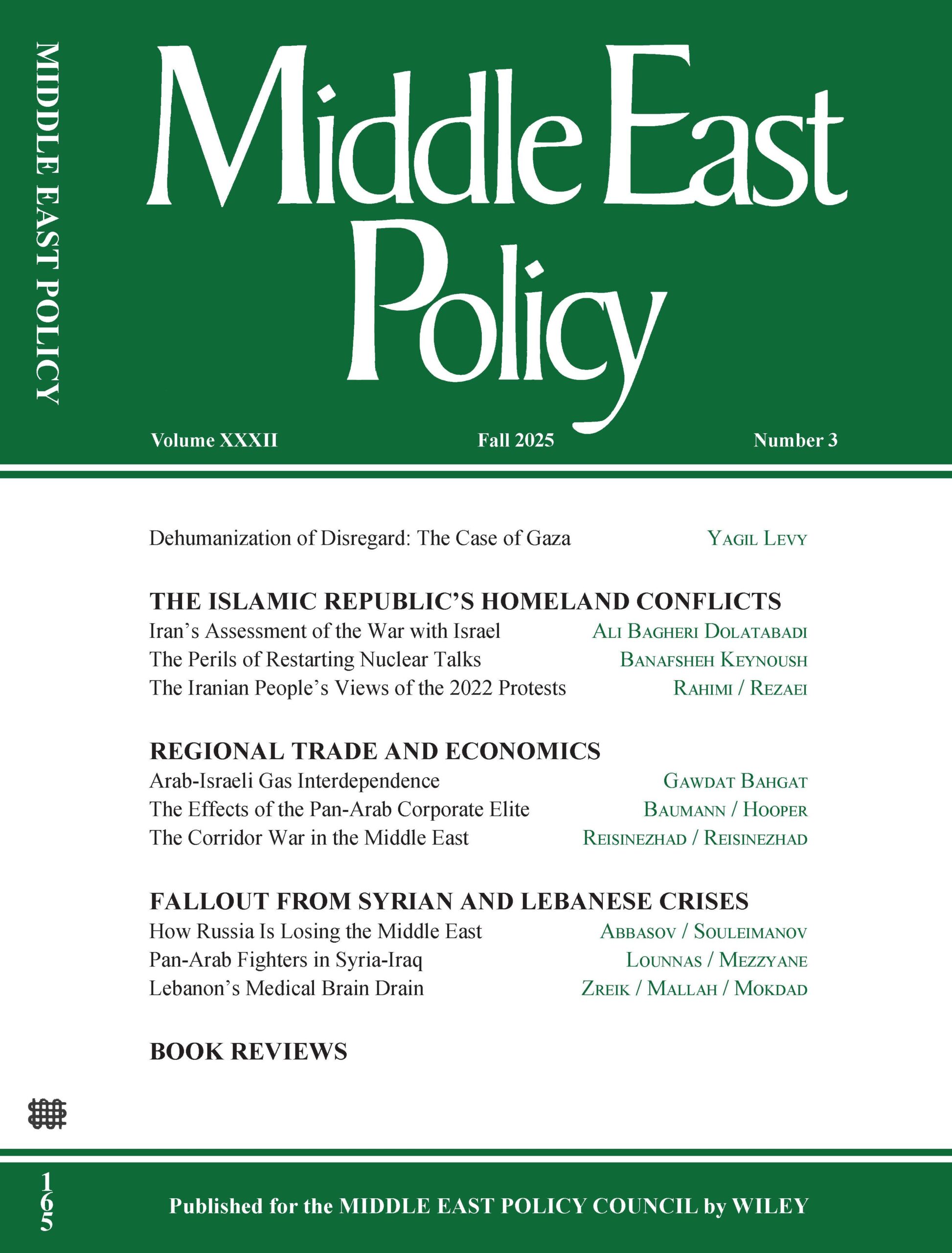

Middle East Policy is proud to announce an Early View of the Fall 2025 journal. The 165th issue in its catalogue analyzes dehumanization in the Gaza war, how Israel’s June bombings have set back both the nuclear infrastructure and international diplomacy, regional integration through trade and the capitalist class, and the effects of crises in Lebanon and Syria on a range of actors, from Russia to Arab nationalists to medical professionals. Four of the original articles are open access.
As the journal prepares to launch its fall issue, there is still time to check out our special issue on the Israel-Iran War, featuring 14 original articles and four book reviews—all free to read for a limited time. If you find our information useful, please forward to others you believe will benefit, and please follow us on the social media sites X, Bluesky, and LinkedIn.
Our fall issue leads with Yagil Levy’s open-access interrogation of the affliction driving the war in Gaza: “the dehumanization of disregard.” This has not simply affected the post-October 7 campaign but has been endemic to the state’s assumptions about Arabs since its founding:
Israeli attitudes toward the Gazan population reflect a passive form of dehumanization, characterized by indifference and neglect. This form of dehumanization, which refuses to acknowledge the population, effectively overlooks Gazans’ ability to make a difference by challenging the indirect Israeli control over them and their territory.
From there, we cover how Iran is dealing with the June war and its own domestic discontent. Ali Bagheri Dolatabadi synthesizes the latest reports from the country, supplemented by his own interviews with Iranian officials, to assess the damage to nuclear capabilities and what Tehran has learned. “Officials are acutely aware of the military asymmetry between Iran and Israel, recognizing weaknesses in the air force, limited access to satellite intelligence, outdated and unsophisticated equipment, and the absence of a powerful strategic ally,” he writes. “Consequently, they aim to respond to Israeli military actions with precision, calculation, and restraint.”
As for the legacy of the Woman, Life, Freedom protests, Rauf Rahimi and Sajjad Rezaei discuss with Iranians the sources of their discontent and how they view “violations of privacy and repression of rights.”
The fall journal includes three other open-access pieces: Banafsheh Keynoush’s analysis of the future of Iran nuclear talks; Hannes Baumann and Alice Hooper’s tracing of a pan-Arab corporate elite through the network of transnational interlocking directorships; and Namig Abbasov and Emil A. Souleimanov’s examination of how the new regime in Syria signals the marginalization of Russia in regional geopolitics.
Finally, we examine how trade, war, and social collapse create crises and opportunities. Gawdat Bahgat finds hope for a softening of conflicts through interdependence stemming from major natural gas discoveries in the eastern Mediterranean. However, Arash Reisinezhad and Arsham Reisinezhad see the region’s sometimes intersecting economic corridors—from China’s Belt and Road Initiative to the Development Road and the India-Middle East-Europe Economic Corridor—as potentially sparking conflicts due to “competition over strategic control of these routes.” The issue finishes with pieces interviewing Arab nationalists who volunteered to defend the Assad regime against the threat from Islamists, as well as medical professionals in Lebanon feeling strains from the economic crisis.
Middle East Policy, Fall 2025 Early View
Dehumanization of Disregard: The Case of Gaza
Yagil Levy—open access!
THE ISLAMIC REPUBLIC’S HOMELAND CONFLICTS
The June 2025 Israeli War: Iran’s Assessment and Regional Consequences
Ali Bagheri Dolatabadi—free to read!
The Perils of Nuclear Talks after the US-Israel War on Iran
Banafsheh Keynoush—open access!
The 2022 Iran Protests: The View from the Streets
Rauf Rahimi | Sajjad Rezaei
EFFECTS OF REGIONAL TRADE AND ECONOMICS
Arab-Israeli Gas Diplomacy: Interdependence and a Path Toward Peace?
Gawdat Bahgat
The Development and Political Effects of a Pan-Arab Corporate Elite
Hannes Baumann | Alice Hooper—open access!
The Corridor War in the Middle East
Arash Reisinezhad | Arsham Reisinezhad
FALLOUT FROM SYRIAN AND LEBANESE CRISES
After Assad: How Russia Is Losing the Middle East
Namig Abbasov | Emil A. Souleimanov—open access!
Forgotten Fighters in Their Own Words: Pan-Arab Volunteers in Syria-Iraq
Djallil Lounnas | Israa Mezzyane
The Factors Driving Lebanon’s Medical Brain Drain
Mohamad Zreik | Houssein Mallah | Mohamad Mokdad
BOOK REVIEWS
Javad Heiran-Nia, Iran and the Security Order in the Persian Gulf
Reviewed by Mahmood Monshipouri
Rob Geist Pinfold, Understanding Territorial Withdrawal: Israeli Occupations and Exits
Reviewed by Nathaniel Shils
Steffen Hertog, Locked Out of Development: Insiders and Outsiders in Arab Capitalism
Reviewed by Ahalla Tsauro
Gilbert Achcar, Gaza Catastrophe: The Genocide in World-Historical Perspective; and Erik Skare, Road to October 7: A Brief History of Palestinian Islamism
Reviewed by A.R. Joyce