

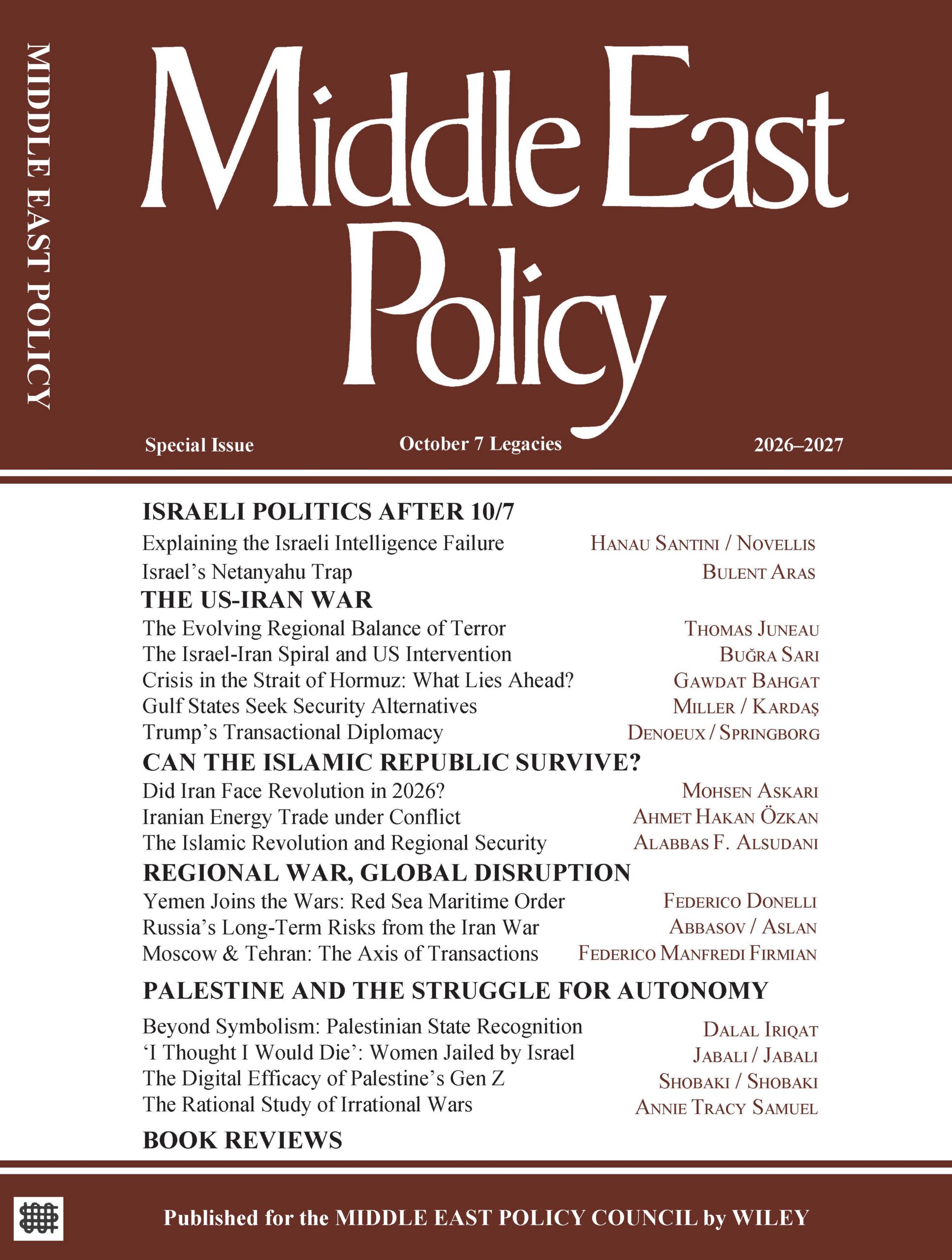

On October 7, 2023, Hamas stormed Israel across multiple breaches in a supposedly impassable barrier, killed nearly 1,200 people, seized 251 hostages—and sparked a conflagration that has only grown more intense. Middle East Policy announces a special issue marking three years since the attacks, featuring investigations of Israeli politics ahead of the late October elections, the regional and global crises triggered by the Iran War, and the Palestinian struggle for autonomy. Fifteen of the 17 articles are outside our paywall and free to read.
Also available is our new Fall 2026 double issue, featuring incisive analyses of regional developments, as well as our special issue commemorating a quarter century since the 9/11 attacks. If you find this article useful, please forward it to others you believe will benefit. You can register to receive our weekly updates here. And please follow us on the social media platforms X and LinkedIn.
Middle East Policy’s new special issue, October 7 Legacies: Regional War, Global Crisis, opens with deep dives into Israeli Prime Minister Benjamin Netanyahu, who faces election for the first time since the launch of the Gaza war—which has claimed the lives of more than 74,000 Palestinians and continues today despite a ceasefire agreement. Ruth Hanau Santini and Andrea Novellis demonstrate how Netanyahu, who had for years played down the threat from Hamas, institutionalized his bias, which shaped how military and intelligence officials misinterpreted warning signs before October 7. “The governing frame penetrated the Israeli bureaucracy through routinized incentives, prioritization rules, and technology choices that compressed interpretive diversity,” Hanau Santini and Novellis explain. This process “fostered a climate of groupthink and self-censorship.”
Bulent Aras, in his contribution to the new special issue, shows how Netanyahu has inflated the perils facing Israel, especially from Iran, affecting both public discourse and military planning. Aras’s analysis of a decade of Netanyahu’s speeches and Israeli military actions finds an approximately 24-month lag between peaks in executive threat inflation and subsequent military escalation. “The peaks of executive hostility occurred during the 2023 judicial overhaul and the post-October 7 coalition crisis of early 2024,” Aras writes. “Roughly two years later, the state was in a multifront war with Iran.”
October 7 Legacies therefore probes the Iran War’s causes and disruptions. Thomas Juneau argues that the United States and Israel squandered a brief shift of the regional order in their favor, as their attacks have restored a balance of terror that had existed before the Hamas attacks. Buğra Sari urges Washington to change the incentives that are leading to greater spirals of enmity between Israel and the Islamic Republic, and Guilain Denoeux and Robert Springborg assess President Donald Trump’s transactionalism against the confrontation with Iran and its ill effects. Rory Miller and Şaban Kardaş explore the few options available to Gulf states seeking to bolster their security regimes as the US umbrella malfunctions, and Gawdat Bahgat examines the limited potential of alternatives to the Strait of Hormuz.
From there, the special issue tackles the strengths and weaknesses of Iran’s internal order, the global disruptions of the post-October 7 conflicts, and how Palestinians and world capitals are seeking to advance the cause of sovereignty and dignity in the occupied territories.
Annie Tracy Samuel concludes the volume with a personal story of surviving Iranian retaliation against Israel for the June 2025 attacks and trying to grapple with how to conduct rational studies of irrational wars:
Perhaps more than anything, what living through a war against Iran has reinforced is that the logic so central to scholarship must take account of the pervasive illogic of lived experience. Analysts must be reasoned and dispassionate. We must carefully and rationally interrogate the world with all of its contingency and complexity. Our scholarship requires that we hold ourselves to a standard to which the actors we analyze hardly ever aspire, let alone meet. That is a strength, not a weakness. While we cannot understand reality without acknowledging what is, we cannot critically assess it or draw out meaning without some sense of what should be.
October 7 Legacies: Regional War, Global Crisis
A Middle East Policy Special Issue
ISRAELI POLITICS AFTER 10/7
Free to read!
Paradigm Lock-In and Strategic Surprise: Explaining Israel’s October 7 Intelligence Failure
Ruth Hanau Santini | Andrea Novellis
Open access!
Israel’s Netanyahu Trap
Bulent Aras
THE US-IRAN WAR
Open access!
The Stability-Instability Paradox and the Evolving Balance of Terror in the Middle East
Thomas Juneau
Open access!
Signals, Red Lines, and Collision: The Israel-Iran Spiral and US Intervention
Buğra Sari
Crisis in the Strait of Hormuz: What Lies Ahead?
Gawdat Bahgat
Open access!
Visions of Gulf Security in an Era of Uncertainty: Between External Alignment and Regional Autonomy
Rory Miller | Şaban Kardaş
Open access!
Trump’s Transactional Diplomacy: Breakthrough or Breakdown?
Guilain Denoeux | Robert Springborg
CAN THE ISLAMIC REPUBLIC SURVIVE?
Open access!
Iran’s Revolutionary Situation and Digital Authoritarianism: 1979 vs. 2026
Mohsen Askari
Open access!
Qatar and Iran: Market Access Under Geopolitical Conflict
Ahmet Hakan Özkan
Open access!
Between Ideology and Strategy: The Iranian Revolution and the Reconfiguration of Middle Eastern Security
Alabbas F. Alsudani
REGIONAL WAR, GLOBAL DISRUPTION
Open access!
Maritime Disruption in Yemen: The Making of a Hybrid Red Sea Order
Federico Donelli
Open access!
Russia’s Strategic Paradox: Short-Term Gains, Long-Term Risks from the Iran War
Namig Abbasov | Emil S. Aslan
Free to read!
Russia and Iran: The Axis of Transactions Unraveled
Federico Manfredi Firmian
PALESTINE AND THE STRUGGLE FOR AUTONOMY
Free to read!
Beyond Symbolism: The Effects of Palestinian State Recognition
Dalal Iriqat
Free to read!
‘I Thought I Would Die’: Testimony from Palestinian Women Jailed by Israel
Oqab Jabali | Saqer Jabali
New Political Actors in Palestine: The Digital Efficacy of Gen Z
Abdalraheem S.H. Shobaki | Mahmoud S.H. Shobaki
Free to read!
The Scholar’s Dilemma: Rational Study of Irrational Wars
Annie Tracy Samuel
BOOK REVIEWS
The Wretched of the Earth: Rashid Khalidi, Omer Bartov, and the Palestinian Tragedy
Review essay by Mohammed Ayoob
Beinart, Being Jewish After the Destruction of Gaza; El Akkad, One Day, Everyone Will Have Always Been Against This
Reviewed by A.R. Joyce
Azizi, The Axis of Resistance
Reviewed by Mahmood Monshipouri
Lynch, America’s Middle East
Reviewed by Yasir Kuoti
Strand, Israel and the Gaza Strip since 1967
Reviewed by Abdulgani Bozkurt
Manfredi Firmian, War in Syria and the Middle East
Reviewed by Bahram P. Kalviri
Donelli, Power Competition in the Red Sea
Reviewed by Riccardo Gasco
Haberman and Swan, Regime Change
Review essay by A.R. Joyce