


At 8:46 am on September 11, 2001, American Airlines flight 11 crashed into the North Tower of the World Trade Center in New York. Just more than 15 minutes later, as Americans tuned in to see rescue crews rushing to the scene, a second plane struck the South Tower, and other hijacked airliners attacked the Pentagon and aimed at the heart of the US government—the latter foiled by heroic passengers. By 10:28 am, both trade center behemoths had collapsed into clouds of debris. With nearly 3,000 people killed, the United States had suffered the deadliest foreign attack on its home soil—and the post-Cold War order was catapulted into a new era: the war on terror.
This special issue presents Middle East Policy’s coverage of the September 11 assault and its aftermath, from analyses by practitioners and scholars envisioning a path forward, to the roots and development of Islamist violence against the West, to the misjudgments and traps of President George W. Bush’s war on terrorism. Examining the origins of 9/11 and the world it created, this collection provides crucial context for the ongoing conflicts in Palestine and Iran, as well as the prospects for American regional and global influence.
We begin with the shock of the attacks and real-time visions of how the United States should respond. John O. Voll underscores the role of “sentiment pools,” groups of Muslims who share grievances and can be linked into al-Qaeda. Alan Richards concurs that such movements enjoyed sympathy in the Muslim world and must be combated by those closest to it, though Americans need to better understand the political and social bases for this support. Julia Nanay laments Washington’s decades-long focus on economic interests without efforts to comprehend the complex forces in the region, while Ian S. Lustick urges attention to issues that are not peripheral but vital to a “victory,” such as resolving the Palestinian struggle for self-determination. William B. Quandt, who participated in the Camp David accords between Israel and Egypt, urges a broad diplomatic agenda and not simply a long war of military, police, and intelligence actions.
The special issue then tackles the larger implications of 9/11: the roots of Islamist terrorism, recruitment and financing around the region, and al-Qaeda’s justification for killing in the name of Islam. Glenn E. Robinson traces four distinct waves of global jihad since 1979, evolving from a campaign to liberate Muslim lands into al-Qaeda’s war against the United States, ISIS’s territorial project, and decentralized “personal jihad.” Jed Lea-Henry examines Abdullah Azzam’s role in creating the ideological foundations of al-Qaeda; Anne M. Lesch sees Osama bin Laden’s turn against the United States as emerging from American actions in the region; and Quintan Wiktorowicz and John Kaltner explore the debates among Islamic fundamentalists over the uses of violence. We also take a look at the nuts and bolts of this phase of global terrorism: the recruitment of suicide bombers; the financial tools used to evade US detection; and the routes toward radicalization in Saudi Arabia.
Most important, the special issue analyzes the war on terrorism, the roads not taken in response to the 9/11 attacks, and whether and how the United States trapped itself through its strategy. Anthony H. Cordesman explores a fundamentally different approach that would downplay military action and seek to engage Muslim states politically and socially. Stephen Van Evera, comparing the American post-9/11 efforts to the forgotten lessons of World War II, castigates the Bush administration for actions far afield from international terrorism: invading Iraq and implementing “hostile policies” toward states like Iran and Syria, while engaging in “a diversion from fighting al-Qaeda, the main threat.” James A. Russell sees this as unleashing regional forces that threatened prolonged instability, and Brynjar Lia criticizes the campaigns for laying “the groundwork for a jihadi recruitment bonanza.” Although many accused the Bush administration of seeking to advance Israel’s interests through its regime-change wars, Ari Barbalat contends that US foreign policy actually bears a “great degree” of responsibility for “the radical deterioration of Israel’s external environment in the Middle East.”
The special issue concludes with a debate over the purpose of the terror war. Ian S. Lustick contends that the Bush administration never saw the threat to the US homeland after 9/11 as immediate or vital. “We are trapped in fighting an unwinnable and essentially nonsensical ‘War on Terror’ because its invention was required in order to fight in Iraq,” he argues. Lustick shows that officials from the White House to the Pentagon had spent a decade after the Persian Gulf War seeking to transform American foreign policy “toward global hegemony and military unilateralism.” Experts Edward Luttwak and Ivan Eland, and former National Security Council official Rand Beers, engage with Lustick’s provocative argument.
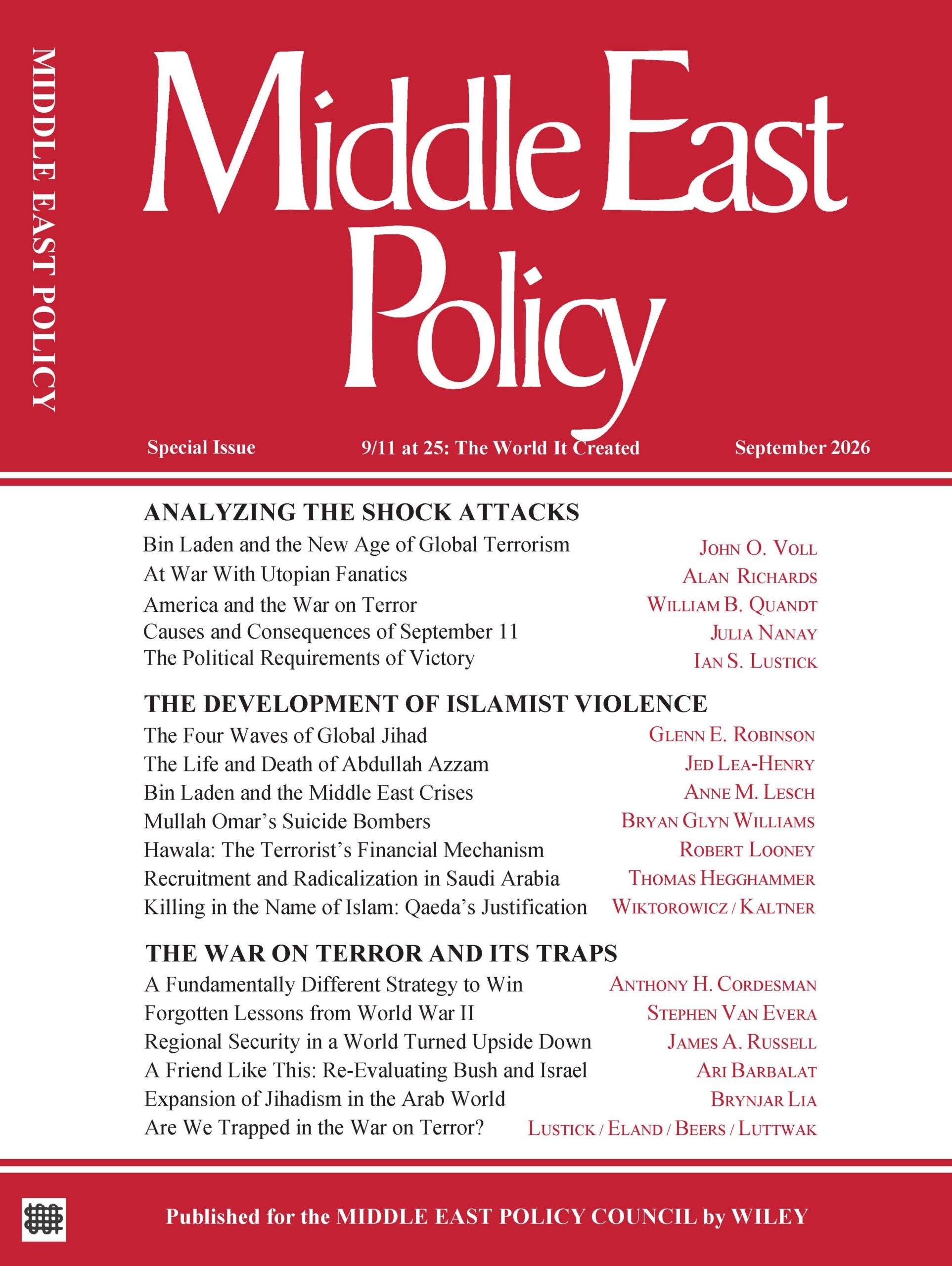
9/11 at 25: The World It Created
A Middle East Policy Special Issue
ANALYZING THE SHOCK ATTACKS
Bin Laden and the New Age of Global Terrorism
John O. Voll
At War With Utopian Fanatics
Alan Richards
America and the War on Terror
William B. Quandt
New Friends, New Enemies and Oil Politics: Causes and Consequences of the September 11 Terrorist Attacks
Julia Nanay
The Political Requirements of Victory
Ian S. Lustick
THE DEVELOPMENT OF ISLAMIST VIOLENCE
The Four Waves of Global Jihad, 1979–2017
Glenn E. Robinson
The Life and Death of Abdullah Azzam
Jed Lea-Henry
Osama bin Laden: Embedded in the Middle East Crises
Ann M. Lesch
Mullah Omar’s Missiles: A Field Report on Suicide Bombers in Afghanistan
Brian Glyn Williams
Hawala: The Terrorist’s Informal Financial Mechanism
Robert Looney
Terrorist Recruitment and Radicalization in Saudi Arabia
Thomas Hegghammer
Killing in the Name of Islam: Al-Qaeda’s Justification for September 11
Quintan Wiktorowicz and John Kaltner
THE WAR ON TERROR AND ITS TRAPS
Winning the “War on Terrorism”: A Fundamentally Different Strategy
Anthony H. Cordesman
The War on Terror: Forgotten Lessons From World War II
Stephen Van Evera
Whither Regional Security in a World Turned Upside Down?
James A. Russell
A Friend Like This: Re-evaluating Bush and Israel
Ari Barbalat
Jihadism in the Arab World after 2011: Explaining Its Expansion
Brynjar Lia
Are We Trapped in the War on Terror?
Ian S. Lustick | Ivan Eland | Charlotte Beers | Edward N. Luttwak
BOOK REVIEWS
Cockburn, Rumsfeld: His Rise, Fall, and Catastrophic Legacy
Reviewed by Jeffrey Record
McGovern and Polk, Out of Iraq: A Practical Plan for Withdrawal Now
Reviewed by Marc Lynch
Richardson, What Terrorists Want: Understanding the Enemy, Containing the Threat
Reviewed by Mia Bloom
Levitt, Hamas: Politics, Charity and Terrorism in the Service of Jihad
Reviewed by Sara Roy
Doumani, Academic Freedom after September 11
Reviewed by Eve M. Troutt Powell
Freeman, America’s Continuing Misadventures in the Middle East
Reviewed by Richard J. Schmierer
Draper, To Start a War: How the Bush Administration Took America into Iraq
Reviewed by Ian S. Lustick
Gorka, Defeating Jihad: The Winnable War
Reviewed by Augustus Richard Norton
Malkasian, Illusions of Victory: The Anbar Awakening and the Rise of the Islamic State
Reviewed by Ronald E. Neumann
Biden’s Gaza Failure, the Syrian Revolution, and the Folly of US Middle East Policy
A.R. Joyce